السلام علیک یا فاطمة الزهراء (س)
الّلهُمَّ صَلِّ عَلی مُحَمَّد وَآلِ مُحَمَّد وَعَجِّل فَرَجَهُمالسلام علیک یا فاطمة الزهراء (س)
الّلهُمَّ صَلِّ عَلی مُحَمَّد وَآلِ مُحَمَّد وَعَجِّل فَرَجَهُم
Three dimensions of Hazrat Fatima's (as) personality according to Ayatollah Khamenei
In the Name of Allah, the Merciful, the Most Merciful
Sura 21: AL-ANBIYA (THE PROPHETS) - Juz' 17 - Translation Qarib
**************
Note: All content is free to use
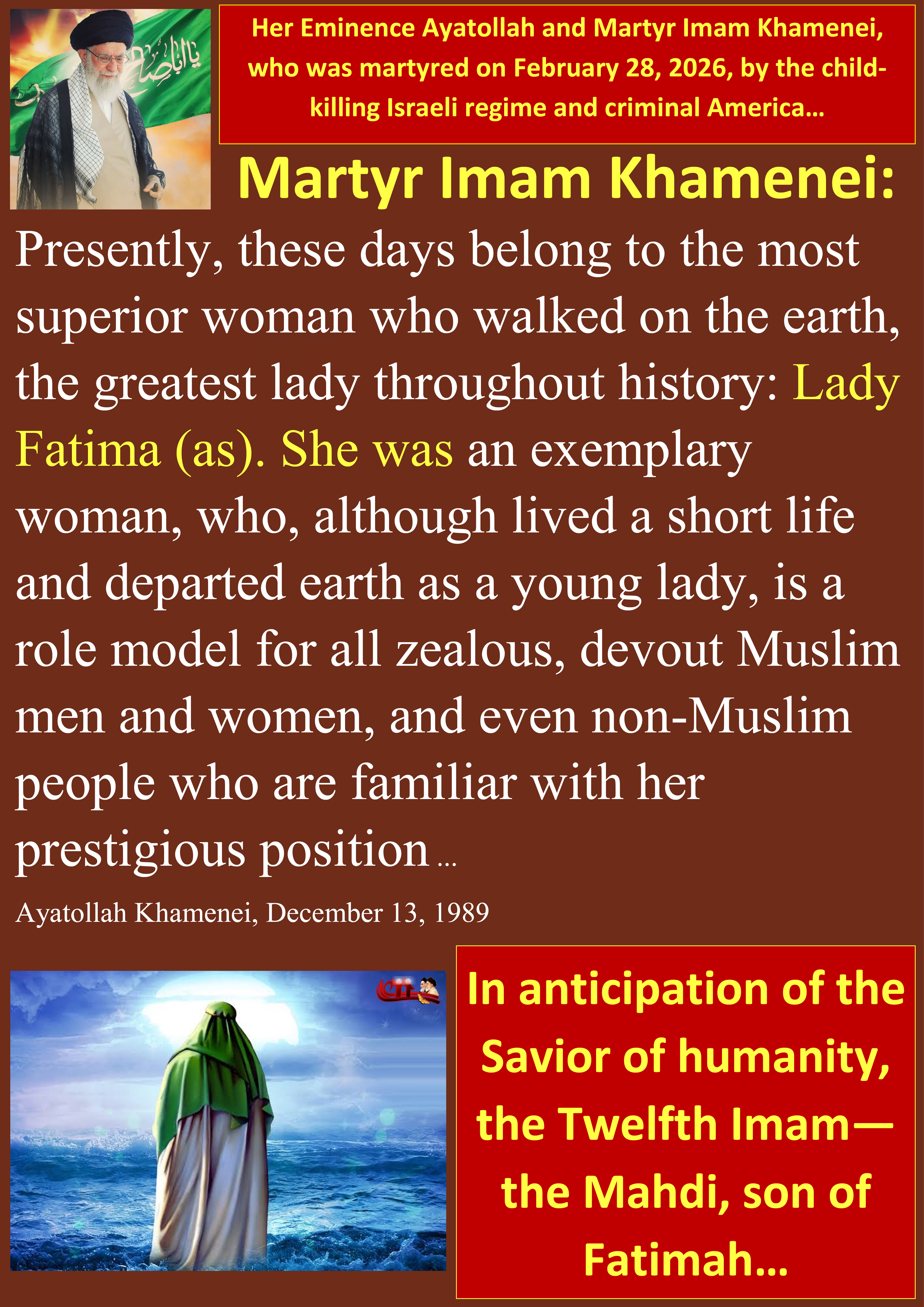
Martyr Imam Khamenei:
Three dimensions of Hazrat Fatima's (as) personality according to Ayatollah
Khamenei
Presently, these days belong to the most superior woman who walked on the earth,
the greatest lady throughout history: Lady Fatima (as). She was an exemplary
woman, who, although lived a short life and departed earth as a young lady, is a
role model for all zealous, devout Muslim men and women, and even non-Muslim
people who are familiar with her prestigious position.
We should follow Fatima's lead. During the life of Fatima (as), there is one
point that we should consider. Here, we will not question the degree of her
spiritual position and knowledge; we are not even capable of comprehending the
spiritual greatness of Fatima (as). In fact, at the top of human spirituality
and perfection, only God knows and understands the high level of such
individuals--and others at their level. Thus, Fatima (as) is only known to her
husband, her great father Mohammad (pbuh), and her pure children. The people of
her time, of other times, and we in this era are not able to recognize the
brilliance and splendour of her spirituality. The bright light of spirituality
is not detectable by everybody’s eyes; our short-sighted and weak eyes are
unable to see the luminosity of humanity in these great personalities.
Therefore, we do not discuss the definition of Fatima’s (as) spirituality.
However, in her ordinary life, there is an important point: on the one hand, as
a Muslim woman, she perfectly performs her duties at home and behaves nicely
towards her husband and children; on the other hand, as a zealous, tireless
person she acts for her causes. In political events, shortly after the death of
her father Prophet Muhammad (PBUH), she went to the mosque, gave a speech,
expressed her position and defended her cause. Hence, she represented a
marvellous, fighting personality that is tireless, enduring, and tolerant.
The third aspect of her life reveals her as a devotee of Allah, who performs
prayers in the dark of nights, uprises for Allah, and is humble before Allah;
and, in the worshipping chamber, this young lady worships and speaks to God like
the old pious people. Combining these three dimensions is the luminous point in
the life of Fatima (as). She did not separate the three dimensions.
Some people think that those who worship God are only concerned with prayers and
worship, and cannot be involved in politics. Or, some people think that
those--women and men--who are active in politics and the arena of jihad on the
path of Allah, if a woman, she cannot perform her duties at home as a mother and
a wife; and as a man, he cannot be a good businessman, husband or father.
They think these qualities are contradictory. Whereas, in the view of Islam,
these aspects not only reveal that there are no contradictions, but they are
also helpful towards achieving the perfect human personality.
Ayatollah Khamenei, December 13, 1989
Sources:
Please click on the links below or any of the images above to view the
full text of Imam Khamenei's statements and access more...
https://english.khamenei.ir/news/5485/Three-dimensions-of-Hazrat-Fatima-s-as-personality-according
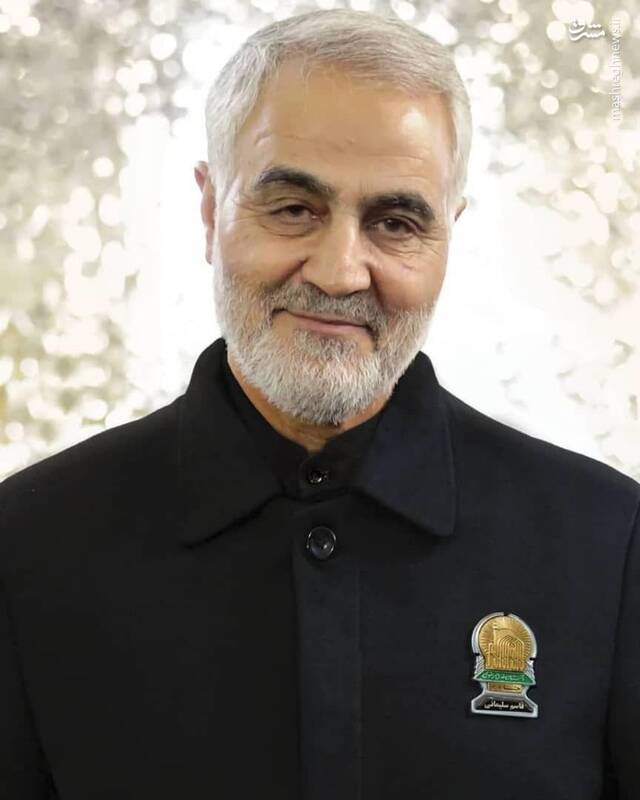
Martyr Hajj Qasem Soleimani, who was martyred at the hands of the criminal United States...
Note: All content is free to use
Links:
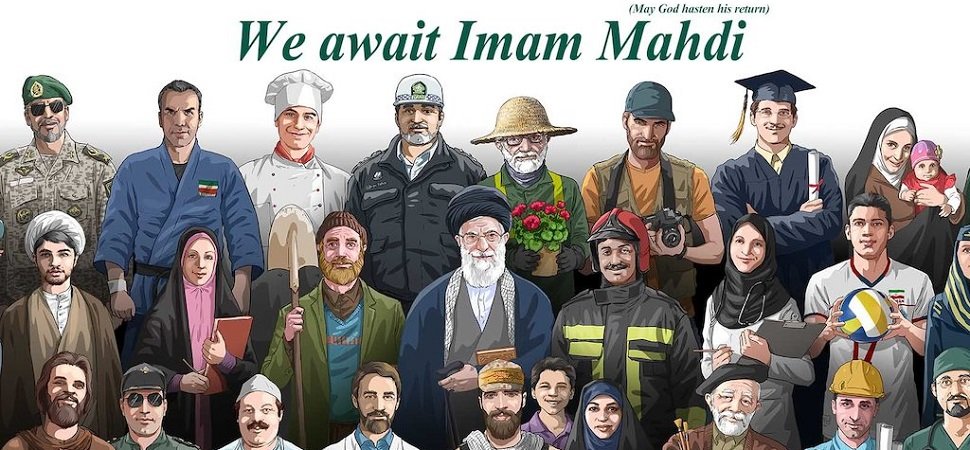


https://english.khamenei.ir/Opinions/Imam_mahdi
Imam Hussain’s Revolution for Humanity
https://english.khamenei.ir/Opinions/AshuraUprising
Who is Imam Hussain? Why did he launch an uprising?

Note: All content is free to use
برای رسیدن به اهداف مقدّس، گاهی باید همه گونه سختی را تحمّل کرد. ضربه به مال، جان، حیثیّت و آبرو...
بِسْمِ اللَّهِ الرَّحْمَنِ الرَّحِیمِ ﴿۱﴾
السَّلامُ عَلَیْکُمْ یا أهلَ بَیْتِ النُّبُوَّةِ
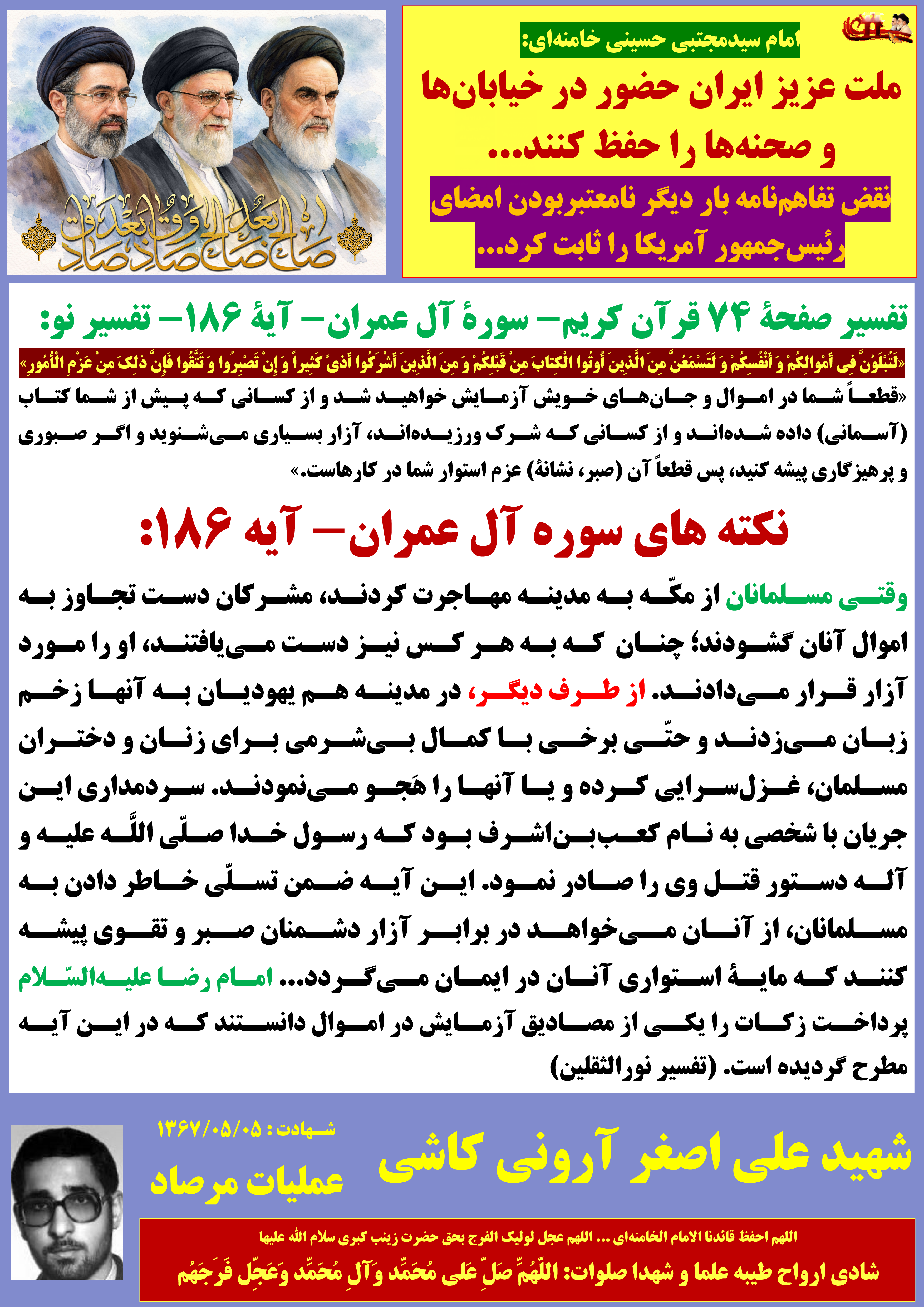
تفسیر صفحۀ ۷۴ قرآن کریم- سورۀ آل عمران- آیۀ ۱۸۶- تفسیر
نور:
«لَتُبْلَوُنَّ فِی أَمْوالِکُمْ وَ أَنْفُسِکُمْ وَ لَتَسْمَعُنَّ مِنَ الَّذِینَ
أُوتُوا الْکِتابَ مِنْ قَبْلِکُمْ وَ مِنَ الَّذِینَ أَشْرَکُوا أَذیً کَثِیراً وَ
إِنْ تَصْبِرُوا وَ تَتَّقُوا فَإِنَّ ذلِکَ مِنْ عَزْمِ الْأُمُورِ» «قطعاً شما در
اموال و جانهای خویش آزمایش خواهید شد و از کسانی که پیش از شما کتاب (آسمانی)
داده شدهاند و از کسانی که شرک ورزیدهاند، آزار بسیاری میشنوید و اگر صبوری و
پرهیزگاری پیشه کنید، پس قطعاً آن (صبر، نشانۀ) عزم استوار شما در کارهاست.»
نکته های سوره آل عمران- آیه ۱۸۶ :
وقتی مسلمانان از مکّه به مدینه مهاجرت کردند، مشرکان دست تجاوز به اموال آنان
گشودند؛ چنانکه به هر کس نیز دست مییافتند، او را مورد آزار قرار میدادند.
از طرف دیگر، در مدینه هم یهودیان به آنها زخم زبان میزدند و حتّی برخی با کمال
بیشرمی برای زنان و دختران مسلمان، غزلسرایی کرده و یا آنها را هَجو مینمودند.
سردمداری این جریان با شخصی به نام کعببناشرف بود که رسول خدا صلّی اللَّه علیه و
آله دستور قتل وی را صادر نمود. این آیه ضمن تسلّی خاطر دادن به مسلمانان، از آنان
میخواهد در برابر آزار دشمنان صبر و تقوی پیشه کنند که مایۀ استواری آنان در
ایمان میگردد.
امام رضا علیهالسّلام پرداخت زکات را یکی از مصادیق آزمایش در اموال دانستند که در
این آیه مطرح گردیده است. (تفسیر نورالثقلین)
پیامهای سورۀ آل عمران- آیۀ ۱۸۶:
۱. آزمایش، یک سنّت جدّی الهی است؛ خود را آماده کنیم. (حرف لام در اوّل و حرف نون
مشدّد در آخرِ «لَتُبْلَوُنَّ» نشانۀ جدّی بودن مسئله است.)
۲. یاد مرگ و زودگذری دنیا، مسائل را برای انسان آسان میکند. «کُلُّ نَفْسٍ
ذائِقَةُ الْمَوْتِ»، «لَتُبْلَوُنَّ فِی أَمْوالِکُمْ»
۳. بیشترین ابزار آزمایش، مال و جان است. «أَمْوالِکُمْ وَ أَنْفُسِکُمْ»
۴. علاوه بر پذیرش خطر جان و مال، باید خود را برای شنیدن انواع نیشها و تحقیرها
آماده کرد. «وَ لَتَسْمَعُنَّ...»
۵. شنیدن تحقیر و هجو، و آزار دیدن از دشمن، یکی از وسایل آزمایش است.
«لَتُبْلَوُنَّ»، «وَ لَتَسْمَعُنَّ»، «أَذیً کَثِیراً»
۶. برای رسیدن به اهداف مقدّس، گاهی باید همه گونه سختی را تحمّل کرد. ضربه به مال،
جان، حیثیّت و آبرو. «أَمْوالِکُمْ وَ أَنْفُسِکُمْ وَ لَتَسْمَعُنَّ»، «أَذیً
کَثِیراً»
۷. انتظار زخم زبان از مخالفان، سبب آمادگی مسلمانان است. «لَتَسْمَعُنَّ...»
۸. مخالفان اسلام در ضربه زدن به مسلمانها، وحدت در هدف و گاهی وحدت در شیوه
دارند. «لَتَسْمَعُنَّ مِنَ الَّذِینَ أُوتُوا الْکِتابَ»، «وَ مِنَ الَّذِینَ
أَشْرَکُوا»
۹. دشمن، به کم قانع نیست. «أَذیً کَثِیراً»
۱۰. صبر و تقوی در کنار هم رمز موفقیّت است. استقامت بدون تقوا، در افراد لجوج نیز
پیدا میشود. «تَصْبِرُوا وَ تَتَّقُوا»
۱۱. صبر و تقوی، ملازم یکدیگرند. کلمۀ «ذلِکَ» مفرد است، درحالیکه به صبر و تقوی
که دو چیزند، اشاره دارد.
محسن قرائتی، تفسیر نور، ج ۲، صفحات۲۱۱- ۲۱۷
شهید علی اصغر آرونی کاشی
شـهادت: 05/05/1367 عملیات مرصاد
نشانی رسانه رهبر معظم انقلاب اسلامی
حضرت آیت الله سید مجتبی خامنه ای
https://rahbar.ir/
جهت دسترسی به منبع
برروی تصاویر فوق کلیک نمایید...
****************
استفاده از کلیه مطالب با ذکر صلوات آزاد است...
سلامتی و تعجیل در فرج امام زمان علیه السلام، هدیه به ساحت مقدس
حضرت زهراء سلام الله علیها، ائمه اطهار علیهم السلام، امام خامنهای حفظه الله
تعالی و ارواح طیبه شهداء صلوات
الّلهُمَّ صَلِّ عَلی مُحَمَّد وَآلِ مُحَمَّد وَعَجِّل فَرَجَهُم
We, as Muslims and as human beings, are today in need of the Holy Prophet, since a ali was a blessing for the entire humanity...
In the Name of Allah, the Merciful, the Most Merciful
Sura 21: AL-ANBIYA (THE PROPHETS) - Juz' 17 - Translation Qarib
**************
Note: All content is free to use
***************
Martyr Imam Khamenei’s selected statements regarding Prophet
Muhammad (pbuh)
We Muslims only need to become familiar with the personality of the Holy Prophet
(pbuh). Of course, we believe that the entire humanity should benefit from the
Holy Prophet (pbuh) and they do, but we members of the Islamic Ummah should be
the first to do so. Allah the Exalted prepared him for the greatest mission in
the history of mankind... Allah the exalted educated him and helped him improve.
He provided him with all the means that he required for this great and historic
achievement and then He put this heavy responsibility and this heavy and
historic mission on his shoulders. Therefore, maybe we can say that today which
is the 17th of Rabi al-Awwal and the birthday anniversary of the Holy Prophet
(pbuh) is the greatest Eid in the history of mankind, a day on which Allah the
Exalted bestowed this great gift on humanity and on the history of mankind. And
the Holy Prophet (pbuh) rose up relying on the tools he had been equipped with.
(February 10, 2012)
The greatness of the event of the birth of the Holy Prophet equals the greatness
of his status. His great status in creation is such that from the beginning to
the end of creation, the Exalted God has not created another being as great as
the Holy Prophet. The responsibility that God placed on his shoulders is just as
great. Because of this great responsibility, God says, “Allah did confer a great
favor on the believers when He sent among them an apostle from among
themselves.” [Quran, 3:164] God conferred a favor on humanity. Such is the
greatness of the Holy Prophet. God, the Exalted, revealed the hidden book to the
holy heart of the Prophet, uttered it through his pure tongue, entrusted him
with the plan for humanity’s felicity in its entirety, and commissioned him to
carry out this plan and to demand that his followers carry it out as well.
(October 24, 2021)
We know how the Holy Prophet (pbuh) lived during his childhood and youth and
before his bi’tha. He was so trustworthy that all members of Quraysh and all the
Arabs who knew him would refer to him as “Muhammad the Trustworthy”. He used to
treat people so fairly that when the Arab tribes were fighting over who was more
qualified to return Hajar al-Aswad to its original place in Kaaba, they decided
that he should be the arbiter. This was while he was a young man. This shows
that he used to treat people fairly and everybody knew this. Everybody
considered him honest and trustworthy. This was how he lived during his youth.
And when God appointed him as prophet, he engaged in selfless struggle and
resistance like that. Everybody was against him at that time. All that pressure
during the first 13 years of his prophethood in Mecca: what difficult years! The
Holy Prophet (pbuh) stood firm and with his resistance, he trained Muslims to
stand firm and not yield to any kind of pressure. These things are lessons for
us. Later on, he established a civil society and he did not rule more than ten
years, but he founded a society that remained the peak of human achievements in
science, civilization, spiritual progress, ethical progress and wealth.
(February 10, 2012)
The Holy Prophet (pbuh) says to God in supplication, "Oh God, guide my people.”
His people were the ones who used to beat, disown and threaten him. They used to
cause serious trouble for him, but he says to Allah the Exalted in supplication,
"Oh God, save, cure and guide these people.” (November 27, 2014)
The auspicious existence of the Holy Prophet was mercy. It was mercy for all the
worlds. This mercy is bestowed upon the followers of that great personality and
those who accept his path and his guidance. They will benefit from divine mercy
… Those who obey that great personality, follow his lead and accept his guidance
will benefit from divine mercy. This is a divine promise which is irrevocable …
The world of Islam and the Islamic Ummah have gone through many peaks and
valleys, but they will benefit from worldly and otherworldly mercy only when
they follow the Holy Prophet. (December 6, 2017) The Holy Existence of the
Messenger of God is the summit of the world and the best spot in the universe in
the true sense of the world. The Holy Quran has referred to itself as light. One
of the words that the Holy Quran uses to describe itself is light: “God has
indeed sent upon you light and the Book.” [The Holy Quran: 5: 15] The Holy Quran
is light. One of the esteemed wives of the Holy Prophet was asked to describe
him and she said in response, “The Holy Quran is in his nature.” This means that
he was the living Quran. So, he was light as well. Light is a means of providing
brightness and ensuring the life of humans. The Holy Prophet too is a means of
providing brightness and ensuring the life of human societies. These are things
that humanity will reach gradually. The holy existence of the Messenger of God
is a source of light in the true sense of the word. (November 15, 2019)
All humanity is indebted to this shining sun … All members of humanity, whether
they believe in this religion or not, are indebted to the Great Prophet. In the
true sense of the word, they belong to his religion. Why? What is this great
debt that causes humanity to be indebted to the Prophet? The Great Prophet
brought humanity the prescription for the treatment of all of humanity’s major
afflictions. This is a fact. Almighty God says, “This is a Book We have sent
down to you that you may bring mankind out from darkness into light” [Quran
14:1]. What is darkness? Darkness is all the things throughout history that have
made human beings’ lives dark, bitter, and poisonous. Ignorance is darkness;
poverty is darkness; oppression is darkness; discrimination is darkness;
drowning in lusts is darkness; moral corruption and social afflictions are all
darkness. These are all different kinds of darkness that humankind has suffered
from throughout the long history of its life. Not having faith is darkness; not
having a purpose is darkness. These are humanities’ serious afflictions. The
Great Prophet brought humankind the prescription — both a prescription in
understanding and a prescription for our actions — for the treatment of these
pains. If you wish to get rid of these pains, these are the cures. Islamic laws
brought by the Prophet and the teachings of the Quran are the cure for
humanity’s pains. This is what the Prophet of Islam has given to humankind. That
is why the Commander of the Faithful (pbuh) says the following about the
Prophet: “The Prophet was like a roaming physician who had prepared his
ointments and heated his instruments” [Nahj al-Balaghah, Sermon 108] … He has
both things, both the ointment and the heating instruments. He has presented
these to humanity in the form of the Quran. If you want to live well, this is
how you should live. (October 3, 2023)
There are many ayahs in the Holy Quran about the Holy Prophet … Some of these
ayahs clearly manifest humanity’s condition in the present time. When one reads
these ayahs, one feels as if they had been sent down for today’s humanity. One
ayah is from holy Sura al-Bara’at: “Now has come unto you a Messenger from among
yourselves: it grieves him that you should perish. Ardently anxious is he over
you: to the Believers is he most kind and merciful” [The Holy Quran: 9: 128].
The first two sentences of the ayah are related to the entire humanity. There is
another ayah which says, “Oh men, I am sent unto you all, as the Messenger of
Allah” [The Holy Quran, 7: 158]. The entire humanity is addressed by the Holy
Prophet in this ayah. These two sentences are very important: “It grieves him
that you should perish.” He suffers from your pain. The next sentence is:
“Ardently anxious is he over you.” He is interested in your fate and he cares
about you. This is addressed to all humans. Today, human society is the
manifestation of this address. In other words, these sentences correspond, to a
large part, to humanity’s condition in the present time. We could really say
that today, humanity is suffering more than ever in history … What global
taghuts do by utilizing human science and technology - resulting in
discrimination, inequality and warmongering – is more serious than ever. The
Holy Prophet really “grieves him that you should perish.” The blessed soul of
the Holy Prophet really suffers from humanity’s pain in the present time. He is
anxious for humanity to achieve bliss and he wishes to guide humanity. Like a
gentle father, in the true sense of the word, he wants humanity to achieve
bliss, to be directed to the straight path and to achieve an end that will be
good for it. (November 3, 2020)
In logic of the wise of the world, the right of life is above all other rights
that human beings have over each other. When someone wants to emphasize the fact
that they are indebted to someone, they will, for example, say, “I owe my life
to this person.” What does the right of life mean? It means, for example, that
you were in danger of drowning, and he/she saved you. You were in danger of
becoming trapped under the rubble of a house that has collapsed and he/she saved
you. In other words, he/she returned this life in the material world to you that
was about to be taken away. That is what we mean by the right of life. It is the
greatest right. When one looks at the general public and investigates this, one
will find that they consider the right of life as the greatest right … Almighty
God says, “O you who have faith! Respond to Allah and the Messenger when he
summons you to that which will give you life” [Quran 8:24]. The Prophet will
give you life. This “life” is not that “life.” This is the life that ensures
your happiness in this world, brings life to your heart, illuminates your soul,
makes your life pleasant, and continues on. This life is not limited; it is not
vulnerable; it is eternal. This life that Islam, religion, and the Prophet give
to humanity is thousands of times more important than the life that is given to
us if someone pulls us out from under rubble or saves us from drowning. This is
why humanity is indebted to the Prophet. This is the right of the Prophet. We
are indebted to the Prophet. (October 3, 2023)
I have chosen three points about the Holy Prophet and his characteristics …
These three points are patience, justice and morality. Patience is something
prominent we can see in the life of the Prophet … What does patience mean? …
Well, patience means endurance. We should show endurance in the face of
temptations to commit sins. We should also show endurance with regard to
carrying out our duty and confront laziness and idleness . We should show
endurance when facing the enemy. We should keep control of ourselves in the face
of various calamities. We should control our will. This is what patience means.
Patience means endurance. Today, we need patience more than ever … [Quran,
33:21] The second point is about justice and equity. One of the most important –
perhaps the most important intermediate goals of sending prophets – was to
administer justice, “We sent aforetime our apostles with clear signs and sent
down with them the Book and the Balance of Right and Wrong, that men may stand
forth in justice.” [Quran, 57:25] The purpose of sending prophets and divine
books was to establish justice and encourage society to work for justice … As
for ethics and morality, we should follow the Holy Prophet’s example in ethics.
God, the Exalted, said, “And you stand on an exalted standard of character.”
[Quran, 68:4] Something that our Creator has said is “an exalted standard of
character” is something extraordinary, “And you stand on an exalted standard of
character.” Such morality should always receive our attention and be a guideline
for us. We should behave in an Islamic way and be humble and forgiving. These
are examples of Islamic ethics. (October 24, 2021)
The Holy Prophet would get along with the poor and the weak. He would not attach
great significance to appearances and to those elements and factors which are
apparently sources of glory, magnificence and the like. The Holy Prophet lived
like that. This is really instructive for us. Of course, we cannot be expected
to behave like the Holy Prophet and the Commander of the Faithful. Well, they
enjoyed a different position and status. Nonetheless, we should set their
behavior as the standard. We should use it as a sign. For example, when you are
climbing a mountain, you look at the summit. You might not reach the summit, but
you move towards it. This is how we should proceed. (December 24, 2019)
We, as Muslims and as human beings, are today in need of the Holy Prophet, since
the Holy Prophet was a blessing for the entire humanity, not just for Muslims.
The entire mankind is indebted to the Holy Prophet for his favor and blessings.
What he bestowed on mankind as a result of his prophetic mission is in the Holy
Quran, which we can benefit from today. The Holy Prophet of Islam [peace be upon
him and his household] led mankind to salvation and prosperity. He encouraged
human beings to move on a path that can lead to a solution for the problems
facing mankind and a remedy for the sufferings besetting human beings. Mankind
has long been suffering from chronic pains in the course of its history.
Humanity is in need of justice; it is in need of guidance and noble human
morality. Human mind requires the help of divine messengers. The Holy Prophet
offered divine guidance to human beings. (April 6, 2007)
Well, we are the followers of the Holy Prophet. We associate ourselves with the
Holy Prophet. What is our duty? In every era, the duty of the believers is to
see what position they are in, what religion asks of them, what duty has been
entrusted to them, what things they should think about, and what they should do.
They should understand these in every era. Well, religious scholars and
intellectuals have discussed these issues at great length. (October 24, 2021)
The exalted rank of the sacred being of the Holy Prophet isn’t something we
human beings can fully portray with our limited, imperfect language and our
inadequate understanding. We can only love him, and we can only express our
sincerity and humility. We’re unable to do more than that. The Prophet is the
one about whom Almighty God said, "Indeed, Allah and His angels send blessings
upon the Prophet" (Quran 33:56).
The sacred Essence of the Lord sends blessings upon him, and Almighty God’s
angels send blessings upon him. Who are we to be able to understand or
comprehend his station? However, we feel an affection for him, we love him, and
we abide by his words. This must remain a principle for us that we must stand by
the word of our Prophet, which is the word of monotheism, the word of Islam, and
the Quran. (Sept. 24, 2012)
Sources:
Please click on the links below or any of the images above to view the
full text of Imam Khamenei's statements and access more...
https://en.khamenei.ir/news/150527
Martyr Hajj Qasem Soleimani, who was martyred at the hands of the criminal United States...
Note: All content is free to use
Links:
https://english.khamenei.ir/Opinions/Imam_mahdi
Imam Hussain’s Revolution for Humanity
https://english.khamenei.ir/Opinions/AshuraUprising
Who is Imam Hussain? Why did he launch an uprising?
Note: All content is free to use
مرگ در راه است، پس این همه لجاجت و استکبار در برابر حق، برای چه؟...
بِسْمِ اللَّهِ الرَّحْمَنِ الرَّحِیمِ ﴿۱﴾
السَّلامُ عَلَیْکُمْ یا أهلَ بَیْتِ النُّبُوَّةِ
تفسیر صفحۀ ۷۴ قرآن کریم- سورۀ آل عمران- آیۀ ۱۸۵-
تفسیر نور:
«کُلُّ نَفْسٍ ذائِقَةُ الْمَوْتِ وَ إِنَّما تُوَفَّوْنَ أُجُورَکُمْ یَوْمَ
الْقِیامَةِ فَمَنْ زُحْزِحَ عَنِ النَّارِ وَ أُدْخِلَ الْجَنَّةَ فَقَدْ فازَ وَ
مَا الْحَیاةُ الدُّنْیا إِلاَّ مَتاعُ الْغُرُورِ» «هر کسی چشندۀ مرگ است و
بیگمان روز قیامت پاداشهای شما بهطورکامل پرداخت خواهد شد. پس هر کس از آتش بر
کنار شد و به بهشت وارد گشت، قطعاً رستگار است و زندگانی دنیا، جز مایۀ فریب نیست.»
نکتههای سورۀ آل عمران- آیۀ ۱۸۵:
این آیه به پیامبر و دیگر مصلحان که مورد آزار و اذیّت و تکذیب کفّار قرار
میگیرند، روحیۀ صبر و مقاومت میبخشد، زیرا میفرماید: همه میمیرند و
لجاجتها موقّتی است و پاداش تحمّل این مشکلات را خداوند بیکموکاست عطا
میکند.
امام صادق علیهالسّلام دربارۀ «کُلُّ نَفْسٍ ذائِقَةُ الْمَوْتِ» فرمودند: همۀ اهل
زمین و آسمان میمیرند و فقط ملکالموت و حاملان عرش و جبرئیل و میکائیل باقی
میمانند، سپس ملکالموت مأمور میشود که روح آنان را نیز بگیرد و تنها خود باقی
میماند و خداوند به او خطاب میکند که بمیر، او نیز میمیرد. (کافی، ج ۳، ص
۲۵۶) و همچنین آن حضرت فرمودند: کسی که مرگ را نچشیده و کشته شده، به دنیا
برگردانده میشود تا مرگ را بچشد. (تفسیر عیّاشی، ج ۲، ص ۲۰۲)
پیامهای سورۀ آل
عمران- آیۀ ۱۸۵:
۱. مرگ در راه است، پس این همه لجاجت و استکبار در برابر حق، برای چه؟
«کَذَّبُوکَ»، «کُلُّ نَفْسٍ ذائِقَةُ الْمَوْتِ»
۲. مرگ، عدم نیست؛ یک امر وجودی است که قابل چشیدن است، راه انتقال از دنیا به آخرت
است. «ذائِقَةُ الْمَوْتِ»
۳. گناهان و عوامل سوقدهنده به دوزخ، دارای جاذبههایی است که باید انسان با نیروی
ایمان و عمل صالح خود را برهاند. «زُحْزِحَ عَنِ النَّارِ»
۴. جزای کامل در آخرت است، و پاداشهای دنیوی بیارزش. «تُوَفَّوْنَ أُجُورَکُمْ
یَوْمَ الْقِیامَةِ»، «مَا الْحَیاةُ الدُّنْیا إِلَّا مَتاعُ الْغُرُورِ»
شهید جواد آستانهپرست
شـهادت : 06/۰۵/1367 عملیات مرصاد
نشانی رسانه رهبر معظم انقلاب اسلامی
حضرت آیت الله سید مجتبی خامنه ای
https://rahbar.ir/
جهت دسترسی به منبع
برروی تصاویر فوق کلیک نمایید...
****************
استفاده از کلیه مطالب با ذکر صلوات آزاد است...
سلامتی و تعجیل در فرج امام زمان علیه السلام، هدیه به ساحت مقدس
حضرت زهراء سلام الله علیها، ائمه اطهار علیهم السلام، امام خامنهای حفظه الله
تعالی و ارواح طیبه شهداء صلوات
الّلهُمَّ صَلِّ عَلی مُحَمَّد وَآلِ مُحَمَّد وَعَجِّل فَرَجَهُم
Trustworthiness of the Prophet of Islam (s.w.a.)...
In the Name of Allah, the Merciful, the Most Merciful
Sura 21: AL-ANBIYA (THE PROPHETS) - Juz' 17 - Translation Qarib
**************
Note: All content is free to use
Martyr Imam Khamenei:
The Supreme Leader’s View of the Holy Prophet (s.w.a.)
The Holy Prophet’s (s.w.a.) leniency and strictness
The Holy Prophet (s.w.a.) has been praised in the Holy Quran because of his
lenient treatment of people. Addressing the Holy Prophet (s.w.a.), Allah the
Exalted says in the Holy Quran, “Thus, it is due to mercy from Allah that you
deal with them gently, and had you been rough and hard-hearted, they would
certainly have dispersed from around you.” [The Holy Quran, 3: 159] Elsewhere in
the Holy Quran, Allah the Exalted tells the Holy Prophet (s.w.a.), “O Prophet,
strive hard against the unbelievers and the hypocrites, and be hard against
them.” [The Holy Quran, 66: 9] Allah the Exalted tells His Messenger to treat
the unbelievers and the hypocrites roughly. The word “hard” has been used in
both ayahs. However, the first ayah is related to the Holy Prophet’s (s.w.a.)
behavior towards other members of his society, while the second ayah is about
enforcing the law, managing society and establishing order. In the first case,
being hard-hearted is bad. But in the second case, being hard-hearted is good.
Being rough is bad in the first case and good in the second…
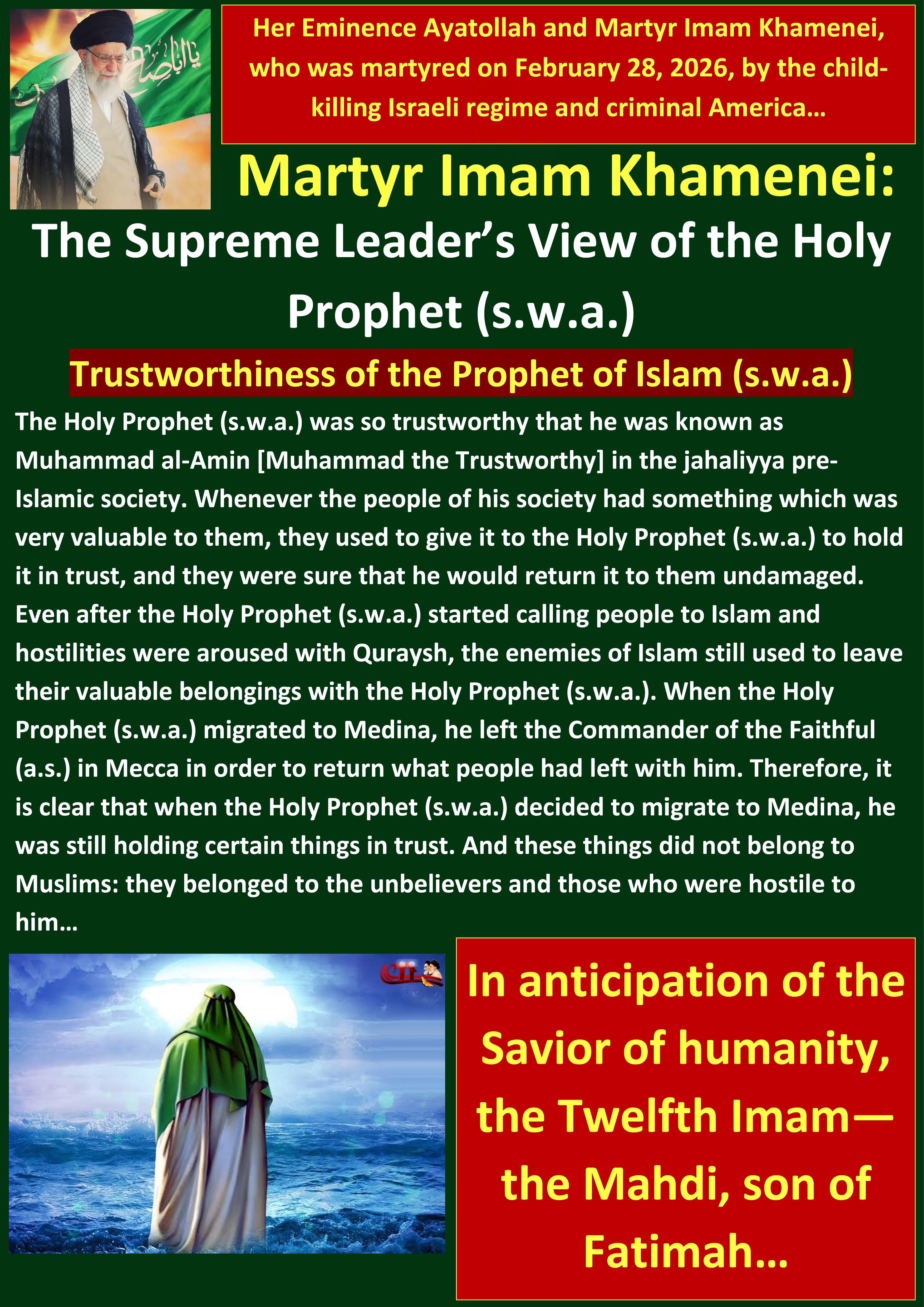
Martyr Imam Khamenei:
The Supreme Leader’s View of the Holy Prophet (s.w.a.)
Trustworthiness of the Prophet of Islam (s.w.a.)
The Holy Prophet (s.w.a.) was so trustworthy that he was known as Muhammad
al-Amin [Muhammad the Trustworthy] in the jahaliyya pre-Islamic society.
Whenever the people of his society had something which was very valuable to
them, they used to give it to the Holy Prophet (s.w.a.) to hold it in trust, and
they were sure that he would return it to them undamaged. Even after the Holy
Prophet (s.w.a.) started calling people to Islam and hostilities were aroused
with Quraysh, the enemies of Islam still used to leave their valuable belongings
with the Holy Prophet (s.w.a.). When the Holy Prophet (s.w.a.) migrated to
Medina, he left the Commander of the Faithful (a.s.) in Mecca in order to return
what people had left with him. Therefore, it is clear that when the Holy Prophet
(s.w.a.) decided to migrate to Medina, he was still holding certain things in
trust. And these things did not belong to Muslims: they belonged to the
unbelievers and those who were hostile to him…

Martyr Imam Khamenei:
The Supreme Leader’s View of the Holy Prophet (s.w.a.)
Patience of the Holy Prophet (s.w.a.)
The Holy Prophet (s.w.a.) was so patient that he was not disturbed by the kind
of things that made other people impatient. Sometimes the enemies of the Holy
Prophet (s.w.a.) in Mecca used to treat him in a way that when Abi Talib [Holy
Prophet’s (s.w.a.) uncle] heard about one case of such treatment, he got so
angry that he drew his sword, went to those who had treated the Prophet (s.w.a.)
with disrespect and treated them in the same way. He said that he would behead
anybody who protested. But the Holy Prophet (s.w.a.) had tolerated that
treatment with patience. In another case, Abu Jahl insulted the Holy Prophet
(s.w.a.) in a very bad way, but the Holy Prophet (s.w.a.) exercised patience and
remained silent. Somebody went to Hamza and told him that his nephew had been
mistreated. Hamza lost patience and went to Abu Jahl. He banged his bow so hard
on Abu Jahl’s head that blood gushed out from his head. Affected by this event,
Hamza converted to Islam later on. Sometimes some people used to go the mosque
where the Prophet (s.w.a.) was and stretched out their feet, and they used to
tell the Holy Prophet (s.w.a.) to cut their nails. But the Holy Prophet (s.w.a.)
used to tolerate their insolence with patience.
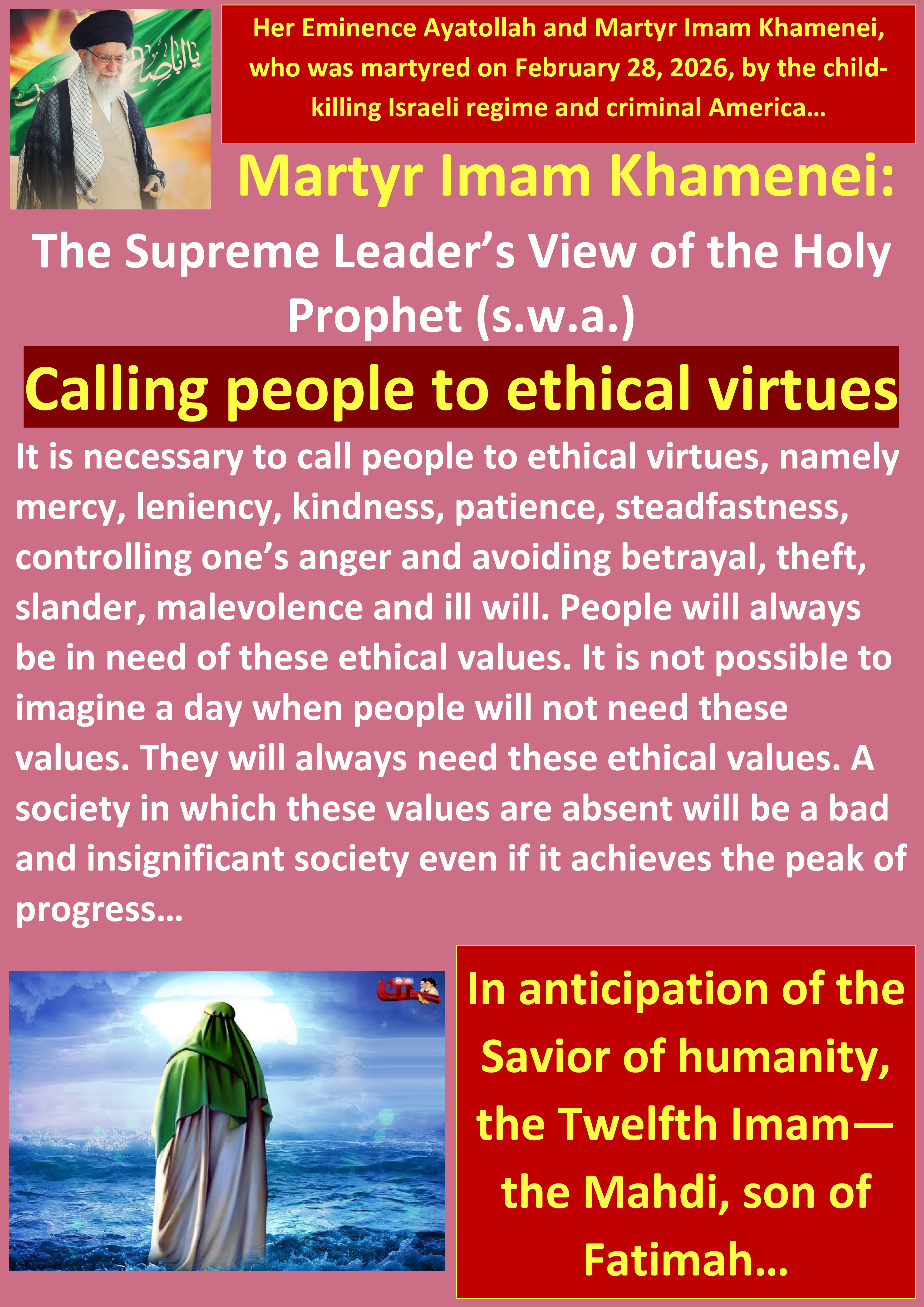
Martyr Imam Khamenei:
The Supreme Leader’s View of the Holy Prophet (s.w.a.)
Calling people to ethical virtues
It is necessary to call people to ethical virtues, namely mercy, leniency,
kindness, patience, steadfastness, controlling one’s anger and avoiding
betrayal, theft, slander, malevolence and ill will. People will always be in
need of these ethical values. It is not possible to imagine a day when people
will not need these values. They will always need these ethical values. A
society in which these values are absent will be a bad and insignificant society
even if it achieves the peak of progress...
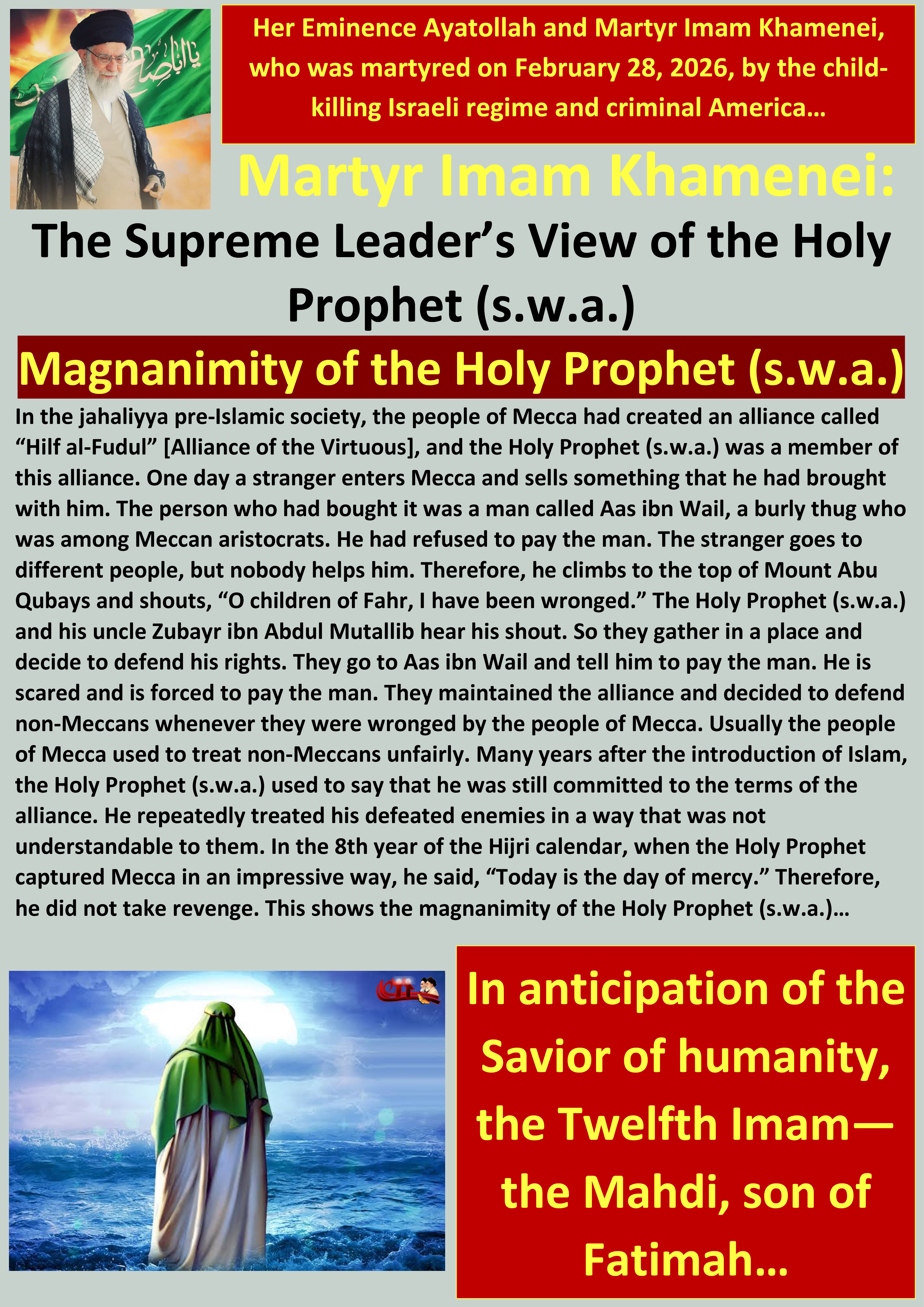
Martyr Imam Khamenei:
The Supreme Leader’s View of the Holy Prophet (s.w.a.)
Magnanimity of the Holy Prophet (s.w.a.)
In the jahaliyya pre-Islamic society, the people of Mecca had created an alliance called “Hilf al-Fudul” [Alliance of the Virtuous], and the Holy Prophet (s.w.a.) was a member of this alliance. One day a stranger enters Mecca and sells something that he had brought with him. The person who had bought it was a man called Aas ibn Wail, a burly thug who was among Meccan aristocrats. He had refused to pay the man. The stranger goes to different people, but nobody helps him. Therefore, he climbs to the top of Mount Abu Qubays and shouts, “O children of Fahr, I have been wronged.” The Holy Prophet (s.w.a.) and his uncle Zubayr ibn Abdul Mutallib hear his shout. So they gather in a place and decide to defend his rights. They go to Aas ibn Wail and tell him to pay the man. He is scared and is forced to pay the man. They maintained the alliance and decided to defend non-Meccans whenever they were wronged by the people of Mecca. Usually the people of Mecca used to treat non-Meccans unfairly. Many years after the introduction of Islam, the Holy Prophet (s.w.a.) used to say that he was still committed to the terms of the alliance. He repeatedly treated his defeated enemies in a way that was not understandable to them. In the 8th year of the Hijri calendar, when the Holy Prophet captured Mecca in an impressive way, he said, “Today is the day of mercy.” Therefore, he did not take revenge. This shows the magnanimity of the Holy Prophet (s.w.a.)...
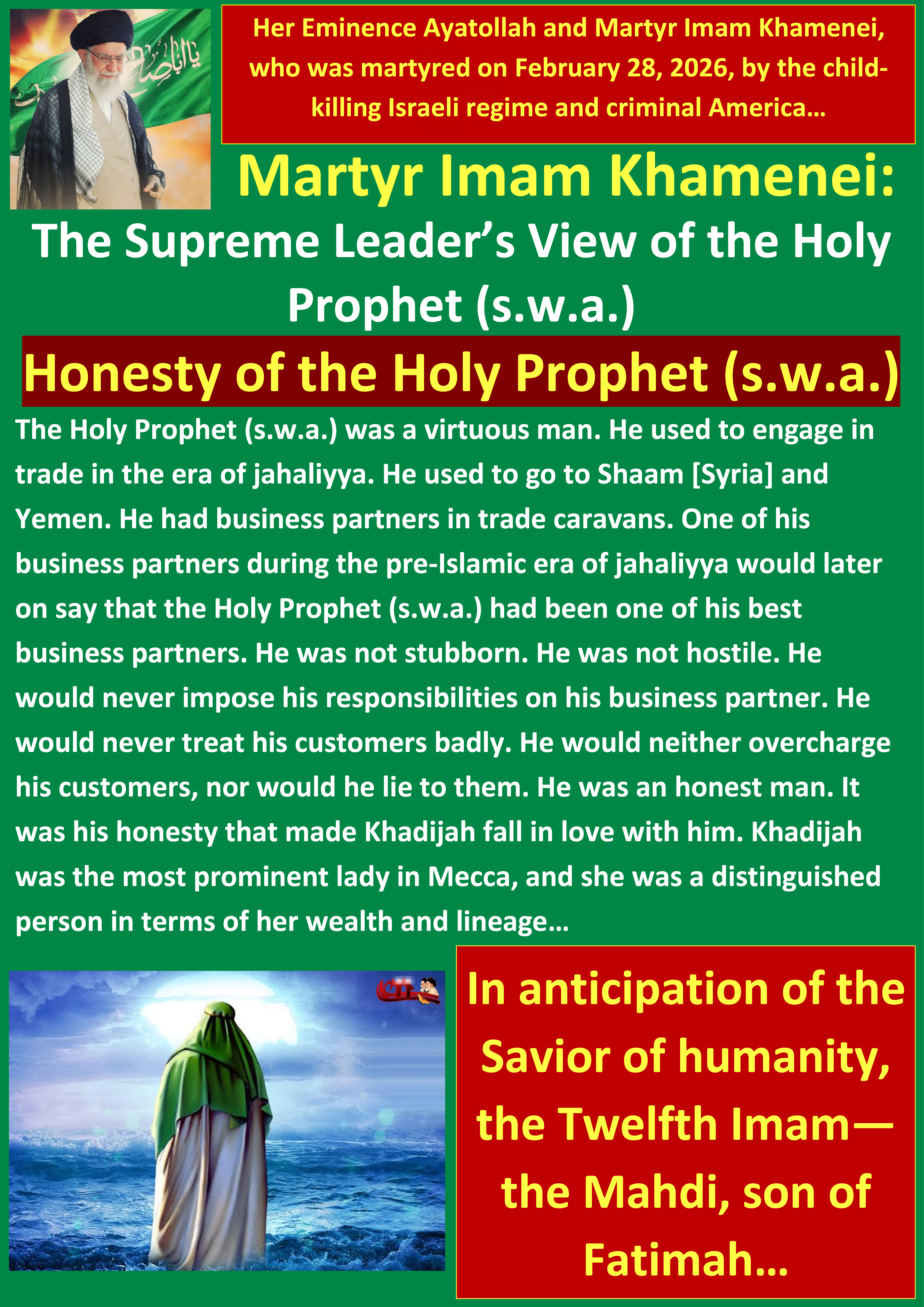
Martyr Imam Khamenei:
The Supreme Leader’s View of the Holy Prophet (s.w.a.)
Honesty of the Holy Prophet (s.w.a.)
The Holy Prophet (s.w.a.) was a virtuous man. He used to engage in trade in the era of jahaliyya. He used to go to Shaam [Syria] and Yemen. He had business partners in trade caravans. One of his business partners during the pre-Islamic era of jahaliyya would later on say that the Holy Prophet (s.w.a.) had been one of his best business partners. He was not stubborn. He was not hostile. He would never impose his responsibilities on his business partner. He would never treat his customers badly. He would neither overcharge his customers, nor would he lie to them. He was an honest man. It was his honesty that made Khadijah fall in love with him. Khadijah was the most prominent lady in Mecca, and she was a distinguished person in terms of her wealth and lineage...

Martyr Imam Khamenei:
The Supreme Leader’s View of the Holy Prophet (s.w.a.)
Cleanliness of the Holy Prophet (s.w.a.)
The Holy Prophet (s.w.a.) was a neat person since his childhood. Unlike children
from Meccan and other Arab tribes, the Holy Prophet (s.w.a.) was hygienic and
neat. When he was a teenager, he used to comb his hair. During his youth he used
to comb his hair and his beard. After being appointed as Prophet, when he was an
old man around the age of 50 to 60, the Holy Prophet (s.w.a.) was still
completely committed to personal hygiene. His hair, which was long enough to
reach his earlobes, was always clean. His beautiful beard was always clean and
perfumed. I read in a narration that he had a bowl of water in his house which
he used to use as a mirror because mirrors were not very common at that time.
Whenever he wanted to call on his friends and other Muslims, he used to clean
his turban and his beard. He always used to wear perfume. In spite of the fact
that he had a very simple lifestyle, he used to pack up perfume and a comb
whenever he wanted to go on a trip. He used to pack up kohl because at that time
it was usual for men to use kohl around their eyes. He used to brush his teeth
several times a day. He used to advise other Muslims to observe hygiene, brush
their teeth and take care of their appearance in a similar way. His clothes were
old and patched up, but they were always clean, as was his body. These things
play a very important role as far as one’s social interactions, appearance and
hygiene are concerned. These things – which may seem to be insignificant – are
very important in reality…

Martyr Imam Khamenei:
The Supreme Leader’s View of the Holy Prophet (s.w.a.)
The Holy Prophet’s (s.w.a.) attitude towards other people
The Holy Prophet (s.w.a.) used to behave well towards other people. He was always cheerful when he was with other people. He used to reveal his sorrows when he was alone. He did not show his sorrows when he was with other people. He was always cheerful when he was among other people. He used to greet everybody. Whenever somebody upset him, his sadness would become clear on his face, but he would never start complaining. He would not allow anybody to curse or slander other people. He would never curse anybody, and he would never slander a person. He was kind to children and women. He behaved extremely well towards weak people of his society. He used to joke with his companions, and he used to race horses with them…
Martyr Imam Khamenei:
The Supreme Leader’s View of the Holy Prophet (s.w.a.)
The Holy Prophet’s (s.w.a.) eating and dressing habits
The Holy Prophet (s.w.a.) used to sit on a carpet made of
straw. His pillow was a leather bag filled with palm leaves. His main meals were
barley bread and dates. It has been narrated that he would never eat wheat bread
– or different types of food – three days in a row. Ayesha [Holy Prophet’s wife]
said that sometimes the Prophet’s (s.w.a.) family would not cook anything in the
kitchen for one month. Sometimes he would ride an unsaddled horse. There was a
time when other people used to ride saddled horses and show off, but the Holy
Prophet (s.w.a.) would use a donkey on many occasions. He was humble. He used to
repair his shoes with his own hands…
Martyr Imam Khamenei:
The Supreme Leader’s View of the Holy Prophet (s.w.a.)
The Holy Prophet’s (s.w.a.) worship
The Holy Prophet (s.w.a.) used to prolong his worship so much that his feet would blister because of standing up for too long. He used to spend a major portion of his nights in prayer, supplication and solemn worship. He used to worship God and pray for His mercy. Apart from the month of Ramadan, he used to fast every other day in that hot weather during Rajab, Sha’ban and other months of the year. “That Allah may forgive your community their past faults and those to follow and complete His favor to you and keep you on a right way.” [The Holy Quran, 48: 2] His companions were surprised why he would ask God to forgive him, so they would tell him, “O Messenger of God, you have not committed any sins. What is all this prayer, worship and penance for?” The Holy Prophet (s.w.a.) would tell them, “Should I not be a thankful servant for all these blessings He has bestowed on me.”

Martyr Imam Khamenei:
The Supreme Leader’s View of the Holy Prophet (s.w.a.)
The Holy Prophet’s (s.w.a.) government
The Holy Prophet (s.w.a.) was just and wise. If somebody studies the time the
Prophet (s.w.a.) entered Medina – about the tribal conflicts, the attempts to
attract the enemies from Mecca out into the desert, the repeated blows, the
fight against the warring enemies – he will notice such wise, firm and
comprehensive strategies that he will be astonished. The Holy Prophet (s.w.a.)
was the person who enforced the laws, and he would not let anybody violate the
laws. He himself was subject to the same laws, and Quranic verses clearly show
this point. The Holy Prophet (s.w.a.) used to act according to the laws that
other people had to observe, and he would not allow any violations of the laws.
He would always keep his promise, and this was another characteristic of the
Holy Prophet (s.w.a.) as the leader of his society. He never broke a promise.
Quraysh broke their promise, but the Holy Prophet (s.w.a.) did not. The Jews
broke their promise, but he did not.
He was also secretive. When he led his army towards Mecca, nobody found out
where the Holy Prophet (s.w.a.) was going. He mobilized the entire army and
ordered them to follow him. They asked him where they were going, and he told
them that everything would become clear later on. Nobody realized that he was
moving towards Mecca. Quraysh did not know that the Holy Prophet (s.w.a.) was
moving towards Mecca until he got close to the city.
When he was among a group of people, it was not clear that he was the Prophet of
Islam and the leader of those people. He had excellent skill for managing social
and military affairs, and he used to directly supervise everything. Of course it
was a small society: it was just Medina and the surrounding areas. Later on
Mecca and a couple of other communities were added this small society. He was
serious about anything related to the people, and he acted with discipline. He
managed to promote management and accountability in that primitive society.

Martyr Imam Khamenei:
The Supreme Leader’s View of the Holy Prophet (s.w.a.)
The attitude of the Holy Prophet (s.w.a.) towards the enemies
of Islam
Not all enemies were the same to the Holy Prophet (s.w.a.). This is one of the
important points about the life of the Holy Prophet (s.w.a.). Some enemies were
extremely hostile, but if the Holy Prophet (s.w.a.) believed that they were
unlikely to pose any serious threats, he would not take it hard on them. There
were certain other enemies – such as Abdullah ibn Ubayy – who were dangerous,
and the Holy Prophet (s.w.a.) used to watch them closely. Abdullah ibn Ubayy was
a real hypocrite who would sometimes design plots against the Holy Prophet
(s.w.a.). But the Holy Prophet (s.w.a.) did not do anything to harm him. He only
kept him under surveillance. Abdullah ibn Ubayy was alive until the end of the
Holy Prophet’s (s.w.a.) life, and he died shortly after the Prophet (s.w.a.)
passed away. The important point is that the Holy Prophet (s.w.a.) tolerated
him. People like Abdullah ibn Ubayy were enemies who did not pose a serious
threat to the early Islamic government and the Muslim community. However, the
Holy Prophet (s.w.a.) was very strict with the enemies who posed a serious
danger to the Islamic society. The Holy Prophet (s.w.a.) who was so kind and
forgiving ordered his men to kill hundreds of traitors from the Bani Qurayza
tribe and to force out Bani Nazir and Bani Qaynuqa. The Holy Prophet (s.w.a.)
also captured the Khaybar citadel. This was because these enemies were
dangerous. When the Holy Prophet (s.w.a.) captured Mecca, he treated them
kindly, but they responded with treachery. They stabbed the Muslims in the back.
They designed plots and threatened the Muslims. The Holy Prophet (s.w.a.)
tolerated Abdullah ibn Ubayy. He tolerated the Jewish people in Medina. He
tolerated the members of Quraysh who had taken refuge in Medina or were
harmless. When he captured Mecca, he was kind to people like Abu Sufyan and
other prominent figures of Quraysh because they did not pose any dangers. But he
used to vigorously suppress dangerous and untrustworthy enemies.
Martyr Hajj Qasem Soleimani, who was martyred at the hands of the criminal United States...
Note: All content is free to use
Sources:
Please click on the links below or any of the images above to view the
full text of Imam Khamenei's statements and access more...
https://farsi.khamenei.ir/speech-content?id=101447#top
Links:
https://english.khamenei.ir/Opinions/Imam_mahdi
Imam Hussain’s Revolution for Humanity
https://english.khamenei.ir/Opinions/AshuraUprising
Who is Imam Hussain? Why did he launch an uprising?
Note: All content is free to use