السلام علیک یا فاطمة الزهراء (س)
الّلهُمَّ صَلِّ عَلی مُحَمَّد وَآلِ مُحَمَّد وَعَجِّل فَرَجَهُمالسلام علیک یا فاطمة الزهراء (س)
الّلهُمَّ صَلِّ عَلی مُحَمَّد وَآلِ مُحَمَّد وَعَجِّل فَرَجَهُم
Believing in Imam Mahdi (a.s.) does not men adopting seclusion
In the Name of Allah, the Merciful, the Most Merciful
Sura 21: AL-ANBIYA (THE PROPHETS) - Juz' 17 - Translation Qarib
**************
Note: All content is free to use

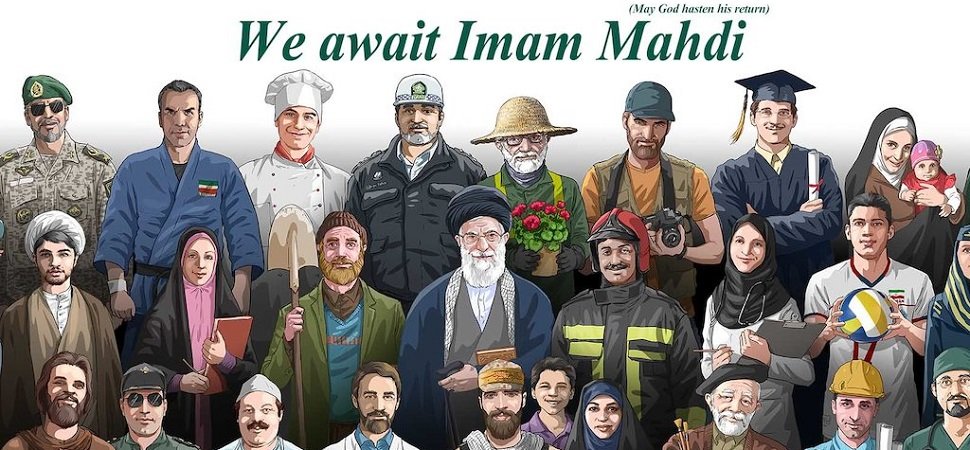
Who is Imam Mahdi? Is he the Savior promised by all religions?
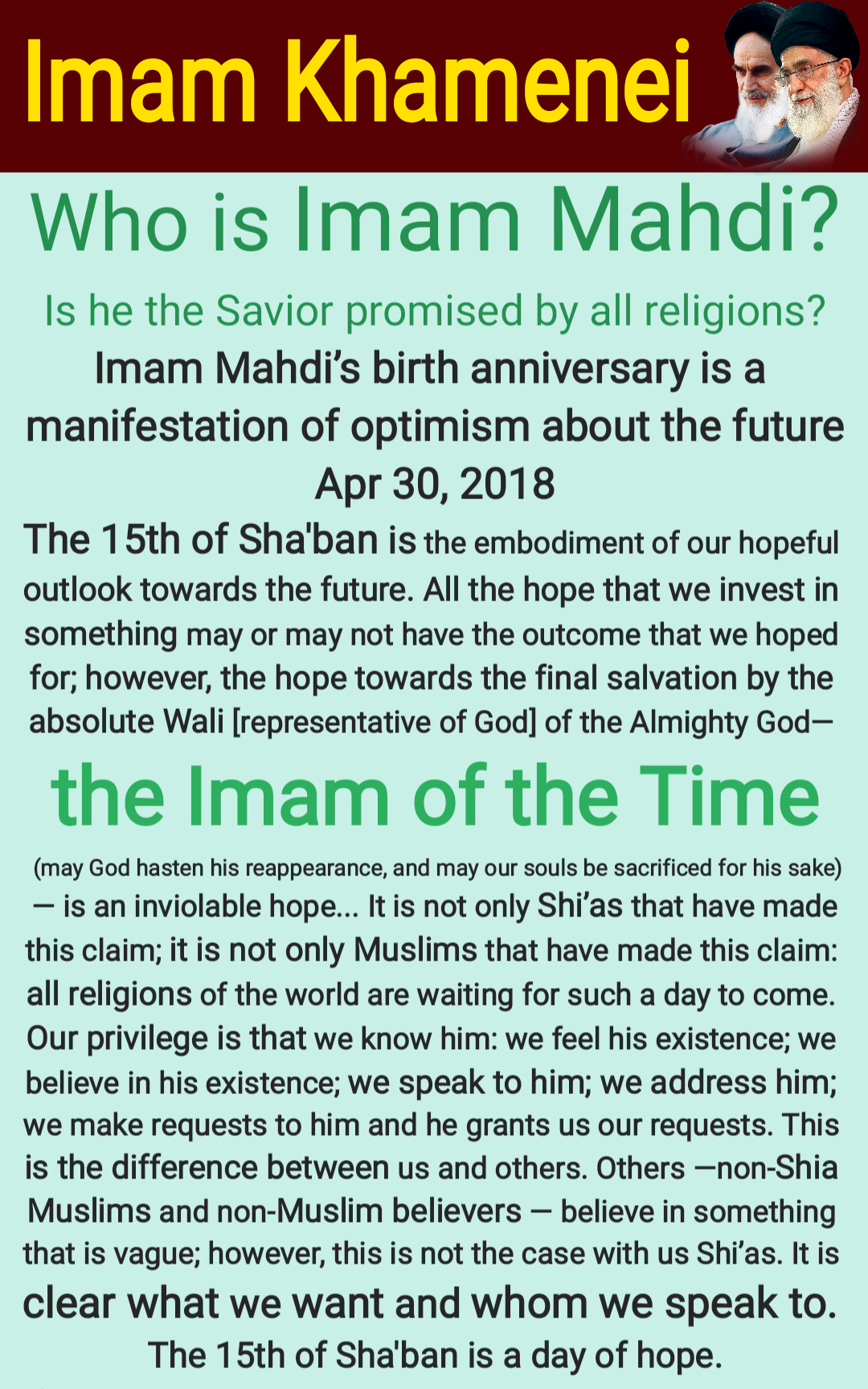
Who is Imam Mahdi?
Is he the Savior promised by all religions?
Imam Mahdi’s birth anniversary is a manifestation of optimism about the future
Apr 30, 2018
The 15th of Sha'ban is the embodiment of our hopeful outlook towards the future. All the hope that we invest in something may or may not have the outcome that we hoped for; however, the hope towards the final salvation by the absolute Wali [representative of God] of the Almighty God— the Imam of the Time
(may God hasten his reappearance, and may our souls be sacrificed for his sake)
— is an inviolable hope... It is not only Shi’as that have made this claim; it is not only Muslims that have made this claim: all religions of the world are waiting for such a day to come. Our privilege is that we know him: we feel his existence; we believe in his existence; we speak to him; we address him; we make requests to him and he grants us our requests. This is the difference between us and others. Others —non-Shia Muslims and non-Muslim believers — believe in something that is vague; however, this is not the case with us Shi’as. It is clear what we want and whom we speak to. The 15th of Sha'ban is a day of hope.
***************
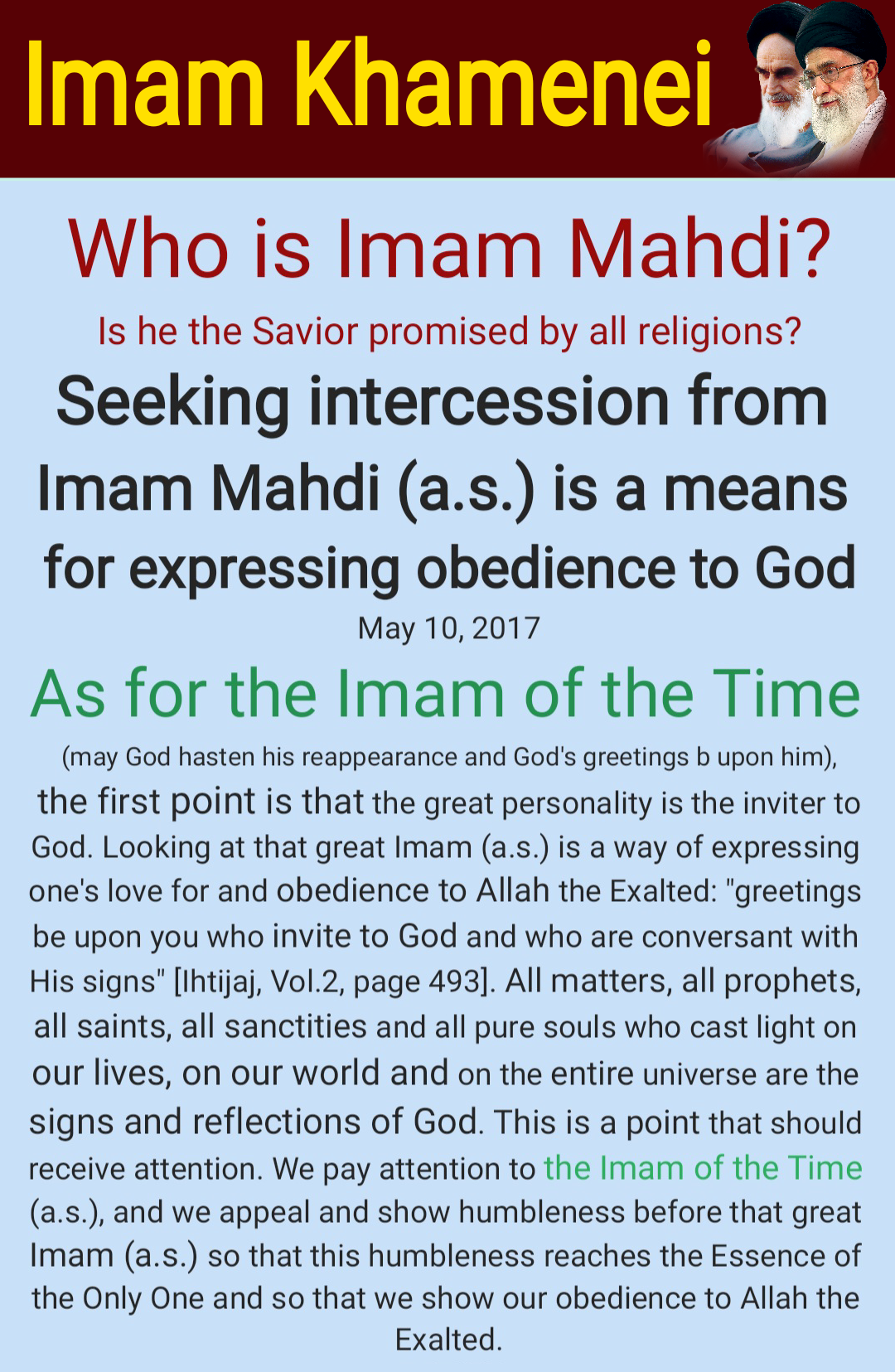
Who is Imam Mahdi?
Is he the Savior promised by all religions?
Seeking intercession from Imam Mahdi (a.s.) is a means for expressing obedience to God
May 10, 2017
As for the Imam of the Time (may God hasten his reappearance and God's greetings b upon him),
the first point is that the great personality is the inviter to God. Looking at that great Imam (a.s.) is a way of expressing one's love for and obedience to Allah the Exalted: "greetings be upon you who invite to God and who are conversant with His signs" [Ihtijaj, Vol.2, page 493]. All matters, all prophets, all saints, all sanctities and all pure souls who cast light on our lives, on our world and on the entire universe are the signs and reflections of God. This is a point that should receive attention. We pay attention to the Imam of the Time (a.s.), and we appeal and show humbleness before that great Imam (a.s.) so that this humbleness reaches the Essence of the Only One and so that we show our obedience to Allah the Exalted.
***************
Who is Imam Mahdi?
Is he the Savior promised by all religions?
Shiism thoroughly introduces the personality of the Savior
Jun 4, 2015
All Abrahamic religions believe in an end-times savior. All Abrahamic religions believe that someone will emerge who will save the world from the morass of oppression and cruelty. In Islam, the name of this savior has been mentioned. All Islamic denominations refer to this divine person and this great and extraordinary individual as Mahdi. Perhaps, there is no Islamic denomination that does not believe Mahdi (a.s.) will emerge. He is a descendent of the Holy Prophet (s.w.a.). Islamic denominations have even specified the name and epithet of that noble man. The feature of Shia ideology is that it thoroughly and clearly introduces this personality. It considers him as the son of the eleventh Imam - Imam Hassan al-Askari (a.s.). From the viewpoint of Shia historians and writers, his birth date is completely clear. Most of other Islamic denominations have not specified his birth date or they have not accepted it, but the Shia prove the existence and birth date of that great personality with strong and cogent reasons. Some people have dismissed the possibility of the existence and survival of a person over this long time. This is the only question that opponents have raised regarding Imam Mahdi (a.s.). However, the Holy Quran dispels this doubt with its clear words. The Holy Prophet (s.w.a.) says about Prophet Noah, "We sent Noah to his people, and he tarried among them a thousand years less fifty" [The Holy Quran, 29: 14]. This does not mean that he lived for 950 years. It apparently means that his mission - to invite people to God - lasted for 950 years. Therefore, this questioning is groundless.
***************
Who is Imam Mahdi?
Is he the Savior promised by all religions?
The greatest quality of belief in Mahdawiyyah is creating hope
Jun 4, 2015
The greatest characteristic of this belief among Shias is that it engenders hope. The Shia community is not reliant only on its prominent historical events in the past. It also looks forward to the future. A person who believes in the issue of Mahdawiyyah on the basis of Shia ideology does not empty his heart of hope even in the most difficult circumstances. There is always a ray of hope in the heart of such a person. They know that this dark era and this era of oppression and illegitimate domination will definitely come to an end. This is one of the most important results and achievements of this belief. Of course, Shia belief in the issue of Mahdawiyyah is not confined to this point: "People all over the world feed from his blessings and the heavens and the earth gain strength thanks to his existence" [Commentary on Usul al-Kafi, Vol. 1, p. 4]. Such is the belief in Mahdawiyyah. This bright flame and this shining light has existed in Shia societies in the course of past centuries and it will continue to exist. By Allah's favor, the era of anticipation will come to an end.
***************
Who is Imam Mahdi?
Is he the Savior promised by all religions?
A major opening to salvation is awaiting the reappearance [of Imam Mahdi]
Jun 11, 2014
We should wait. The outlook of religions towards the final destination of the caravan of mankind is a very promising outlook. The spirit of waiting and establishing a close relationship with the Imam of the Time (may our souls be sacrificed for his sake)
and anticipating the day when he reappears is really one of the greatest gates of salvation [faraj] for the Islamic community. We are waiting for salvation. This anticipation itself is salvation. This anticipating is the gate to salvation. It is promising and revitalizing. It prevents us from feeling desperate, ruined, hopeless and confused about the future. It gives us hope and it provides guidance. This is the point about the Imam of the Time (God's greetings be upon him).
***************
Who is Imam Mahdi?
Is he the Savior promised by all religions?
Belief in the Savior is a component of religions’ worldviews
Jun 11, 2014
Belief in the Imam of the Time (a.j.) is a component of religions’ worldviews. That is, just as divine religions hold viewpoints within their general worldviews about the universe, mankind, origin and the end of human life’s trajectory—about genesis and resurrection—they also hold viewpoints in their worldviews about the final destination of the caravan of humans. A worldview is a great system which lays the foundation for all the thoughts, obligations and rules of religions. It addresses the issues of the afterlife and the hereafter. Another issue is where the mankind is heading to. If we liken the human community throughout history to a caravan which is taking a specific path, then we are faced with this question: Where is this caravan going? What is the destination of this caravan? What is the end of this path? This is a serious question and every worldview should answer it. Religions have answered this question... all of them believe that this caravan will reach a favorable, sweet and pleasant destination in the end. The main characteristic of this destination is justice. Justice has been humanity's general request from the first day until today and it will remain mankind’s main request until the end. Those people who try to believe in variety, diversity and change in their principles and main philosophies cannot deny the fact that humanity has had certain requests from the first day until today, the most important of which is justice. Humanity is after justice. It has never changed its mind about this demand and in the end, this demand will be met.
***************
Who is Imam Mahdi?
Is he the Savior promised by all religions?
Self-edification is a prerequisite to awaiting
Jul 9, 2011
Awaiting requires that we prepare ourselves. We should know that a great event will take place and we should always expect it to happen. We can never say that the event will not happen in a few years nor can we say that the event will happen in the near future. We should always wait for it. Those who are waiting should develop characteristics and manners that are expected in the awaited era. This is the requirement for awaiting. If there is supposed to be justice, truth, monotheism, purity and submission to God in the awaited era, then as the people who are waiting, we should get closer to these qualities. We should become familiar with justice. We should prepare ourselves for justice. We should prepare ourselves for accepting the truth. These are the consequences of awaiting.
***************
Who is Imam Mahdi?
Is he the Savior promised by all religions?
The issue of awaiting is an inseparable component of Mahdawiyyah
Jul 9, 2011
The issue of waiting [for the re-appearance of Imam Mahdi (a.s.)] is an inseparable component of Mahdawiyyah. It is one of the key concepts for understanding religion and the general movement of the Islamic Ummah towards the lofty goals of Islam. Awaiting means expecting an event that will definitely happen. This is the meaning of awaiting. Awaiting means that this future is definite. This is especially true if we are awaiting a living and primed entity. This is a very important issue. We are not awaiting someone who has not been born yet. No, we are awaiting someone who exists and is present among us. There are certain narrations according to which people can see him, but they do not recognize him. In certain narrations, he has been likened to Prophet Joseph whose brothers used to see him. He was present among his brothers and he used to sit beside them, but they could not recognize him. It is such a clear and motivating truth. This facilitates awaiting. Humanity needs this awaiting and the Islamic Ummah needs it even more. This waiting puts responsibilities on the shoulders of human beings.
***************
Who is Imam Mahdi?
Is he the Savior promised by all religions?
Without Mahdawiyyah, all efforts by the all prophets will turn futile
Jul 9, 2011
If Mahdawiyyah did not exist, it would mean that all the efforts by divine prophets, all prophetic missions, all the strenuous efforts of divine prophets were futile. Therefore, the issue of Mahdawiyyah is an essential issue. It is one of the central divine teachings. For this reason, as far as I know, in all divine religions, there are teachings which are essentially the equivalent to Mahdawiyyah. However, these teachings have been distorted and blurred over time and it is not clear what they are trying to say. The issue of Mahdawiyyah is among the undeniable Islamic realities. That is to say, Mahdawiyyah is not limited to Shia Islam. There is a consensus among all Islamic denominations on the end of the days-- which includes when Imam Mahdi (may God hasten his re-appearance) establishes ultimate justice in the world. There are valid narrations [confirming that] by the Holy Prophet (s.w.a.) and Islamic luminaries from different denominations of Islam. Therefore, there is no doubt in this regard. However, Shia Islam has an advantage among other denominations; because the issue of Mahdawiyyah is not an ambiguous issue in Shia Islam. The issue of Mahdawiyyah is not a convoluted issue; it is not complicating to understand. It is clear. Mahdawiyyah has an epitome and we are familiar with this epitome. We know his characteristics. We know his ancestors. We know his family. We know when he was born. We know the details. And this familiarity is not based on Shia narrations alone. There are non-Shia narrations that clarify the details for us. Followers of other Islamic denominations should pay careful attention in order to understand this clear truth.
***************
Who is Imam Mahdi?
Is he the Savior promised by all religions?
The time after the reappearance of Imam Mahdi is the time of the true rule of spirituality and religion over mankind’s life
Jul 9, 2011
The topic of Mahdawiyyah is among the main topics in the cycle and set of noble religious knowledges; such as the topic of Prophethood. That is, it is comparable to prophethood: this is the importance that we should attach to the issue of Mahdawiyyah. Why? Because Mahdawiyyah represents what all prophets were sent for - namely, building a monotheistic world on the basis of justice using all the capacities that Allah the Exalted has bestowed on humanity. This is the era that will come after the reappearance of Imam Mahdi (God's greetings be upon him and may God hasten his re-appearance): the era in which monotheism and genuine spirituality will be dominant over the entire life of human beings, the era in which justice will be established in the real sense of the word. Well, this was what prophets were sent for.
***************
Who is Imam Mahdi?
Is he the Savior promised by all religions?
Who is the promised Imam of the Shias and the Savior of the world? Is the belief in him logical?
Aug 17, 2008
The Shias are awaiting the arrival of the promised savior-- Imam Mahdi (a.s.) -- and are not lost in their fantasies; they are searching for an existing reality. He is alive and lives among the people. He sees people. He can feel their sufferings. Those who are lucky enough and have the capacity sometimes meet him without recognizing him. He does exist. He is a real human: a known being with a given name; his parents are known and he lives among the people and with them. This is how our—the Shias’—belief is. And the followers of other faiths who do not believe in this reality have never been able to provide any logical reasons to reject this belief. There are several obvious and strong reasons, also accepted by Sunni Muslims, which are a testimony to the existence of this exalted servant of God. All these reasons provide evidence that Imam Mahdi (may our souls be sacrificed for his sake) is living among us - and we are all aware of his characteristics. This is what has been cited in many non-Shia sources as well. The birth date of the pure-hearted son of Imam Hassan al-Askari (a.s.) is known to everyone. His miracles and those who are connected with him are also known to us. God Almighty has granted a long life to him. These are the characteristics of the Imam of the Time (may our souls be sacrificed for his sake) whom all the nations of the world, all ethnic groups, and people from all faiths and races have been impatiently waiting for at all times. These are the beliefs of Shia Muslims about this important issue.
***************
Who is Imam Mahdi?
Is he the Savior promised by all religions?
The Torah and the Gospel give tidings of the truth of the belief in the Mahdawiyyah
Aug 17, 2008
Regarding the issue of Mahdawiyyah, Sunni Muslims - and even non-Muslim scholars who have studied the Shia beliefs about the issue of Mahdawiyyah - all confirm the fact that the tidings given by the Torah, Gospel, and scriptures of other religions are based on the same Mahdawiyyah concept held by Shia Islam.
***************
Who is Imam Mahdi?
Is he the Savior promised by all religions?
What does awaiting the savior entail?
Aug 17, 2008
Awaiting the Savior means that we should not accept or be satisfied with the current situation in our lives, and we should make efforts towards living an ideal life. And it is evident that such an ideal situation can only be created by Imam Mahdi (may our souls be sacrificed for his sake). We should prepare ourselves to fight like a soldier for such a situation. Waiting for the arrival of Imam Mahdi does not mean that we should remain idle and not make any efforts to improve. Simply waiting for the arrival of the Imam of the Time (may our souls be sacrificed for his sake) is not what we should do. What does waiting for the savior mean? It means waiting for the strong, powerful and divine hand of Imam Mahdi to put an end to the domination of the oppressive powers with the help of humans; to bring justice to the world; to raise the flag of monotheism, and to lead humans to truly submit to God. We should get prepared for this. The formation of the Islamic Republic prepared the ground for this great and historic movement. Everything that is done to achieve justice in the world takes us one step forward towards reaching this lofty goal. This is the meaning of waiting for Imam Mahdi. Awaiting the Savior means that we should move and not remain idle. Awaiting the Savior does not mean that we should leave things to others and wait for something to happen. Awaiting the Savior means that we should move and get prepared for the arrival of Imam Mahdi. We should be individually and socially prepared. Taking this great step and being able to prepare the right atmosphere for the arrival of Imam Mahdi was a blessing from God Almighty bestowed on our nation. This is the meaning of awaiting Imam Mahdi. Being prepared on all fronts to achieve the purpose for which the Imam of the Time (may our souls be sacrificed for his sake) will rise up is the true meaning of awaiting him. That great revolution will happen to achieve such goals as promoting justice, living a humane and moral life, and submitting to God. This is what awaiting the Savior means.
***************
Who is Imam Mahdi?
Is he the Savior promised by all religions?
Worlds current situation resembles the features of the awaited era as explained by narrations
Aug 17, 2008
Look at the current situation of the world. What has been described in traditions about the time of the arrival of Imam Mahdi (may our souls be sacrificed for his sake) exists in the world: The world is brimful of oppression and tyranny... Today, oppression and tyranny are prevalent in the world. Today, the life of human beings is dominated by the oppressive and arrogant powers of the world. This is the situation that exists in all parts of the world. Today, human beings are suffering many a problem due to the prevalence of tyranny and egocentric desires in their lives. That there are two billion people starving in the world, the existence of millions of people who are under the influence of egocentric desires in non-divine governments, and the pressure that is currently being exerted on faithful people and those who fight for justice on God's path-- such as the Iranian nation who has managed to raise the flag of justice in a certain part of the world-- are all indicative of the prevalence of tyranny and oppression in the world.
***************
Who is Imam Mahdi?
Is he the Savior promised by all religions?
What is meant by faraj [salvation]?
Aug 17, 2008
One important point regarding the issue of Mahdawiyyah is that in the Islamic and Shia belief systems, waiting for the arrival of Imam Mahdi has been interpreted as waiting for salvation. What does salvation mean? It means being saved. When do we usually yearn for salvation? We do so when we are in a difficult situation, and when there is a problem. When we face problems, we are in need of salvation - that is someone who can solve our problems and save us. This is an important point. The true meaning of waiting for a savior is that those who believe in Islam and the religion of the Prophet's household (a.s.) identify the problems of humans in the modern world. This is what they should actually do. They are waiting for the problems of humanity to be solved. The issue is not limited to my or your problems only. The Imam of the Time (may our souls be sacrificed for his sake) will come to solve the problems of humanity. He will come to save humanity forever. This means that those who are waiting for the arrival of Imam Mahdi are discontent about the current situation of the world - the unfair situation of the world in which many innocent people are oppressed, many are misled, and many others do not find the opportunity to worship God. Waiting for the arrival of Imam Mahdi means opposing the current situation that is prevalent in humans' life, and which has been caused due to the prevalence of ignorance and carnal desires in humans' life. This is the true meaning of waiting for the arrival of Imam Mahdi.
***************
Who is Imam Mahdi?
Is he the Savior promised by all religions?
Divine religions do not give baseless hopes to people
Aug 17, 2008
The 15th of Sha'ban is a day that is full of hopefulness. This hopefulness is neither exclusive to Shia Muslims nor even to the entire Islamic Ummah. To the best of my knowledge, the promise of a bright future for humanity and the arrival of a promised savior for promoting justice are universal beliefs that are shared by almost all divine religions across the world. Apart from Islam, Christianity, and Judaism, even Hindi faiths such as Buddhism - and other religions that most people have not even heard about - have informed their followers of such a future in their teachings. In fact, this has provided man with a kind of hope throughout history. It is a response to human need for this hope. Divine religions - which often have divine and celestial roots - did not intend to give people false hopes. They all expressed a reality. There is a reality in the creation of man and in the long history of humanity, and that reality is that one day the battle between good and evil is going to result in the defeat of evil and the victory of good. After this stage, man's true and pleasant life is going to begin in which struggle will no longer imply fighting. Rather, people will struggle for equality in doing righteous deeds. This is a fact that is shared by all religions.
***************
Who is Imam Mahdi?
Is he the Savior promised by all religions?
Hopefulness and justice: two prominent qualities of awaiting the Savior
Aug 26, 2007
One quality of the 15th of Sha'ban and the birth anniversary of the Imam of the Time (may our souls be sacrificed for his sake) is hope and justice. There are two outstanding points in our anticipation and our celebration of 15th of Sha'ban. One is the issue of raising hopes about this birth and the future that humanity is waiting for as a consequence of this birth. This is a source of hope. Another is that in the world that will be created after the reappearance of that great Imam (a.j.), the most prominent characteristic is justice. When you take a look at all the narrations and ahadith that have been narrated about that great Imam (a.j.) and that era, you see that the main focus is not on people's piety. Of course, people will be pious and religious in that era, but the main focus is on the fact that people will benefit from justice at that time and that justice and equality will be established. This matter exists in all supplications (duas), prayers and narrations about that great Imam (a.j.). That is to say, an outstanding feature in that promising future is justice, as humanity is thirsty for justice.
***************
Who is Imam Mahdi?
Is he the Savior promised by all religions?
A society that believes in Mahdawiyyah grows heartened
Sep 20, 2005
A society believing in Mahdi receives oriflamme and warmth in their hearts. This spirit is very important for nations. Know that colonialism gained the upper hand on Muslim countries after putting fear in the nations' hearts. They felt vulnerable, and powerless. Then they were conquered powerfully. It's the same today... Feeling weakened is a dangerous feeling and a deadly poison for a nation. One of the blessings of believing in Mahdawiyyah is feeling reassured, and heartened. It makes one feel powerful. And our nation feels this way, thanks be to God.
***************
Who is Imam Mahdi?
Is he the Savior promised by all religions?
The sacred existence of Imam Mahdi (a.s.) is a continuation of the prophets’ movements and divine calls
Sep 20, 2005
The sacred existence of Imam Mahdi (a.s.) is a continuation of the movement of divine prophets and their calls, since the beginning of the history till today. As you read in Nodbeh supplication, there is a related and attached sequence in the history of mankind since the time of Adam till the last prophet-- prophet Muhammad (pbuh)-- followed by his successors and his progeny, reaching Imam Mahdi. This means the great movement of the prophets and the divine calls by the prophets have never stopped throughout history. Humanity has always needed a prophet, a divine call, and the individuals who call the people to worship God. And this need persists today. As the time has passed, humanity has become closer to the prophets' teachings. Today, with advances in intellectuality, civilization and wisdom, human societies have come to comprehend many of the teachings of the prophets which were not understandable for them tens of centuries ago. The topics of justice, freedom, human dignity, etc. -- which are popular in the world today-- were originally raised by the prophets. At the time of the prophets, the masses of the people could not comprehend these concepts. The fact that the prophets were sent consecutively and their message spread, has made these thoughts inherent in the people's minds, hearts and nature-- generation after generation. Those messengers of Allah have not stopped their succession: Imam Mahdi (a.s.) assures the succession of the honorable messengers of Allah. That is, you can see the call by Abraham, Moses, Jesus, the call by all the prophets and redeemers sent by God and the call by prophet Muhammad (pbuh) represented in Imam Mahdi (a.s.). His excellency is the heir of all of them and holds their flag, inviting the world to the same teachings that the prophets have brought over time and have offered to humanity. This is an important point.
***************
Who is Imam Mahdi?
Is he the Savior promised by all religions?
What are the epitomes of awaiting salvation?
Sep 20, 2005
Awaiting redemption and salvation [through the reappearance of Imam Mahdi] in our era-- when humans are afflicted with oppressions and sufferings-- is an example of awaiting redemption; however, awaiting redemption has other forms, too. When we are told to await redemption, it does not only refer to the final redemption [reappearance of Imam Mahdi (a.s.)]. Instead, it means that any dead-end can be opened; any problem can be resolved. This is the true meaning of redemption: salvage. Learning from awaiting, a Muslim is taught redemption and is taught that there is no dead-end in human life which cannot be opened; or that humans can lose hope and stop acting on the pretext that it would be useless. Never! When at the final stage of human life, against the myriad of oppressive and merciless actions, the sun of redemption will rise, then, in daily dead-ends of life, redemption is expected, too. This is the lesson of hope for all humans; this is the lesson that true awaiting offers to all the humans. Thus, awaiting redemption is regarded as the best of actions.
***************
Who is Imam Mahdi?
Is he the Savior promised by all religions?
The most outstanding moto of Mahdawiyyah is justice
Oct 22, 2002
The most prominent moto of Mahdawiyyah involves justice. For instance, when in Ale-Yassin supplication you mention the features of his excellency [the Savior], one of the most prominent among them is: “The one who will fill the earth with justice and equity just as it was filled with injustice and oppression.†It is expected that he will fill all the globe – not just a specific area-- with justice, and establish equality everywhere. This notion also exists in the narrations about Imam Mahdi (a.j.). Thus, those who await the reappearance of the Promised Mahdi (a.s.), primarily await the establishment of justice. The biggest challenge of the present time is the lack of justice. Oppressive and tyrannical systems have always suppressed the people across the world, in different manners. They have compelled humanity; and have deprived the people from their natural rights. However, today this is more severe than any time in history and mankind is longing for the reappearance of Mahdi (a.s.) seeking that this will be resolved by his reappearance. Hence, this is a matter of seeking justice.
***************
Who is Imam Mahdi?
Is he the Savior promised by all religions?
Imam Mahdis future government is a popular government in the real sense of the word
Oct 22, 2002
Another important lesson we should consider is that Imam Mahdi’s future government is a popular, people-oriented government, in all respects. What does popular mean? It means the government relies on people’s belief, will-power and work. Imam Mahdi (a.j.) won’t fill the world with justice alone; instead, he will establish the foundation of justice across the world, with the help of devout masses of believers, and he will establish an entirely popular government. Nevertheless, this popular government is utterly different from today’s so-called democratic governments. What is carrying the title of democracy today, is indeed the old dictatorships that is represented in new disguises: that is, the dictatorships of the groups. Even if there is competition, the competition involves the groups; so, the people play no effective role. A group gains power, and due to its political power-- which grants it the authority to rule over all the affairs of the country-- and by abusing the power, it hoards on wealth, capital, and money. Then, the group uses the money to achieve even more power. Today’s democracies around the world are based on false and deceptive propaganda that beguiles the eyes and the hearts. Whereas, Imam Mahdi’s democracy is a religious democracy, completely different from these methods.
***************

Who is Imam Mahdi?
Is he the Savior promised by all religions?
Believing in Imam Mahdi (a.s.) does not men adopting seclusion
Oct 22, 2002
Believing in Imam Mahdi (a.s.) is not equivalent to seclusion. Deviated movements before the revolution advocated-- and some are still promoting in some areas today-- that Imam Mahdi (a.s.) will come and resolve the problems; so we would we need to do anything! This is like avoiding to turn on the lights at dark nights because the sun will come out the next day and lighten everywhere. Tomorrow's sun has nothing to do with today’s conditions of you and I. Today, we see there is oppression, injustice, discrimination, domineering anywhere in the world—and these are the same predicaments that Imam Mahdi (a.j.) will come to combat. If we claim to be soldiers of Imam Mahdi (a.j.), we should prepare ourselves to fight against them. The most important duty of those who await Imam Mahdi (a.j.) is to prepare themselves in areas of spirituality, ethics, religious practice, and to develop religious, and friendly bonds with other believers; as well as prepare themselves for confronting the domineering powers… anyone who awaits the great redeemer should prepare in themselves the basis for redemption, so they can endure establishing redemption in the world.
***************
Who is Imam Mahdi?
Is he the Savior promised by all religions?
Awaiting reappearance of Imam Mahdi (a.s.) is not about only sitting by and weeping;
we should prepare ourselves to serve as his soldiers
Oct 22, 2002
Another lesson for me and you to learn from the belief in Mahdawiyah and ceremonies of mid-Sha'ban [on the birth anniversary of Imam Mahdi (a.s.)] is that although believing in Imam Mahdi (mayour souls be sacrificed for him) is a lofty aspiration, and there is no doubt in it; the matter should not solely be regarded as an aspiration-- that is, as a dream in hearts, or only a step farther and just in words, or as celebrations. Rather, this is an aspiration that should be followed by action. Awaiting, which is encouraged in narrations, is not only about sitting by idly and weeping. Awaiting means that we should prepare ourselves to serve as the soldiers of Imam Mahdi (a.s.). Being his soldiers is not easy. Being soldiers of a great redeemer who wants to fight against all the international powers and hubs of corruption requires self-preparation, awareness, and ability to distinguish. Some mistakenly take the awaiting as a pretext for indolence. We should not think that because Imam Mahdi (a.s.) will come and will fill the world with justice one day, we have no responsibilities today. On the contrary, we have the duty to move in that direction today to get prepared for his Excellency’s reappearance.
***************
Who is Imam Mahdi?
Is he the Savior promised by all religions?
Establishment of justice requires a government led
by justice seekers
Oct 22, 2002
Another lesson the belief in Mahdawiyyah and mid-Sha'ban celebrations [rejoicing the birth anniversary of Imam Mahdi (a.j.)] must give us is: the justice we are looking forward to-- justice established Imam Mahdi (a.j.) that is to fill the world-- is not achieved by simply preaching and giving advice. That is, the promised Mahdi of nations is not going to preach the oppressive powers to make them avoid oppression, avarice, hegemony and exploitation of other nations. By only giving advice, justice will never be established. Establishing justice, either at the global level --as will be done by the heir of the Prophets-- or in any area of the world, requires that just, benevolent individuals hold a powerful position and address the domineering powers with a language of power. It is impossible to advise those who are arrogant, due to their oppressive power. Only a language of sovereignty works for communicating with them... Those who favor justice, should equip themselves with power against domineering hegemonic powers who invade humans' rights. So you see, ever since the Islamic establishment was formed--that is, Islam gained the power of a big nation, and resources of a big country and government-- the enemies of Islam took the movement of Islam seriously and the supporters of Islam across the world became hopeful.
***************

Who is Imam Mahdi?
Is he the Savior promised by all religions?
Belief in Mahdi (a.s.) opposes the false and oppressive propaganda by arrogant powers
Oct 22, 2002
Humans can make an effort to raise the flag of justice –even if only in a certain area. If the nations living under pressures of oppression today can develop the hope that it is possible to fight against oppression, what will happen in the world and how the nations will awaken! The Iranian nation was once under the tyrannical [Pahlavi] regime's claws of despotism and had no hope. However, our magnanimous Imam Khomeini cleared the hearts from disappointment and inspired the people with hope and bravery via Islamic teachings. As a result, the people rose up and brought about a revolution. They underwent hardships; they fought; they sacrificed their lives, and they managed to fight against, uproot and overthrow the agents of oppression and the oppressive system in this part of the world. Today, the propaganda centers of the Arrogant Powers in the world and the illuminati affiliated with them, promote around the world the belief that no movement can counter the current oppressive order. They fight against the notions of revolution and idealism and want to convince the nations to tolerate the actual oppressive situation of the world and avoid reacting to it. The belief in reappearance of Imam Mahdi (a.j.) opposes the false and oppressive propaganda. Believing in reappearance of Imam Mahdi (a.j.), our youth, intellectuals and nation nurture in their hearts the strong belief that the global oppressive order is going to perish; it is not permanent. It is possible to fight and resist against it.
***************
Who is Imam Mahdi?
Is he the Savior promised by all religions?
The first practical lesson from the belief in Savior: Elimination of Oppression from the world is definite
Oct 22, 2002
The first lesson we can learn from believing in the reappearance of Imam Mahdi (a.j.) is that eliminating oppression from the world is not only possible, but it is definite. This is extremely important for the young generations not to believe that it is impossible to counter the global oppression. Today, when we speak with world-renowned political intellectuals about oppression exercised by the international powers and the global system of oppression—which is headed by the Arrogant Power [U.S.] around the world today—they say they agree that there is oppression, but there is no possible way to oppose the oppressive powers! That is, a great number of the elites who lead the world are afflicted with disappointment and they transfer this feeling of disappointment to their nations, and dishearten them about overturning the oppressive and devilish plots in today’s world. Evidently, hopeless individuals can never take action against oppression. What will make people act and move is the beacon and power of hope. Believing in the promised Mahdi (a.j.) will fill the hearts with the beacon of hope. For us, who believe in the definite reappearance of Imam Mahdi (a.j.), the hopelessness that has afflicted many intellectuals around the world makes no sense. We hold that it is possible to change the oppressive systems of the world, that it is possible to encounter oppression and oppressive powers, and that in the future this is not only possible but it will definitely happen.
***************
Who is Imam Mahdi?
Is he the Savior promised by all religions?
Believing in Mahdawiyyah is not exclusive to Shiism
Oct 22, 2002
Believing in the reappearance of Imam Mahdi (a.s.) at one time in history is not specific to Shia Muslims. Rather, all Muslims—including Shias and Sunnis—believe in this notion. However, the Shias are privileged in that they know this Savior by name and features, and believes that he is always ready and prepared to receive the divine order. Any time God the Almighty commands him [to reappear], he is ready to initiate the great movement, which is supposed to revolutionize humanity and history. The lesson and the pragmatic and cognitive teaching we need to learn from this notion is significant.
***************
Who is Imam Mahdi?
Is he the Savior promised by all religions?
Reappearance of Imam Mahdi (aj)
is near, because minds are ready
Nov 24, 1999
Presently the mind of humankind is ready to understand, to learn, and to know,undoubtedly, that a lofty human will come to save them from the burden of oppression and tyranny. The exact effort that all the prophets made, the exact promise the Prophet of Islam (pbuh) has made to people via the Quranic verse: "And relieves them of their burdens and the shackles that were upon them," [7:157] is expressed. The hand of divine power can make this dream of humankind come true through a heavenly human, a divine human, a human connected to worlds of mystery, spirituality, and worlds that are not understandable to shortsighted humans like us. Hence, the hearts, the enthusiasm, and love are attracted to that point; and, every day they grow more attracted than the day before. The Iranian nation, enjoys a great privilege today: the atmosphere of the country is an atmosphere of Imam Mahdi (aj). Not only Shias across the world, but all Muslims are awaiting the Promised Mahdi. The privilege of the Shia is that they know this divine and certain promise made to all Muslim nations as well as followers of all religions, by name, attributes, characteristics and birth date. Many of our great scholars have personally met with this beloved (Imam) of hearts of the admirers during his occultation; many have made a pledge to him in person; many have heard from him some heartwarming words; many have been caressed by him and many others have received his kindness, care, and love without having recognized him. On the battlefield, of the imposed war on Iran, there were many young men who felt a spiritual and bright presence at their most crucial moments: they sensed and received an assurance in their hearts without recognizing and knowing the source. The same is true today.
***************
Who is Imam Mahdi?
Is he the Savior promised by all religions?
Is the reappearance of the Imam of the Time close? Why or why not?
Nov 24, 1999
Dear youth; the Basij members (Mobilized Forces)! One of those glowing Suns—by the Grace, Assistance and Will of God—is on the Earth today, at our time, as â€کWhat remains from Allah on the Earth’; as â€کthe Argument of God for his servants’; as the Master of our Time, and the Absolute Wali of God. The blessings resulting from his presence, and the rays of light emitting from his existence reach out to the mankind today. Even today, humanity with all its weaknesses, errors, and entanglements, uses the gleaming light of this divine and spiritual sun who is the remainder of Ahlulbayt. Today, the sacred existence of Imam Mahdi-- may our souls be sacrificed for him-- among human beings on earth, is the source of blessings, knowledge, splendor, beauty and all that is good. Our weak and humble eyes cannot see that divine face from close by. But he is like a glowing sun, bonded with the hearts, and connected to the spirits and the inner selves. And for those with knowledge, there is no greater reward than feeling that the Wali of Allah-- the rightful Imam, the righteous one, the chosen worshiper among all worshipers in the universe, and God's address when he calls for his Caliph on Earth-- is with them and beside them. He sees them and is connected to them. The ultimate aspiration of every man is the existence of such a great element. Mankind’s unfulfilled wishes throughout history look on to this horizon, waiting for the great man, and a chosen man among the chosen men of God, to come and tear apart the fabric of cruelty and oppression, woven by the wicked throughout history. Today, mankind is also affected by cruelty and oppression, more than many other periods of time in history; but mankind has also progressed, and human wisdom has advanced. We have approached the reappearance of Imam Mahdi, the real love of human hearts (may our spirits be sacrificed for him) for wisdoms have developed and progressed.
***************
Who is Imam Mahdi?
Is he the Savior promised by all religions?
Which society can receive the Promised Mahdi (a.s.)?
Dec 16, 1997
It is nonsensical to say Imam Mahdi (a.s.) will come and do the work. What is your duty today then? What should you do today? You should prepare the grounds so his excellency can come and act in the prepared grounds. It is impossible to start from scratch. A society can receive the Promised Mahdi (Our souls be sacrificed for him) that is prepared and has the potentials; otherwise, it will end in the same way as the efforts of prophets and Imams throughout history did. Why did many of the messengers of God come but couldn't rid the world of evil? Because they lacked prepared grounds... Then, if Imam Mahdi (a.s.) reappears in an unprepared society, the result will be the same! Preparation is needed. How does the preparation happen? It can happen in the forms you already see in your own society. Today, in the Islamic Iran, there are cases of spiritual accomplishments, which are unparalleled in the world, as far as we know and are informed – and we are not unaware of the world.
***************
Who is Imam Mahdi?
Is he the Savior promised by all religions?
The Global Arrogance seeks to inject despair among Muslim nations
Dec 16, 1997
There are a number of features in the belief in Mahdawiyyah which work like blood in the vessels, and soul in the body. One of them is hope. Sometimes, powerful and vulgar hands bring weak nations to the point where they completely lose hope. When they lose hope, they won’t make a move. They think it is useless, and it is too late. They think they cannot confront the powers, because they won’t succeed. This is the spirit of despair. This is what colonialism seeks. Today, the global Arrogant power wants Muslim nations, including the dear Iranian nation, to get afflicted with the spirit of despair, so they say â€کwe cannot do anything, it is useless!’. The Arrogance wants to inject this among the people by force. What for? So they can take enthusiasm and hope away from the human community who advances with hope, and turn the people into dead or dead-looking beings. So they can do whatever they want! They cannot do whatever they want with a living and enthusiastic nation. To an unconscious, dazed being who is left inert in a corner, anyone can inject anything they want; they can do anything they want to them. Whereas, with a vital, enthusiastic, intelligent, active nation they cannot do whatever they want.
***************
Who is Imam Mahdi?
Is he the Savior promised by all religions?
Arrogant powers effort to obliterate the belief in Mahdawiyyah among the people
Dec 16, 1997
I saw a document that dated back to decades ago; that is, to the time when colonialism had just entered Northern Africa. The countries in Northern Africa are strongly interested in Ahlulbait. Regardless of the Islamic denomination they believe in, they like the Ahlulbait (a.s.). In countries like Sudan, in Maghreb, and other countries of that region the belief in Mahdawiyyah is pronounced. When colonialism entered the mentioned region, during the past century, one of the matters that troubled colonialism was the belief in Mahdawiyyah! In the document I saw, the heads and commanders of colonialism suggested they needed to do something so the belief in Mahdawiyyah would gradually disappear from among the people. At that time, the French and English colonizers were present in some of the African countries. No matter where the colonizers came from, they judged that until the belief in Mahdawiyyah existed among these people, they would not be able to completely control these countries! Now you see how important the belief in Mahdawiyyah is! What a big mistake is made by those who, in the name of intellectualism and seeking new approaches, question and raise objections to Islamic beliefs, without any prior investigation and information; without knowing what they are actually doing! They do what the enemies seek to do! Islamic beliefs are like that.
***************
Who is Imam Mahdi?
Is he the Savior promised by all religions?
Imam of the time
is present among the people
Jan 7, 1996
Believing in Imam of the time [Imam Mahdi (a.s.)] helps the people not to succumb [to evil]; provided that they fully comprehend this belief. When this belief is truly placed in hearts, his presence is felt among the people. The sacred, beloved and infallible Imam-- the hub of the universe, the refuge for the entire creation-- is present; even though he is in occultation and has not reappeared. How is it possible to think he is not present? The devout believers will feel his presence in their hearts, via all their emotions and senses. Those individuals who pray and supplicate to God, read the Nodbeh supplication with attention, and recite the Ziarat of Aale-Yassin understand what they say. They feel the presence of this great person; even if he has not yet reappeared. His absence does not affect the feeling that he is present. He has not reappeared; but he is present in the hearts and among the people. How is it possible to believe he is not present? A true Shia is someone who feels this presence, and feels himself before him. This gives vitality and enthusiasm to a person. This great nation—above all— needs this hope. The nation-- who fights in the path of God and for the sake of magnificence of Islam, and has become a pride for the whole of history and history of Islam, in particular, and has raised the flag of Islam in our era—needs this bright hope, more than anything else. This belief provides the hope for them.
***************
Who is Imam Mahdi?
Is he the Savior promised by all religions?
Two effects among the great effects of believing in Mahdawiyyah
Jan 7, 1996
On the matter of the birth anniversary of his excellency [Imam Mahdi], and the belief in this truth, if one investigates and searches in two directions or areas, they will notice great results: Firstly, in the spiritual and mental aspect with regard to closeness to God and individual development of humans. The person who believes in this cause-since they build spiritual relation with the center of divine blessings, the pivotal point and core of God's mercy, will have a better opportunity for enjoying the means of spiritual development and closeness to God. That is why, the people of wisdom, in their spiritual supplication, constantly consider him and give special attention to his excellency. Spiritual bond, remembrance, and attention to the manifestation of God’s mercy, power and justice will itself lead humans to growth and elevation, and provides them with the means of progress in spirituality and wisdom. The second aspect is in the social and public life and what relates to the collective fate of nations and humanity. In this arena, believing in Imam Mahdi (a.s.) and his reappearance represents a great resource from which nations can benefit a lot. Imagine a ship in a stormy sea. If the people aboard the ship believe that there is no land around their ship within thousands of miles, and they have limited food and water reserves and limited means for movement, what would they do? Can you imagine that they would take any actions at all to move the ship forward? No! Because they think their death is inevitable, they have no hope to take any measures.
***************
Who is Imam Mahdi?
Is he the Savior promised by all religions?
The birth of Imam Mahdi (a.s.) is an Eid for all the mankind
Jan 7, 1996
The birth anniversary of the promised Imam Mahdi (a.s.) is a true Eid for all the humans; for all those who underwent a suffering, oppression; those whose hearts have been broken; who have wept; who have waited, or have endured hardships during their life-- anywhere on the Earth, or at any point of history. All of those people have felt hopeful, happy and enthusiastic on this day, and in hope for this day. This great birth and important fact does not belong to a single nation or time. It belongs to the entire humanity. It represents a covenant between God and humans: “Peace be upon you, O the covenant of Allah, which He took it and He fastened it [Ziarat of Aale Yassin].†It represents God’s guaranteed promise: “Peace be upon you, O the promise of Allah which He guaranteed it [Aale Yassin Ziarat].†All humans throughout history have felt the spiritual and heartfelt quest for this great and extraordinary phenomenon. Because the history, since the beginning till today, and since today till the world's glowing sun rises [till Imam Mahdi (a.s.) reappears] has been filled with evil and oppression. All those who have suffered from oppression and those who witnessed the sufferings of others and were heartbroken upon it, will feel hope in their hearts by remembering the birth anniversary of the great redeemer of history and humanity.
***************
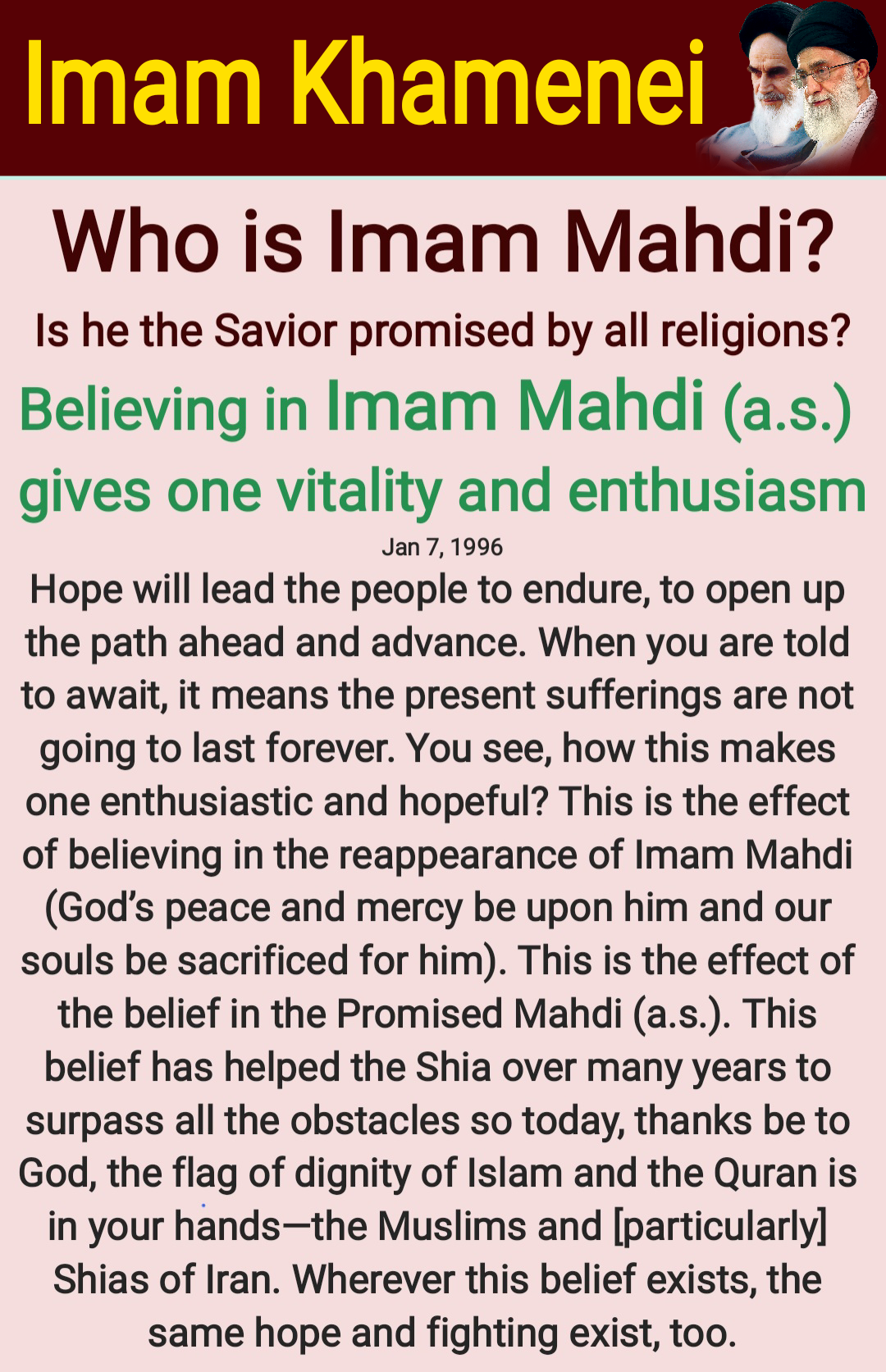
Who is Imam Mahdi?
Is he the Savior promised by all religions?
Believing in Imam Mahdi (a.s.) gives one vitality and enthusiasm
Jan 7, 1996
Hope will lead the people to endure, to open up the path ahead and advance. When you are told to await, it means the present sufferings are not going to last forever. You see, how this makes one enthusiastic and hopeful? This is the effect of believing in the reappearance of Imam Mahdi (God’s peace and mercy be upon him and our souls be sacrificed for him). This is the effect of the belief in the Promised Mahdi (a.s.). This belief has helped the Shia over many years to surpass all the obstacles so today, thanks be to God, the flag of dignity of Islam and the Quran is in your hands—the Muslims and [particularly] Shias of Iran. Wherever this belief exists, the same hope and fighting exist, too.
***************
_pic-5792-1641623459_pic-6624-1673673413313211shiagharghdanoorhalal_jc4y.png)
Who is Imam Mahdi?
Is he the Savior promised by all religions?
Why does the whole of the mankind await the reappearance of the Savior?
Feb 7, 1993
Imam Mahdi (a.s.) is the key to justice and the symbol of divine justice on earth. As a result, all the humanity look forward to his Excellency’s reappearance, in one way or another. Well, Muslims have precisely identified this great awaiting, and the Shia have clear and detailed information about the redeemer. So the matter of awaiting Imam Mahdi, from this perspective, is not only specific to Shia, and not even only to Islam. Rather, it represents awaiting among people from all walks of life and all nations of the world. It represents hope in the hearts of humanity: history of humankind moves toward improvement. This hope gives power to bodies, light to the hearts, and determines that every move towards seeking justice is aligned with the natural direction and order of the world and human history. Consequently, before the revolution when our nation was fighting, they felt like they were advancing toward the ideal of humanity. Similarly, after the revolution, the Iranian nation feel like every move and action they take, every fight and hardship they endure, is directed towards a goal which is shared by all the humans and all the believers. The purpose is to establish justice and the goal is to achieve justice for all the humans. Islam will provide this justice.
***************
_pic-5792-1641623459_pic-6624-1673673413313211shiagharghdanoorhalal_z9mb.png)
Who is Imam Mahdi?
Is he the Savior promised by all religions?
By acting according to Islamic laws, we should prepare the ground for the reappearance
Feb 19, 1992
We will be considered as truly awaiting the Savior only when we prepare the ground for it. For the reappearance of the promised Imam Mahdi (may our spirits be sacrificed for him) the ground needs to be prepared. And that is achievable by acting upon Islamic laws and the rule of Qur'an and Islam. As I said, it is narrated that: by God, you will be tested, and by God you will be sifted. This great trial which faces the followers and the Shia of Imam Mahdi (may our spirits be sacrificed for him) is a test of making efforts for fulfilling the rule of Islam. You must endeavor for the fulfillment of the rule of Islam. Our great nation made this one step. I must say, in this city of Qom-- which is the birthplace of resistance and revolution, and in this holy place which has witnessed long devoted efforts and endeavors for God, during the movement, before and after the revolution-- that the first step for the rule of Islam and for Muslim nations to get nearer to the time of reappearance of Imam Mahdi (may our spirits be sacrificed for him and may God hasten his reappearance) was taken by the Iranian nation. And that is, establishing the rule of Qur'an. This is what the materialistic world would not want to believe. After centuries of trying to outdo religion, and especially the holy religion of Islam, they would not want to see that this religion has appeared on the world scene, governing a country, attracting and pulling nations towards itself. That is why the animosity of imperialism, enemies of religion, and the fronts of Arrogance, heresy and paganism started to counter the Islamic Republic.
***************
_pic-5792-1641623459_pic-6624-1673673413313211shiagharghdanoorhalal_owwi.png)
Who is Imam Mahdi?
Is he the Savior promised by all religions?
While awaiting the Promised Mahdi (a.s.) indolence should not be sought
Feb 19, 1992
You dear youth who are starting your life and work, should try to prepare the grounds for the promised era, when there is no trace of oppression; when human mind and intellects are more active and flourishing that ever before; when nations do not fight, when the warmongering agents of the world-- who caused and continue to cause regional and global fights-- can no longer stage any war; when all across the world, there will be peace and security. We should endeavor to achieve that era. Before the era of Promised Mahdi (a.s.) comfort and peace do not exist. In narrations we have expressions such as, “the people will be put on the hardest trials†or “the people will undergo the harshest pressures.†When and where is the trial? When there is a field of combating. Before the reappearance of Imam Mahdi (a.s.), pure individuals are put on trial in combating fields; they are put on trial, and they pass the trials successfully; and the world approaches day after day the ideal and aspired era of Promised Mahdi (a.s.). This is the great hope. So the day of Sha’ban 15 [birth anniversary of Imam Mahdi (a.s.)] is an important Eid.
***************
_pic-5792-1641623459_pic-6624-1673673413313211shiagharghdanoorhalal_ys9o.png)
Who is Imam Mahdi?
Is he the Savior promised by all religions?
Why do the youth in Western countries succumb to ennui and despair?
Feb 19, 1992
The overwhelming oppression that dominates the world, the unrighteous rulings, the bullying of nations around the world, the unjust bloodshed, disregarding the most honorable and important human values, the lies and tricks that the leaders of global arrogant powers deliver to humans every day-- all this malevolence, exploitation and oppression, naturally disappoints a person who does not have a source of hope in their heart. As a result, you see the youth in Western countries succumb to ennui and despair. The young generation who is not accustomed to the traditions and has not learned to rely on the traditions—when encountered with the chaos in human life-- becomes desperate, and turns to ennui. Many of the boys and girls in Western countries incline to nihilism, ignore expressions of life and sink in instant desires. This is caused by hopelessness. Many of the world renowned scientists, authors and orators fall for the same predicament. But this is not the case for a nation who has hope in the future; who knows that the days of oppression, invasion, domination and arrogance will—despite its massiveness that has overwhelmed the world today—come to an end one day; that a time will come when the great power of Truth will obliterate all the peaks of corruption and oppression and it will illuminate the landscape of human life with the beacon of justice. This is the significance of awaiting Imam Mahdi's era.
***************
_pic-5792-1641623459_pic-6624-1673673413313211shiagharghdanoorhalal_08xz.png)
Who is Imam Mahdi?
Is he the Savior promised by all religions?
A mistaken interpretation of awaiting reappearance
Mar 2, 1991
There existed a deviated concept with regard to awaiting the reappearance of Imam Mahdi (a.j.), and fortunately, today there is little trace of that wrong interpretation. Some ignorant or malignant people had promoted the view that awaiting meant avoiding any positive action or fights against evil; that it meant waiting till Imam Mahdi (a.j.) would come and amend the world, and obliterates corruptions! Thanks to the revolution, this false interpretation was obliterated or, at least, it lost popularity. Thanks be to God, this concept no longer exists in our society. The appropriate sense of awaiting constitutes of some dimensions and heeding these dimensions are extremely important for anyone who understands how much significance is given to awaiting in the culture of Islam and Shia.
***************
_pic-5792-1641623459_pic-6624-1673673413313211shiagharghdanoorhalal_3ha4.png)
Who is Imam Mahdi?
Is he the Savior promised by all religions?
The blessings of the Belief in Mahdawiyyah for societies
Mar 13, 1990
Heartfelt relation between each and every believing man and woman with his eminence-- the greatest Wali of Allah-- is one of the blessings resulting from our people’s belief in the promised Mahdi (may God hasten his reappearance). In addition to believing in Mahdi-- the fact that someone will come and spread justice all around the world-- we know the personality of Mahdi; his name and his cognomen; his father and mother; his birth date; how he disappeared; his close companions, and even some incidents that are to unfold around the time of his appearance. Even though we do not meet this great personality—this brilliant individual and glowing sun around us—by recognizing him, we are aware of his status. The relation between the Shia with this belief and their Wali, the promised Mahdi, is a permanent relation, and it would be great, even necessary, that each and every one of us keep this heartfelt relation with attention to, appealing to, and talking to him. According to the Ziarats (supplications) that are available to us, narrated by most probably an infallible imam, this heartfelt and spiritual relation between individuals and Imam Mahdi, is recommended, even necessary and effective; because that it keeps hope and prospect constantly alive in one's heart.
Source:
https://english.khamenei.ir/Opinions/Imam_mahdi
Links:
Imam Hussain’s Revolution for Humanity
https://english.khamenei.ir/Opinions/AshuraUprising
Who is Imam Hussain? Why did he launch an uprising?


Note: All content is free to use
A world replete with justice, purity, truthfulness, and kindness is the world of the era of Imam Mahdi (pbuh) ...
In the Name of Allah, the Merciful, the Most Merciful
Sura 21: AL-ANBIYA (THE PROPHETS) - Juz' 17 - Translation Qarib
**************
Note: All content is free to use
Why did Imam Hussain (pbuh) rise up? Did Imam Hussain (pbuh) rise up only for opposing a corrupt ruler like Yazid? Which were the true dimensions of Imam Hussain's movement?

Imam Khamenei:
Imam Hussain's (pbuh) movement is, indeed, perceivable via two perspectives—both of which are acceptable. Nonetheless, when put together, the two views show the extensive dimensions of this movement. One perspective involves the appearance of Imam Hussain’s action, which is a movement against a corrupt, deviated, suppressive and oppressive regime: Yazid’s Regime. But, at the heart of his action, there is a more important movement that the second perspective will lead to the move against ignorance and humiliation of mankind. In fact, even though Imam Hussain (pbuh) fights against Yazid, his extensive historical fight is not against the short-living and insignificant Yazid. Rather, his main fight is against mankind’s ignorance, abasement, deviation and humiliation. Indeed, Imam Hussain (pbuh) fights against such vices.
January 16, 1994
_8j9y.png)
Imam Khamenei:
An ideal government was formed by Islam. If we want to summarize the story of Imam Hussain (pbuh) in a few lines, we can say: humanity suffers from ignorance, oppression and discrimination. The big rulings of the world, the empires of the Caesars and Kisras of the time—either in ancient Persia or the Roman Empire—were regimes of extravagance, non-democratic establishments, ruling through illogical coercion, ignorance and corruption. Smaller establishments--like those in the Arabian Peninsula-- were even worse than them; overall, ignorance reigned over the world. Meanwhile, the light of Islam managed to enlighten, first, the Arabian Peninsula, and then gradually grow to encompass all the world, by the Messenger of God, via Divine assistance, as well as massive and strenuous popular resistance. At the time the Prophet dies, this government was a stable establishment that could be a model for all humans throughout history. Had that establishment continued in the same direction, the history would undoubtedly change. That is, what is supposed to happen centuries later-- at the time of Imam Mahdi’s (pbuh) reappearance in the current situation—would have happened at that time. A world replete with justice, purity, truthfulness, and kindness is the world of the era of Imam Mahdi (pbuh); it is the time when the authentic life of humanity begins. The Authentic life of mankind in this world begins after the reappearance of the Imam of the Time (may God hasten his return), and humanity will achieve great development then. Thus, had the persistence of Prophet Muhammad’s establishment been made possible, and had it been formed during the early years, the history of mankind would have changed, and the final destiny of human life would have unfolded much earlier. However, this was not realized for various reasons ...
January 16, 1994
_gagj.png)
Imam Khamenei:
A world replete with justice, purity, truthfulness, and kindness is the world of the era of Imam Mahdi (pbuh); it is the time when the authentic life of humanity begins. The Authentic life of mankind in this world begins after the reappearance of the Imam of the Time (may God hasten his return), and humanity will achieve great development then ...
January 16, 1994
_wu5v.png)
Imam Khamenei:
The main feature of Prophet Muhammad’s establishment was that instead of relying
on oppression, it relied on justice. Instead of relying on paganism and division
of human thought, it relied on monotheism and focused on worshipping God.
Instead of ignorance, it relied on knowledge and wisdom. Instead of promoting
revengeful behavior among the people, it relied on kindness, compassion, the
establishment of friendly relations, and tolerance: a neat government both in
apparent aspects and innermost aspects. One who grows under such a government
becomes pious, chaste, knowledgeable, insightful, active, enthusiastic, dynamic,
and moves on the path toward perfection. Fifty years after [the passing away of
the prophet], everything changed. The name of Islam remained; the word ‘Islam’
persisted; however, in reality, true Islam was no longer practiced. Instead of
the government of justice, a government of oppression was established again.
Instead of fraternity and equality, discrimination, division and separation
reigned. Instead of wisdom, ignorance ruled. During this period of fifty years,
as we move on, we can find hundreds of examples of such cases; researchers are
recommended to elaborate on them for the young and investigative minds.
Imamate was transformed into the kingdom! The essence of Imamate is
contradictory to the essence of the kingdom. These two are contradictory.
Imamate is moral and spiritual leadership and compassionate and belief-related
bonds with the people. Whereas, a kingdom is ruling via coercion, power and
deluding, without any spiritual, compassion and belief-related bonds. The two
are binary opposites. Imamate is a movement among the ummah, for the ummah and
in favor of rightfulness. A kingdom is an authoritarian dominance against the
interests of the people, only serving particular classes of society, to fulfill
the ruling group’s hoarding wealth and pleasing lust. What we see at the time of
Imam Hussain’s uprising is the second case, not the first one. That is, Yazid
who was in power then, had no relations with the people; he had no knowledge, no
piety, no chastity, no experience of jihad for the cause of God, and no belief
in Islamic spirituality; his behavior was not a behavior of a believer in Islam,
his words were not the words of a wise man. He was in no way similar to Prophet
Muhammad (pbuh). In this situation, an opportunity arose for a person like Imam
Hussain (pbuh) -- the Imam who was apt for succeeding the Prophet (pbuh)--and he
rose up.
Looking at the surface of the events, this uprising was against the corrupt and
unpopular regime of Yazid. However, beneath the surface, it is an uprising for
the sake of Islamic values, understanding, faith, and dignity. It is for the
people to be set free from corruption, subordination, lowliness, and ignorance.
It was for this reason that when Imam Hussain (pbuh) left Medina, in a message
to his brother Muhammad Ibn Hanafiah, and in reality a message to the history,
he wrote: I am not rising out of selfishness, or lust for power, nor to cause
mayhem or pain. I rise looking for the correction in my grandfather's ummah. I
see that things have changed in the society that the prophet left. It is going
towards the wrong direction, towards corruption. It is against the direction
coveted by Islam and the prophet had preached. I rise to fight against these
[vices].
Imam Hussain’s fight had two dimensions and can have two different fallouts.
Nonetheless, both outcomes are good. One result was that Imam Hussain (pbuh)
could defeat Yazid’s government and take power away from those who oppressed the
people, and devastated the fate of the people, so he could arrange things in an
appropriate way. If this had happened, the route of history would have revolved.
Another dimension was that, if Imam Hussain (pbuh) could not, for whatever
reason, achieve political and military victory, then he would—not by words, but
rather by blood, by resisting oppression, by a language that history will never
forget—make his narrative flow like a perpetual and non-interruptible stream in
history; this is what Imam Hussain (pbuh) did.
Of course, for those who claimed to be believers, if they had acted differently
than what they did to Imam Hussain (pbuh), the first case would have happened
and Imam Hussain (pbuh) could have reformed the world and the hereafter at that
time! But the people did not cooperate. The discussion about why and how the
people did not act appropriately, is a very long and exhausting discussion,
which I elaborated to some extent some years ago under the title “the common
people and the elite”-- it included who failed to act properly, who was
responsible for this behavior, how they behaved, and in which areas-- I am not
going to mention this discussion now.
So, as a result of some people’s carelessness, the first goal was not achieved;
but the second goal was accomplished. This is something that no power can take
away from Imam Hussain (pbuh). The power of going to the battlefield of
martyrdom; sacrificing oneself and loved ones, the grand sacrifice that is so
great that no matter how big the enemy is, it will appear small and unimportant
before it. This bright sun will continue to emanate more light in the Muslim
world day after day till his light encompasses the whole humanity.
January 16, 1994
_trfj.png)
Imam Khamenei:
Today, Imam Hussain (pbuh) is known to the world more than he was five centuries, or ten centuries ago. Today the situation is such that when impartial intellectuals learn about the history of Islam, and the story of Imam Hussain (pbuh), they feel humble. Even for those who do not know anything about Islam, yet recognize the notions of freedom, justice, dignity, elevation, and lofty human values, Imam Hussain (pbuh) is an invaluable role model in seeking liberty and justice, in rising up against vices and evils as well as in fighting ignorance and humiliation of mankind ...
April 14, 2000
_84f1.png)
Imam Khamenei:
Today, wherever humanity has undergone some defeat, either political, military
or economic, the roots of it can be traced to ignorance or abasement. That is,
either they do not have the knowledge and necessary understanding, or they
understand but have sold themselves cheap. They have bought into abasement and
have submitted to viciousness. Imam Sajjad (pbuh) and Imam Ali (pbuh) have been
narrated to have said: “Oh! Man, if your essence and existence is to be sold, it
has only one price, which is the divine heaven. If you sell it to anything
cheaper than heaven, you are at loss.” Even if you are offered the whole world
in exchange for accepting abasement and viciousness, it is not fitting. All
those who in different places around the world have surrendered to coercion and
money of the wealthy and powerful, and have accepted this abasement, --whatever
position they are in scholar, politician, political or social activist or
intellectual-- they have failed to know their value and have sold themselves
cheap. Many politicians of the world have sold themselves.
Dignity is not simply represented by holding high positions like a king or a
boss. Sometimes a person is sitting on a throne, bullying a thousand people
boastfully. Meanwhile, he is under the coercion of another power or center. He
might be a captive of his own desires and lust; but today's political captives
will not reach the latter, because they are captives of major powers.
April 14, 2000
_ean8.png)
Imam Khamenei:
The prophets save humans; so, in the Quran, one important purpose of prophethood is said to be establishing justice. “We sent Our Messengers with clear evidence (to support their truthfulness), and sent with them the Book and the Balance so that people would maintain justice {Quran; 57:25}.” In fact, the divine books and the prophets were sent in order for justice to be established in societies; that is, to remove the symbols of oppression, coercion, and corruption. The movement of Imam Hussain (pbuh) was a movement of such nature. He said: “I rose up to reform the Muslim community of my grandfather [Prophet Muhammad (pbuh)].” (Bihar Al-Anvar: V.44, P. 329) He also said: “Whoever observes a ruler legalize what God has made unlawful, violating the covenant of God, opposing the Sunnah of the Messenger of God, and treating the creatures of God sinfully and oppressively; he who does not oppose him with his speech and action, God has a right to bring him to the same fate as that of the tyrant.” (Bihar al-Anwar, v. 44, p. 381) That is if a person sees where corruption and oppression emerge from, yet they do not do anything to oppose the source of corruption and oppression, for God the Exalted, they have the same fate as the corrupt oppressor. He said that he did not rise up for the cause of wickedness, amusement, corruption or oppression. The people of Iraq invited Imam Hussain (pbuh) to rule over them, and Imam Hussain (pbuh) answered their request. So, it is not that Imam Hussain (pbuh) did not think of creating a government; he was indeed thinking of overturning tyrannical powers; either by taking the government away from them or by martyrdom ...
_e5e.png)
Imam Khamenei:
Imam Hussain (pbuh) knew what would his silence, his endorsement and his
indifference would do to Islam if he did not take any action. When a power takes
all the capacities of a community or some communities under control, and acts
tyrannically, if the men of truth do not oppose him, refuting his actions, they
have actually endorsed his actions. That is, oppression is endorsed by the men
of truth, without them really wanting it. This was a sin committed by the elites
from among the Bani-Hashem, and the children of the prominent figures of the
early years of Islam. Imam Hussain, however, would not tolerate it, and hence he
rose up. It is narrated that after Imam Sajjad (pbuh) returned to Medina from
Karbala-- maybe ten or eleven months passed between the time this caravan left
Medina and returned-- a person visited him and said: "Oh! Son of the Messenger
of Allah, you see, you went and what happened?” He was right; the caravan had
left while Imam Hussain (pbuh), the bright sun of Ahlulbait, so much loved by
the Messenger of Allah, was among them, leading them. The daughter of Imam Ali
(pbuh) had left while she was dignified and honored. The children of Imam Ali
(pbuh) --Abbas and others-- the children of Imam Hassan (pbuh), prominent and
talented youth of Bani Hashem had all left with this caravan. But the caravan
returned with only one man -- Imam Sajjad (pbuh), with the women gone through
sufferings of captivity and the loss of their loved ones. Imam Hussain (pbuh),
Ali Akbar (pbuh), and even the baby were now gone. Imam Sajjad (pbuh) answered
that man, stating: "Imagine what would have happened if we had not gone."
Yes! If they had not gone, their bodies might have survived, but the truth would
have died. The soul would have died out. Consciences would have been shattered.
Logic and reason would have been condemned throughout history, and even the name
of Islam would not have remained ...
March 18, 2002
*****************
Why did Imam Hussain (pbuh) take his family to Karbala? Why didn't he refuse to
fight with several thousand-fighter army of Yazid, in spite of having only 72
people in his army? Why didn't he try other methods?
_shohadaye_karbala_w8z.png)
Imam Hussain (pbuh) brought his dear ones to the desert of Karbala in order to
clarify the truth. He knew what was going to happen, yet he brought Zeinab, his
wives, his children, and his brothers with him. Like the day of Mubahila, it was
again a matter of clarifying the truth and promoting Islam in the real sense of
the word. That shows the importance of promoting Islam. "If someone comes across
a ruthless sultan who mixes up halal with haraam and breaks his promise to God,
they deserve living with the sultan in the hereafter." That is to say, when
someone sees such a person, they should clarify the truth through their words
and actions just as Imam Hussain (pbuh) did - and he paid the price for it. Imam
Hussain brought his dear ones and his wives and children to Karbala in order to
clarify the truth.
Dec 13, 2009
_pfyb.png)
Imam Khamenei:
One can clearly notice in his lifestyle all the methods that could have been
used by a descendant of the Holy Prophet (pbuh) to preserve the great legacy of
Islam which has been passed down by the Holy Prophet (pbuh) and his father as
well as their genuine followers. We can clearly see everything in the lifestyle
of the Lord of the Martyrs (pbuh) - everything ranging from clarification to
forewarning, to promotion of Islam, to provoking the conscience of prominent
figures of his time during a sermon in Mina. All these things are tangible in
the lifestyle of the Lord of the Martyrs (pbuh). Later on, he stood up against a
great deviation and laid down his life. Imam Hussain (pbuh) was aware of the
consequences of his movement. He was an infallible Imam. Infallible Imams'
extensive knowledge and insight are beyond our heads. Imam Hussain (pbuh)
revolted to set a role model and he refused to surrender. He asked people to
help him and when a group of people from Kufa expressed their willingness to
accompany him on this path, Imam Hussain (pbuh) accepted their offer and moved
towards Kufa and he did not give up in the middle of the way. Imam Hussain
(pbuh) stood up against the deviated current of his time, which was extremely
dangerous. And this became a lesson and Imam Hussain (pbuh) himself makes the
same point. That is to say, he backed up his action with the order of Islam. He
said that his duty was what he was doing. He said that he had to express his
opposition, no matter what the consequences were. He said, "It is good if my
destiny is a victory and if my destiny is martyrdom, so much the better." This
was how Imam Hussain (pbuh) acted.
This was a perfect instance of self-sacrifice and it safeguarded Islam. This
move preserved Islam. This move institutionalized values in society. If Imam
Hussain (pbuh) had not accepted this danger, if he had not made a move, if he
had not taken action, if his blood had not been shed, if those great tragedies
had not happened to the shrine of the Holy Prophet (pbuh), to Imam Ali's (pbuh)
daughter and to the Holy Prophet's (pbuh) descendants, this event would not have
gone down in history. The event that could have prevented that great deviation
had to shock people and history as much as the deviation did. This shows Imam
Hussain's (pbuh) self-sacrifice.
Of course, this is easier said than done. What Imam Hussain (pbuh) did was an
extraordinary feat. That is to say, the dimensions of his action are far more
than what we estimate. We usually ignore aspects and details. Once I spoke about
Imam Hussain's (pbuh) patience. His patience was not limited to enduring thirst
or seeing his companions being killed. These things are relatively easy to
tolerate. The kind of patience that is difficult to practice is to listen to
influential, aware and respectable people who keep creating doubts and telling
you that what you are doing is dangerous and wrong. Who did those things? People
like Abdullah Ja'far, Abdullah Zubair and Abdullah Abbas. These prominent
figures of that time were constantly telling Imam Hussain (pbuh) not to do what
he was doing. If it were somebody else, somebody who did not have that
determination and stable character, he would have thought, "Well, I did my duty.
These people are talking like this and the world is acting like that, so I
should just say what I am supposed to say and do nothing else." A person who
decides to stand up against such statements, such temptations, such doubts and
such efforts to bend sharia and is not dissuaded from continuing his path - such
a person is the one who can give rise to such a great transformation. In this
regard, our magnanimous Imam (r.a.) was similar to the Lord of the Martyrs. I
explained this in another meeting and I do not want to go into the details now.
This was how Imam Hussain (pbuh) acted as a guardian.
Jul 4, 2011
_p6k0.png)
Imam Khamenei:
Zeinab al-Kubra (pbuh) is a prominent role model in history and shows the
significance of a woman's presence in one of the most important events in human
history. Blood gained a victory over the sword on the day of Ashura, and Zeinab
al-Kubra (pbuh) was the cause of that victory. This was because the forces of
righteousness were apparently defeated in a military fight in Karbala, but
Zeinab al-Kubra's (pbuh) behavior was the factor that turned this apparent
defeat into a permanent and decisive victory. That victory was due to the role
she played after the day of Ashura. That is a very important point. The event
proved that women are not on the periphery of history. It proved that women can
have a central role in important historical events. This has been pointed out in
several places in the Holy Quran as well. But Zeinab al-Kubra (pbuh) is a recent
example and does not belong to ancient times. The story of her life is a
tangible event. She played a brilliant role, making the enemies - who had
apparently won the battle and slain all their opponents - feel humiliated in
their own base. She branded them with permanent disgrace and turned their
victory into a defeat. That was what Zeinab al-Kubra (pbuh) did. She proved that
it is possible to turn feminine morality and modesty into glory and a great
jihad …
Apr 21, 2010
_752q.png)
Imam Khamenei:
https://english.khamenei.ir/news/5942/Who-is-Imam-Hussain-Why-did-he-launch-an-uprisingThe greatness of Zeinab al-Kubra's (pbuh) movement is reflected in what is left of her sermons. Her unforgettable sermon in Kufa's marketplace was not just an ordinary speech. It was not just the personal opinion of an important figure. Her sermon was a great and beautifully-worded analysis of the Islamic community's situation at that time. The sermon included the most profound Islamic concepts. See how strong her character was. Her brother - her Imam and leader - had been martyred in a desert just two days before. Her dear ones, her children, and many other people had been martyred. She and tens of other women and children were taken captive on the same day. They were paraded in different places. Some of the people who were watching them were cheerful and some were shedding tears. Zeinab (pbuh) suddenly started her great mission in that critical situation. She spoke like her father did when he was delivering a sermon to his people during his rule. She spoke with the same tone. She spoke using the same kind of words Imam Ali (pbuh) would use. She was equally eloquent and precise, and her words were equally profound. "O plotters and pretenders, maybe you yourselves were starting to believe that you were following Islam and the Holy Prophet's household, but you failed miserably in the test. You proved to be blind in the fitna. Do you pledge allegiance while you are planning a conspiracy? You can do nothing but engage in shifting allegiance, hypocrisy, flattery, self-humiliation, and empty talk. Your actions were different from your words. You became arrogant and wrongly thought that you were pious. You thought you were still revolutionary. You thought you were still the followers of the Commander of the Faithful. But the truth was something else. You were not able to deal with the fitna. You were not able to save yourselves. You ruined everything you had done before. Because of your lack of insight, your lack of knowledge of the situation, and your inability to distinguish right from wrong, you ruined everything you had built. You look faithful and you keep making revolutionary claims, but deep down you are empty and weak." Zeinab al-Kubra (pbuh) presented a deep analysis of her society's pathologies ...
Apr 21, 2010
_b338.png)
Imam Khamenei:
Zeinab al-Kubra (pbuh) presented a deep analysis of her society's pathologies.
She spoke firmly and eloquently in that difficult situation. It was not the case
that she had an audience sitting in front of her and listening in silence. She
was not speaking the way an orator would speak to his audience. She was
surrounded by the enemies, holding spears in their hands. There were also some
ordinary people there - the same people who gave up Moslem to Ibn Ziad, the same
people who wrote letters to Imam Hussain and then broke their allegiance to him,
the same people who hid in their homes exactly when they were supposed to stand
up to Ibn Ziad. Among the people there were also some individuals who were not
courageous enough to do what they should have done, and they were watching Imam
Ali's daughter in tears on that day. Zeinab al-Kubra (pbuh) was faced with this
motley and unreliable crowd, yet she spoke in a firm manner. She was an
exemplary woman in history. Such women cannot be considered weak. This faithful
feminine nature may reveal itself in difficult conditions. She is a role model
for all great men and women in the world. She presented a deep analysis of the
problems facing the revolution started by the Holy Prophet (pbuh) and Imam Ali
(pbuh). She said, "You could not distinguish between right and wrong in the
fitna. You were unable to fulfill your duty. As a result, they severed the head
of the Holy Prophet's (pbuh) grandson and put it on a spear." We can understand
the greatness of her character when we consider such things.
Apr 21, 2010

Imam Khamenei:
Zeinab (pbuh) played an unparalleled role on the way to Karbala with Imam Hussain (pbuh), on the day of Ashura with all those hardships, and after Imam Hussain (pbuh) had been martyred. It is impossible to find a similar figure in history. Later on, numerous events took place - during her captivity, in Kufa, and in Sham. Because of these great selfless efforts, Zeinab al-Kubra (pbuh) gained a prominent position before Allah the Exalted, and this is something that we cannot describe …
Feb 8, 2010

Imam Khamenei:
In the Holy Quran Allah, the Exalted mentions the names of two women as perfect examples of faith. God also mentions the names of two women as examples of infidelity. "Allah sets forth, for an example to the unbelievers, the wife of Noah and the wife of Lut: They were (respectively) under two of our righteous servants" [The Holy Quran, 66: 10]. These two women exemplify infidelity. That is to say, Allah the Exalted, mentions women, not men, as examples of both infidelity and faith. "And Allah sets forth, as an example to those who believe the wife of Pharaoh" [The Holy Quran, 66: 11]. He mentions the wife of Pharaoh and Mary as two perfect examples of faith. "And Mary the daughter of Imran" [The Holy Quran, 66: 12].
A brief comparison between Zeinab al-Kubra (pbuh) and the wife of Pharaoh would show the greatness of Zeinab al-Kubra's (pbuh) position. In the Holy Quran, the wife of Pharaoh has been recognized as an example of faith for both men and women until the end of time. But just compare the wife of Pharaoh - who had faith in Moses' prophethood and had been enchanted by his guidance - with Zeinab al-Kubra. When she was tortured by Pharaoh - according to narrations and historical texts, she passed away due to the torture she suffered - she was frustrated by the physical pain. She said, "O my Lord, build for me, in nearness to You, a mansion in the Garden, and save me from Pharaoh and his doings." [The Holy Quran, 66: 11] In fact, she was praying for her death: "And save me from Pharaoh and his doings." This was while her problem was only the physical torture. Unlike Zeinab al-Kubra, she had not suffered the loss of several brothers, two children, and many of her relatives and nephews. She had not watched her dear ones go to the battlefield where they were supposed to be killed. Asiah - the wife of Pharaoh - did not have to endure the psychological pains that Zeinab al-Kubra went through.
On the day of Ashura, Zeinab al-Kubra watched many of her dear ones go to the battlefield to get martyred. She watched Hussain ibn Ali (pbuh), Abbas, Ali Akbar, Qasem, her children, and other dear ones go to the battlefield. After they were martyred, she went through all those pains: The invasion of the enemy, disrespect, and the responsibility to take care of the surviving children and women. Is it possible to compare the enormity of this tragedy with physical pain? But when she was faced with these difficulties, Zeinab al-Kubra did not tell God to save her. She did not say, "O my Lord, save me." On the day of Ashura, she said, "O God, accept this from us." While the shredded body of her brother lay in front of her eyes, tells God, "O God, accept this sacrifice from us." When she was asked to describe what she had seen, she replied, "I did not see anything but beauty." All those tragedies were beautiful to Zeinab al-Kubra because they were from and for God - because they were supposed to promote the word of God. See how different this position, this patience, and this love of justice and truth are compared to Asiah's position described in the Holy Quran. This shows the greatness of Zeinab's position …
Feb 8, 2010

Imam Khamenei:
On the day of Ashura, Zeinab al-Kubra watched many of her dear ones go to the
battlefield to get martyred. She watched Hussain ibn Ali (pbuh), Abbas, Ali
Akbar, Qasem, her children, and other dear ones go to the battlefield. After
they were martyred, she went through all those pains: The invasion of the enemy,
disrespect, and the responsibility to take care of the surviving children and
women. Is it possible to compare the enormity of this tragedy with physical
pain? But when she was faced with these difficulties, Zeinab al-Kubra did not
tell God to save her. She did not say, "O my Lord, save me." On the day of
Ashura, she said, "O God, accept this from us." While the shredded body of her
brother lay in front of her eyes, tells God, "O God, accept this sacrifice from
us." When she was asked to describe what she had seen, she replied, "I did not
see anything but beauty." All those tragedies were beautiful to Zeinab al-Kubra
because they were from and for God - because they were supposed to promote the
word of God. See how different this position, this patience, and this love of
justice and truth are compared to Asiah's position described in the Holy Quran.
This shows the greatness of Zeinab's position.
This is the nature of actions that are carried out for the sake of God.
Therefore, Zeinab's actions are currently a model, and her name and achievements
will remain until the end of time. The permanence of Islam and the divine path
and continuation of this path by God's servants are based on what Hussain ibn
Ali (pbuh) and Zeinab al-Kubra (pbuh) did. That is to say, as a result of the
great patience, resistance, and endurance of hardships, you see that religious
values have gained a lot of ground in the modern world. All these human values,
which are consistent with human nature in different schools of thought, are
rooted in religious values. These values have been promoted by religion. That is
the nature of efforts for a divine cause ...
Feb 8, 2010

Imam Khamenei:
What is the use of crying and mourning the martyrdom of Imam Hussain (pbuh) after 1400 years?
"Why are you disseminating sadness, crying and tears among people?" They complain. This is not sadness and tears for the sake of sadness and tears. This is for the sake of the values. The things that lie behind the lamentation, beating the chest and the head, and shedding tears are the dearest things that one might find in the treasure trove of humanity, and they are the divine spiritual values. The Shia are trying to uphold the fact that Hussain ibn Ali (AS) is the epitome of all these values. The Shia are trying to keep their memories alive.
And if the Muslim Ummah keeps Imam Hussain's (AS) name and memory alive and
follows him, it will overcome all the obstacles and hardships. And that is why
all of us in the Islamic Revolution, in the Islamic Republic, from the highest
to the lowest echelons including the people, the authorities, the senior
officials and our honorable Imam have relied on the issue of Imam Hussain and
the issue of Ashura and people's mourning. The mourning has a symbolic as well
as a realistic aspect. It binds hearts together and broadens knowledge ...
Jan 9, 2008

Imam Khamenei:
I would like to discuss a point regarding the efforts to promote Islam in the
month of Muharram. Some people may question the value of the ceremonies for
mourning Imam Hussain's (pbuh) martyrdom. They may say, "If you want to speak
about Imam Hussain's (pbuh) movement, just go ahead and speak about his
movement. Why all the crying?" This is a wrong assumption. It will be extremely
hard to move ahead on this path in the absence of this emotional connection to
the infallible Imams. This is why Imam Khomeini (r.a.) recommended the
traditional forms of mourning.
The Quranic verses about the role of the infallible Imams are interpreted in
three different ways. Wilayat is one of these interpretations. "Your guardian
can only be Allah - and His messenger and those who believe, who establish
worship and pay charity, and bow down (in prayer)." [The Holy Quran, 5: 55]
Another interpretation is submission and obedience. "Obey Allah and obey the
Messenger and those in authority from among you." [The Holy Quran, 4: 59]
Friendship is the third interpretation. "Say: I do not ask of you any reward for
it but love for my near relatives." [The Holy Quran, 42: 23] What is this
friendship? People are advised to accept their Wilayat and obey them, but what
is friendship for? This friendship is a kind of assurance. After the Holy
Prophet (pbuh) passed away, those who ended this friendship gradually brushed
aside the leadership of the infallible Imams (pbut). In the absence of this
sense of friendship, the Islamic Ummah will face the same disasters. Therefore,
this sense of friendship is of paramount importance, and it can be achieved
through this emotional connection to the infallible Imams (pbut). Narrating the
tragedies that happened to them is an attempt to establish this emotional
connection. Similarly, praising their virtues [through the mourning ceremonies]
is another way to form this emotional bond.
Therefore, it is necessary to hold the mourning ceremonies and narrate the
events of Ashura. Some people should not adopt a so-called intellectual position
and reject the necessity of these mourning ceremonies. These ceremonies are
necessary, and they will always be necessary. Of course, some forms of mourning
are unacceptable. For instance, tatbir [a religiously prohibited ritual in which
people cut their foreheads] has been declared haraam, and it must not be
practiced. That is because tatbir will make the enemies more insolent and will
give them an advantage over those who love the members of the Holy Prophet's
household. But the common mourning rituals can increasingly strengthen one's
emotional connection to the infallible Imams. These rituals are very good.
Dec 13, 2009
_orte.png)
Imam Khamenei:
Why is the uprising of Ashura different from all the uprisings and movements of
the world?
We need to read between the lines, and carefully ponder over the life story of
Hussain ibn-Ali (pbuh). Many have risen up in the world; they have had a leader,
and they were also killed. Among them, numerous were children of the prophets
and Imams (pbut). However, Imam Hussain (pbuh) was unique. The event of Karbala
was extraordinary. The martyrs of Karbala have a special position. Why? The
answer is to be searched in the nature of the event, which gives a lesson to us
all, including and maybe, in particular, to you, dear [disabled] war veterans.
One characteristic of the event is that Imam Hussain's movement was solely and
truly for the sake of God, the religion and rectifying the society of Muslims.
This first feature is very important. Imam Hussain (pbuh) stated: "I did not
rise up [leaving my homeland] out of self-interest, for the sake of seeking
pleasure, corruption or oppression;”—that is, it was not for swaggering, selling
himself, desiring something for himself, or a pretentious spectacle. There was
not even a bit of oppression or corruption in this movement. “I rise up only for
the sake of rectification of the nation of my grandfather, the Messenger of
Allah."-This is an extremely important point. The Arabic word used which means
'only' indicates that there is no other intention that can contaminate the pure
intention and the sun-like mind of Imam Hussain (pbuh). When addressing the
first Muslims of the early years of Islam, the Holy Quran states: "Do not be
like those who marched out boastfully to show off their strength to people and
hinder people from the way of God {Quran; 8:47}.” Here, Imam Hussain (pbuh)
says: “I did not rise up out of self-interest or for the sake of seeking
pleasure.”
These are two different manners, two different behaviors. The Quran reads: "Do
not be like those who marched out boastfully”, arrogantly, and selfishly. It
means that this kind of behavior lacks purity of intentions. That is, in the
movement of the corrupt approach, it is only self-centeredness that matters. “To
show off”: This kind of person adorns himself, rides an expensive horse, wears
pieces of jewelry, recites arrogant chants, and comes out. Toward where? Toward
the battlefield. The battlefield is where this person and many like him will
die. Such a person rises up in this manner. There is nothing but arrogance in
him.
This is one way [of coming out]. On the other side, the best example is Hussain
Ibn Ali (AS) who is pure from any form of selfishness and is not after
self-interest or personal, familial, or communitarian gains. This is the first
characteristic of the movement of Hussain Ibn Ali (AS). The more selfless one
is, the more value does he gain in what he does. The more one moves away from
the peak of selflessness, the closer they get to the peak of selfishness,
egotism, self-interest, personal and seeking familial gain and such which is a
whole other spectrum. Between that pure selflessness and pure selfishness, there
is a vast field. Going from one side of it to the other decreases the value of
our work. It becomes less fruitful, and also less durable. This is an outcome of
the matter. The more defective the product, the sooner it decays. If it is pure,
it will never go bad. Giving you a physical example, a piece of 100% pure gold
never decays. Nor does it rust. But the more copper, iron, and other cheaper
elements are added to the alloy, the more it becomes prone to decay and
destruction. This is a general rule.
This applies to what is tangible. But when it comes to spirituality, these
equations are far more discerning. We do not understand it because of our
materialistic and ordinary vision. Nonetheless, men of vision and understanding
perceive. The Critic in this matter, the Goldsmith and the Jeweler, is God the
Almighty. And for sure, the Critic sees well. If there is an ounce of impurity
in our work, its value would diminish accordingly, and God would reduce its
lasting effect ...
January 16, 1994
_s8q8.png)
Imam Khamenei:
Why is the uprising of Ashura different from all the uprisings and movements of the world?
God, the Exalted, is an insightful critic. The work of Imam Hussain (pbuh) is a work in which there is not even a slight hint of impurity. Hence, you see this quality achievement has lasted to this day and will last forever. Who could believe that after these people were killed in that desert far from their homes, while their bodies were buried there; with so much propaganda spread against them; all killed in such a heartless manner; their hometown of Medina was put on fire even after their martyrdom (the story of Harra, which happened the next year); -- this rose garden was devastated, and the petals of roses were all thrust, yet, later anyone would feel the aroma of the rosewater from this garden? According to which rule of nature, a petal of that rose garden can last so long in nature? However, you view the more time passes by, the more the aroma of that rose garden spreads. There are some people who do not believe that Prophet Muhammad (pbuh) is the grandfather of Imam Hussain (pbuh) and that he follows in his path; yet, they believe in Imam Hussain (pbuh)! Some do not believe in his father, Ali (pbuh), yet, they believe in Imam Hussain (pbuh)! They do not believe in God—the God Imam Hussain worshipped, yet, before Imam Hussain (pbuh), they are humble and respectful! This is the outgrowth of Imam Hussain’s purity …
January 16, 1994
Source:
Who is Imam Hussain? Why did he launch an uprising?
Links:
Imam Hussain’s Revolution for Humanity
Note: All content is free to use