السلام علیک یا فاطمة الزهراء (س)
الّلهُمَّ صَلِّ عَلی مُحَمَّد وَآلِ مُحَمَّد وَعَجِّل فَرَجَهُمالسلام علیک یا فاطمة الزهراء (س)
الّلهُمَّ صَلِّ عَلی مُحَمَّد وَآلِ مُحَمَّد وَعَجِّل فَرَجَهُم
Trustworthiness of the Prophet of Islam (s.w.a.)...
In the Name of Allah, the Merciful, the Most Merciful
Sura 21: AL-ANBIYA (THE PROPHETS) - Juz' 17 - Translation Qarib
**************
Note: All content is free to use
Martyr Imam Khamenei:
The Supreme Leader’s View of the Holy Prophet (s.w.a.)
The Holy Prophet’s (s.w.a.) leniency and strictness
The Holy Prophet (s.w.a.) has been praised in the Holy Quran because of his
lenient treatment of people. Addressing the Holy Prophet (s.w.a.), Allah the
Exalted says in the Holy Quran, “Thus, it is due to mercy from Allah that you
deal with them gently, and had you been rough and hard-hearted, they would
certainly have dispersed from around you.” [The Holy Quran, 3: 159] Elsewhere in
the Holy Quran, Allah the Exalted tells the Holy Prophet (s.w.a.), “O Prophet,
strive hard against the unbelievers and the hypocrites, and be hard against
them.” [The Holy Quran, 66: 9] Allah the Exalted tells His Messenger to treat
the unbelievers and the hypocrites roughly. The word “hard” has been used in
both ayahs. However, the first ayah is related to the Holy Prophet’s (s.w.a.)
behavior towards other members of his society, while the second ayah is about
enforcing the law, managing society and establishing order. In the first case,
being hard-hearted is bad. But in the second case, being hard-hearted is good.
Being rough is bad in the first case and good in the second…
Martyr Imam Khamenei:
The Supreme Leader’s View of the Holy Prophet (s.w.a.)
Trustworthiness of the Prophet of Islam (s.w.a.)
The Holy Prophet (s.w.a.) was so trustworthy that he was known as Muhammad
al-Amin [Muhammad the Trustworthy] in the jahaliyya pre-Islamic society.
Whenever the people of his society had something which was very valuable to
them, they used to give it to the Holy Prophet (s.w.a.) to hold it in trust, and
they were sure that he would return it to them undamaged. Even after the Holy
Prophet (s.w.a.) started calling people to Islam and hostilities were aroused
with Quraysh, the enemies of Islam still used to leave their valuable belongings
with the Holy Prophet (s.w.a.). When the Holy Prophet (s.w.a.) migrated to
Medina, he left the Commander of the Faithful (a.s.) in Mecca in order to return
what people had left with him. Therefore, it is clear that when the Holy Prophet
(s.w.a.) decided to migrate to Medina, he was still holding certain things in
trust. And these things did not belong to Muslims: they belonged to the
unbelievers and those who were hostile to him…

Martyr Imam Khamenei:
The Supreme Leader’s View of the Holy Prophet (s.w.a.)
Patience of the Holy Prophet (s.w.a.)
The Holy Prophet (s.w.a.) was so patient that he was not disturbed by the kind
of things that made other people impatient. Sometimes the enemies of the Holy
Prophet (s.w.a.) in Mecca used to treat him in a way that when Abi Talib [Holy
Prophet’s (s.w.a.) uncle] heard about one case of such treatment, he got so
angry that he drew his sword, went to those who had treated the Prophet (s.w.a.)
with disrespect and treated them in the same way. He said that he would behead
anybody who protested. But the Holy Prophet (s.w.a.) had tolerated that
treatment with patience. In another case, Abu Jahl insulted the Holy Prophet
(s.w.a.) in a very bad way, but the Holy Prophet (s.w.a.) exercised patience and
remained silent. Somebody went to Hamza and told him that his nephew had been
mistreated. Hamza lost patience and went to Abu Jahl. He banged his bow so hard
on Abu Jahl’s head that blood gushed out from his head. Affected by this event,
Hamza converted to Islam later on. Sometimes some people used to go the mosque
where the Prophet (s.w.a.) was and stretched out their feet, and they used to
tell the Holy Prophet (s.w.a.) to cut their nails. But the Holy Prophet (s.w.a.)
used to tolerate their insolence with patience.
Martyr Imam Khamenei:
The Supreme Leader’s View of the Holy Prophet (s.w.a.)
Calling people to ethical virtues
It is necessary to call people to ethical virtues, namely mercy, leniency,
kindness, patience, steadfastness, controlling one’s anger and avoiding
betrayal, theft, slander, malevolence and ill will. People will always be in
need of these ethical values. It is not possible to imagine a day when people
will not need these values. They will always need these ethical values. A
society in which these values are absent will be a bad and insignificant society
even if it achieves the peak of progress...
Martyr Imam Khamenei:
The Supreme Leader’s View of the Holy Prophet (s.w.a.)
Magnanimity of the Holy Prophet (s.w.a.)
In the jahaliyya pre-Islamic society, the people of Mecca had created an alliance called “Hilf al-Fudul” [Alliance of the Virtuous], and the Holy Prophet (s.w.a.) was a member of this alliance. One day a stranger enters Mecca and sells something that he had brought with him. The person who had bought it was a man called Aas ibn Wail, a burly thug who was among Meccan aristocrats. He had refused to pay the man. The stranger goes to different people, but nobody helps him. Therefore, he climbs to the top of Mount Abu Qubays and shouts, “O children of Fahr, I have been wronged.” The Holy Prophet (s.w.a.) and his uncle Zubayr ibn Abdul Mutallib hear his shout. So they gather in a place and decide to defend his rights. They go to Aas ibn Wail and tell him to pay the man. He is scared and is forced to pay the man. They maintained the alliance and decided to defend non-Meccans whenever they were wronged by the people of Mecca. Usually the people of Mecca used to treat non-Meccans unfairly. Many years after the introduction of Islam, the Holy Prophet (s.w.a.) used to say that he was still committed to the terms of the alliance. He repeatedly treated his defeated enemies in a way that was not understandable to them. In the 8th year of the Hijri calendar, when the Holy Prophet captured Mecca in an impressive way, he said, “Today is the day of mercy.” Therefore, he did not take revenge. This shows the magnanimity of the Holy Prophet (s.w.a.)...
Martyr Imam Khamenei:
The Supreme Leader’s View of the Holy Prophet (s.w.a.)
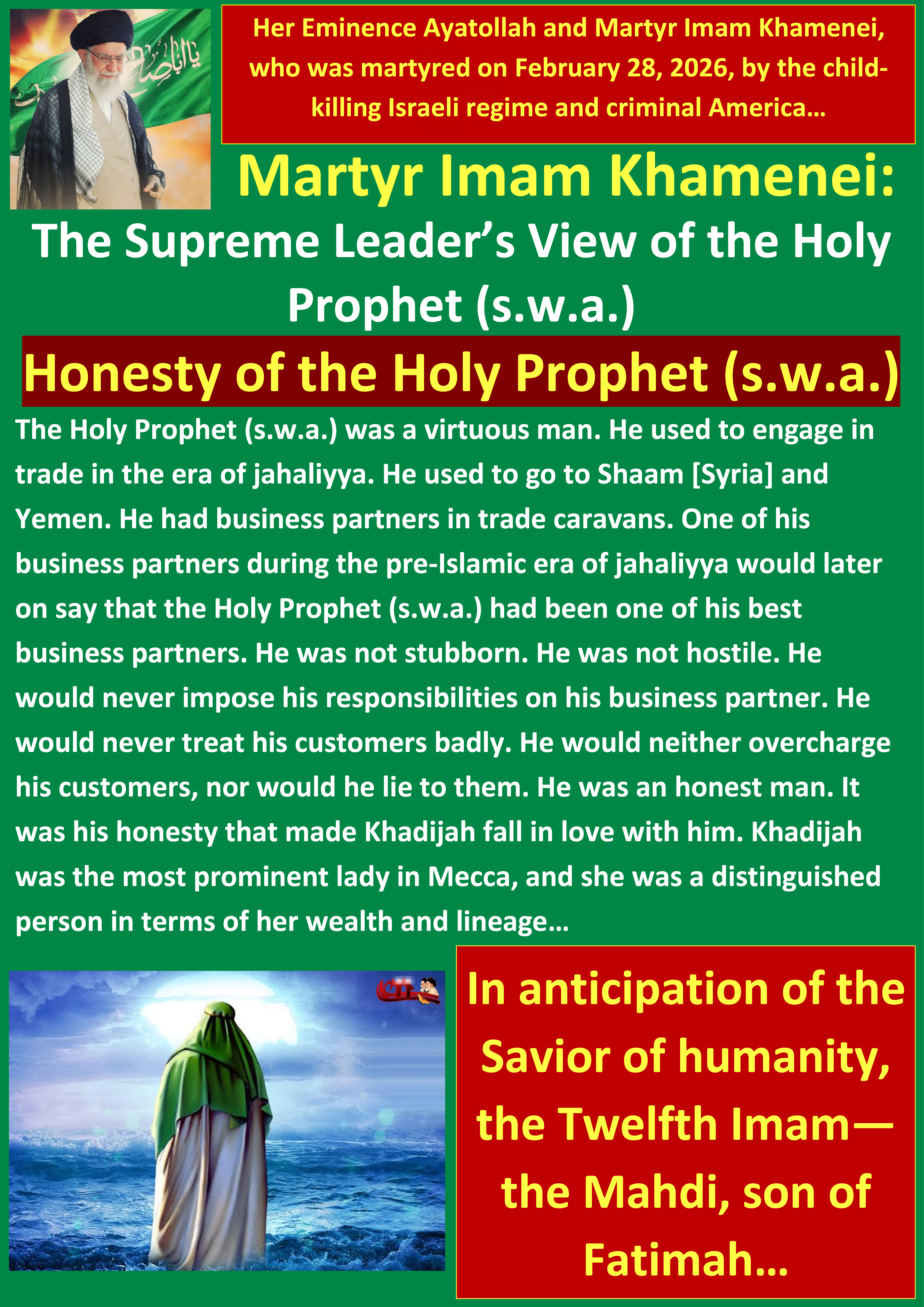
Honesty of the Holy Prophet (s.w.a.)
The Holy Prophet (s.w.a.) was a virtuous man. He used to engage in trade in the era of jahaliyya. He used to go to Shaam [Syria] and Yemen. He had business partners in trade caravans. One of his business partners during the pre-Islamic era of jahaliyya would later on say that the Holy Prophet (s.w.a.) had been one of his best business partners. He was not stubborn. He was not hostile. He would never impose his responsibilities on his business partner. He would never treat his customers badly. He would neither overcharge his customers, nor would he lie to them. He was an honest man. It was his honesty that made Khadijah fall in love with him. Khadijah was the most prominent lady in Mecca, and she was a distinguished person in terms of her wealth and lineage...

Martyr Imam Khamenei:
The Supreme Leader’s View of the Holy Prophet (s.w.a.)
Cleanliness of the Holy Prophet (s.w.a.)
The Holy Prophet (s.w.a.) was a neat person since his childhood. Unlike children
from Meccan and other Arab tribes, the Holy Prophet (s.w.a.) was hygienic and
neat. When he was a teenager, he used to comb his hair. During his youth he used
to comb his hair and his beard. After being appointed as Prophet, when he was an
old man around the age of 50 to 60, the Holy Prophet (s.w.a.) was still
completely committed to personal hygiene. His hair, which was long enough to
reach his earlobes, was always clean. His beautiful beard was always clean and
perfumed. I read in a narration that he had a bowl of water in his house which
he used to use as a mirror because mirrors were not very common at that time.
Whenever he wanted to call on his friends and other Muslims, he used to clean
his turban and his beard. He always used to wear perfume. In spite of the fact
that he had a very simple lifestyle, he used to pack up perfume and a comb
whenever he wanted to go on a trip. He used to pack up kohl because at that time
it was usual for men to use kohl around their eyes. He used to brush his teeth
several times a day. He used to advise other Muslims to observe hygiene, brush
their teeth and take care of their appearance in a similar way. His clothes were
old and patched up, but they were always clean, as was his body. These things
play a very important role as far as one’s social interactions, appearance and
hygiene are concerned. These things – which may seem to be insignificant – are
very important in reality…

Martyr Imam Khamenei:
The Supreme Leader’s View of the Holy Prophet (s.w.a.)
The Holy Prophet’s (s.w.a.) attitude towards other people
The Holy Prophet (s.w.a.) used to behave well towards other people. He was always cheerful when he was with other people. He used to reveal his sorrows when he was alone. He did not show his sorrows when he was with other people. He was always cheerful when he was among other people. He used to greet everybody. Whenever somebody upset him, his sadness would become clear on his face, but he would never start complaining. He would not allow anybody to curse or slander other people. He would never curse anybody, and he would never slander a person. He was kind to children and women. He behaved extremely well towards weak people of his society. He used to joke with his companions, and he used to race horses with them…
Martyr Imam Khamenei:
The Supreme Leader’s View of the Holy Prophet (s.w.a.)
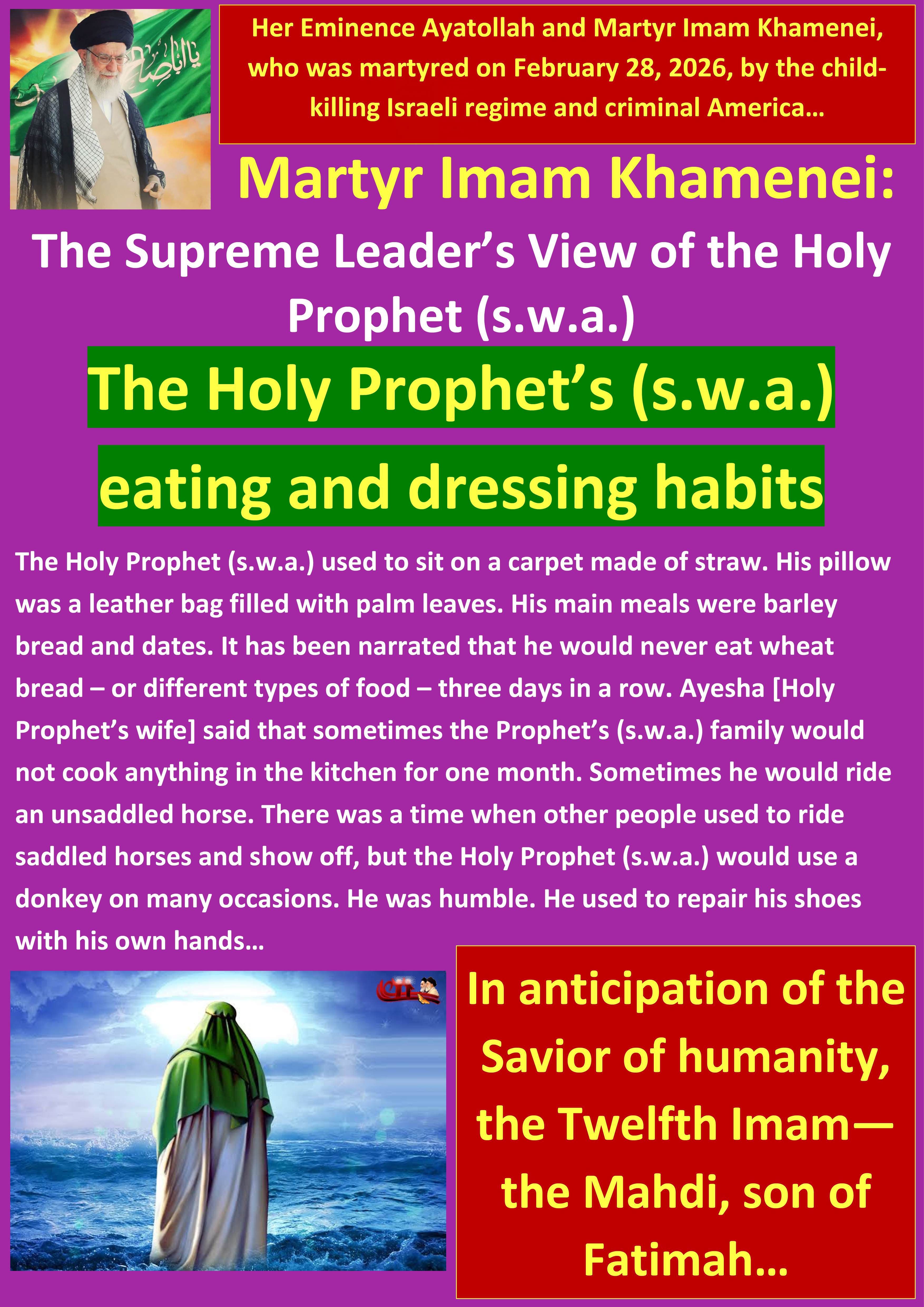
The Holy Prophet’s (s.w.a.) eating and dressing habits
The Holy Prophet (s.w.a.) used to sit on a carpet made of
straw. His pillow was a leather bag filled with palm leaves. His main meals were
barley bread and dates. It has been narrated that he would never eat wheat bread
– or different types of food – three days in a row. Ayesha [Holy Prophet’s wife]
said that sometimes the Prophet’s (s.w.a.) family would not cook anything in the
kitchen for one month. Sometimes he would ride an unsaddled horse. There was a
time when other people used to ride saddled horses and show off, but the Holy
Prophet (s.w.a.) would use a donkey on many occasions. He was humble. He used to
repair his shoes with his own hands…
Martyr Imam Khamenei:
The Supreme Leader’s View of the Holy Prophet (s.w.a.)
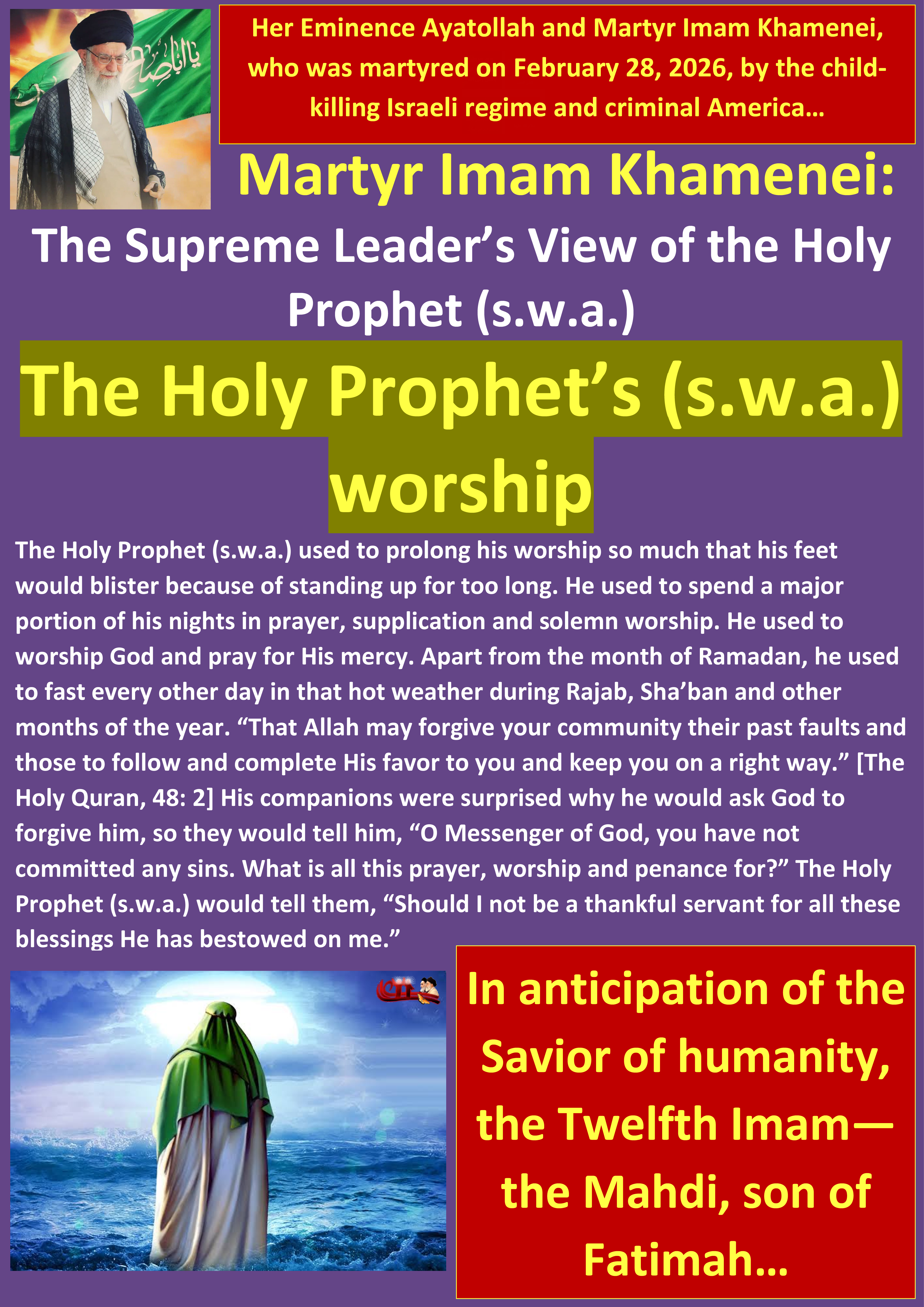
The Holy Prophet’s (s.w.a.) worship
The Holy Prophet (s.w.a.) used to prolong his worship so much that his feet would blister because of standing up for too long. He used to spend a major portion of his nights in prayer, supplication and solemn worship. He used to worship God and pray for His mercy. Apart from the month of Ramadan, he used to fast every other day in that hot weather during Rajab, Sha’ban and other months of the year. “That Allah may forgive your community their past faults and those to follow and complete His favor to you and keep you on a right way.” [The Holy Quran, 48: 2] His companions were surprised why he would ask God to forgive him, so they would tell him, “O Messenger of God, you have not committed any sins. What is all this prayer, worship and penance for?” The Holy Prophet (s.w.a.) would tell them, “Should I not be a thankful servant for all these blessings He has bestowed on me.”

Martyr Imam Khamenei:
The Supreme Leader’s View of the Holy Prophet (s.w.a.)
The Holy Prophet’s (s.w.a.) government
The Holy Prophet (s.w.a.) was just and wise. If somebody studies the time the
Prophet (s.w.a.) entered Medina – about the tribal conflicts, the attempts to
attract the enemies from Mecca out into the desert, the repeated blows, the
fight against the warring enemies – he will notice such wise, firm and
comprehensive strategies that he will be astonished. The Holy Prophet (s.w.a.)
was the person who enforced the laws, and he would not let anybody violate the
laws. He himself was subject to the same laws, and Quranic verses clearly show
this point. The Holy Prophet (s.w.a.) used to act according to the laws that
other people had to observe, and he would not allow any violations of the laws.
He would always keep his promise, and this was another characteristic of the
Holy Prophet (s.w.a.) as the leader of his society. He never broke a promise.
Quraysh broke their promise, but the Holy Prophet (s.w.a.) did not. The Jews
broke their promise, but he did not.
He was also secretive. When he led his army towards Mecca, nobody found out
where the Holy Prophet (s.w.a.) was going. He mobilized the entire army and
ordered them to follow him. They asked him where they were going, and he told
them that everything would become clear later on. Nobody realized that he was
moving towards Mecca. Quraysh did not know that the Holy Prophet (s.w.a.) was
moving towards Mecca until he got close to the city.
When he was among a group of people, it was not clear that he was the Prophet of
Islam and the leader of those people. He had excellent skill for managing social
and military affairs, and he used to directly supervise everything. Of course it
was a small society: it was just Medina and the surrounding areas. Later on
Mecca and a couple of other communities were added this small society. He was
serious about anything related to the people, and he acted with discipline. He
managed to promote management and accountability in that primitive society.

Martyr Imam Khamenei:
The Supreme Leader’s View of the Holy Prophet (s.w.a.)
The attitude of the Holy Prophet (s.w.a.) towards the enemies
of Islam
Not all enemies were the same to the Holy Prophet (s.w.a.). This is one of the
important points about the life of the Holy Prophet (s.w.a.). Some enemies were
extremely hostile, but if the Holy Prophet (s.w.a.) believed that they were
unlikely to pose any serious threats, he would not take it hard on them. There
were certain other enemies – such as Abdullah ibn Ubayy – who were dangerous,
and the Holy Prophet (s.w.a.) used to watch them closely. Abdullah ibn Ubayy was
a real hypocrite who would sometimes design plots against the Holy Prophet
(s.w.a.). But the Holy Prophet (s.w.a.) did not do anything to harm him. He only
kept him under surveillance. Abdullah ibn Ubayy was alive until the end of the
Holy Prophet’s (s.w.a.) life, and he died shortly after the Prophet (s.w.a.)
passed away. The important point is that the Holy Prophet (s.w.a.) tolerated
him. People like Abdullah ibn Ubayy were enemies who did not pose a serious
threat to the early Islamic government and the Muslim community. However, the
Holy Prophet (s.w.a.) was very strict with the enemies who posed a serious
danger to the Islamic society. The Holy Prophet (s.w.a.) who was so kind and
forgiving ordered his men to kill hundreds of traitors from the Bani Qurayza
tribe and to force out Bani Nazir and Bani Qaynuqa. The Holy Prophet (s.w.a.)
also captured the Khaybar citadel. This was because these enemies were
dangerous. When the Holy Prophet (s.w.a.) captured Mecca, he treated them
kindly, but they responded with treachery. They stabbed the Muslims in the back.
They designed plots and threatened the Muslims. The Holy Prophet (s.w.a.)
tolerated Abdullah ibn Ubayy. He tolerated the Jewish people in Medina. He
tolerated the members of Quraysh who had taken refuge in Medina or were
harmless. When he captured Mecca, he was kind to people like Abu Sufyan and
other prominent figures of Quraysh because they did not pose any dangers. But he
used to vigorously suppress dangerous and untrustworthy enemies.
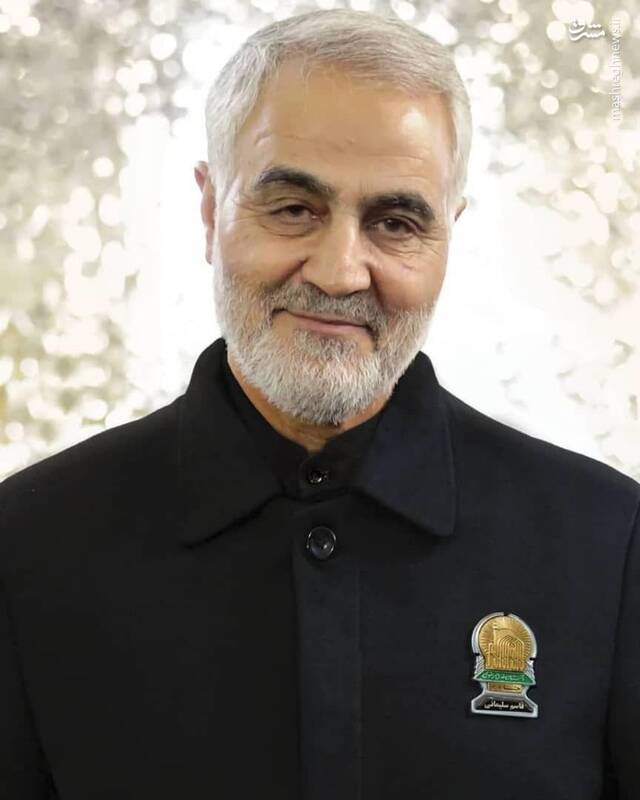
Martyr Hajj Qasem Soleimani, who was martyred at the hands of the criminal United States...
Note: All content is free to use
Sources:
Please click on the links below or any of the images above to view the
full text of Imam Khamenei's statements and access more...
https://farsi.khamenei.ir/speech-content?id=101447#top
Links:
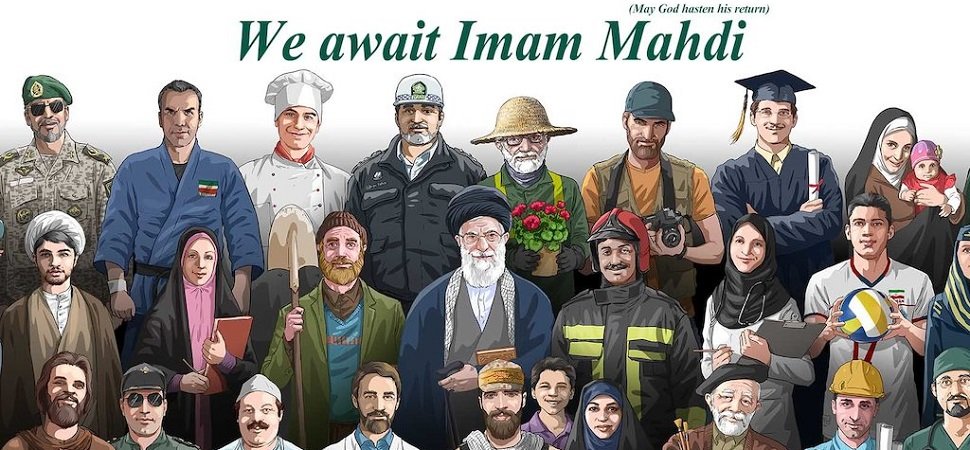


https://english.khamenei.ir/Opinions/Imam_mahdi
Imam Hussain’s Revolution for Humanity
https://english.khamenei.ir/Opinions/AshuraUprising
Who is Imam Hussain? Why did he launch an uprising?

Note: All content is free to use
Imam Ali's(as) great sacrifice to save the life of Prophet Muhammad(pbuh): Imam Khamenei elaborates ...
In the Name of Allah, the Merciful, the Most Merciful
Sura 21: AL-ANBIYA (THE PROPHETS) - Juz' 17 - Translation Qarib
**************
Note: All content is free to use
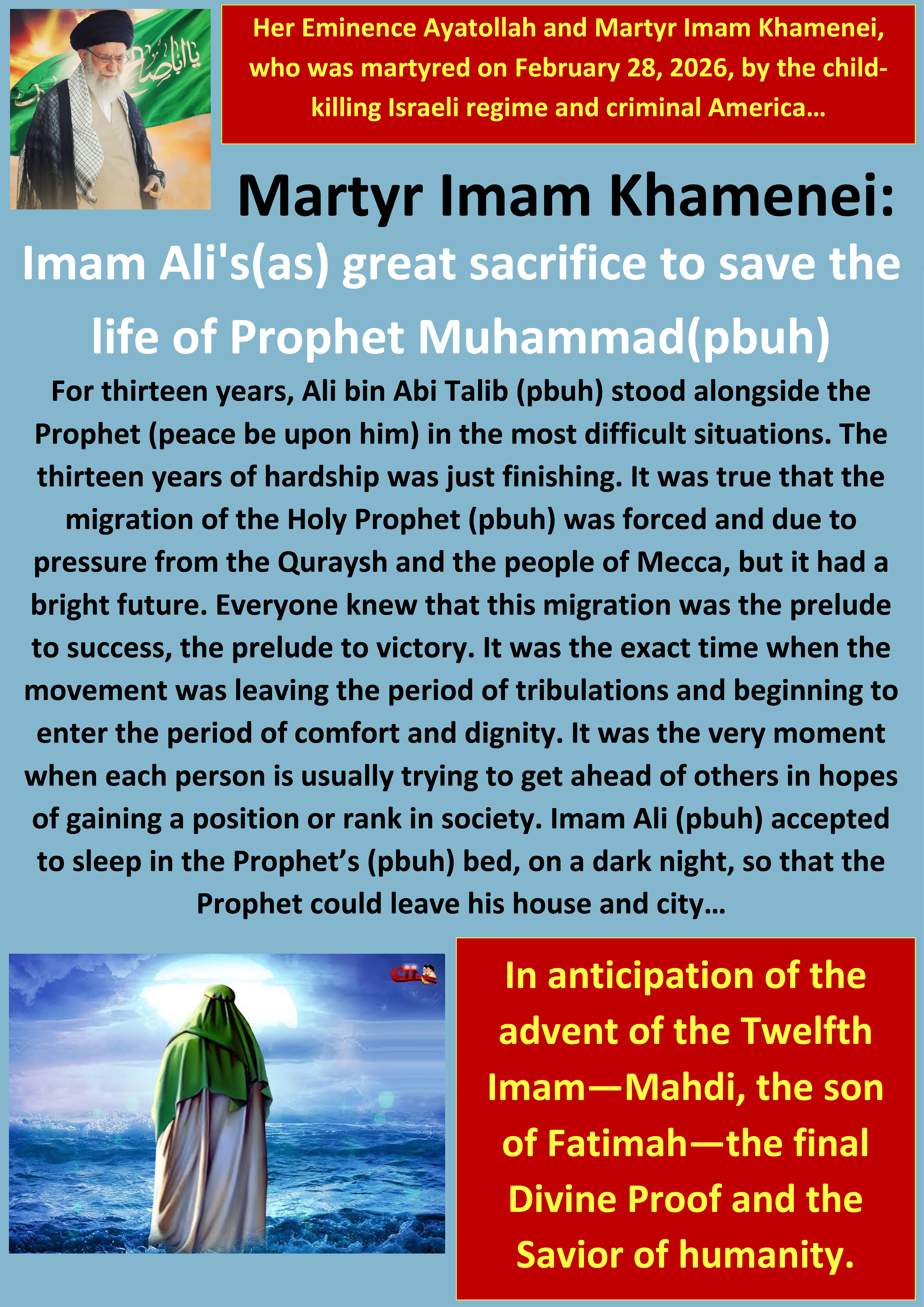
Her Eminence Ayatollah and Martyr Imam Khamenei, who was martyred on February 28, 2026, by the child-killing Israeli regime and criminal America…
Martyr Imam Khamenei:
Imam Ali's(as) great sacrifice to save the life of Prophet Muhammad(pbuh): Imam Khamenei elaborates
For thirteen years, Ali bin Abi Talib (pbuh) stood alongside the Prophet (peace be upon him) in the most difficult situations. The thirteen years of hardship was just finishing. It was true that the migration of the Holy Prophet (pbuh) was forced and due to pressure from the Quraysh and the people of Mecca, but it had a bright future. Everyone knew that this migration was the prelude to success, the prelude to victory. It was the exact time when the movement was leaving the period of tribulations and beginning to enter the period of comfort and dignity. It was the very moment when each person is usually trying to get ahead of others in hopes of gaining a position or rank in society. Imam Ali (pbuh) accepted to sleep in the Prophet’s (pbuh) bed, on a dark night, so that the Prophet could leave his house and city.
That night, the death of the person who was sleeping in that bed was almost certain and definite. We cannot say that everyone knew the end of the story at that time because you and I know the story now, and we know that Amir al-Mu'minin (pbuh) was not martyred in that incident. No. The matter is that on a dark night and at a certain place there was a plan to kill someone, it was certain. They said that in order for the Prophet (pbuh) to get out from that place someone had to sleep in his place, so that when the spies looked at him they would think that someone was there. Who was ready to do this? This sacrifice of Imam Ali (pbuh) in itself is an extremely important event, but the timing of it also adds to its significance. When did this happen? It happened when the period of tribulations was supposed to be coming to an end. They were supposed to be going to form a government and start a more comfortable life. The people of Medina - Yathrib - had become believers, and were waiting for the Prophet, everyone knew this. At that moment, this sacrifice was made by Imam Ali (pbuh). The person who took such an important measure certainly had no personal motivations.
Imam Khamenei, April 28, 1989
In anticipation of the advent of the Twelfth Imam—Mahdi, the son of Fatimah—the final Divine Proof and the Savior of humanity.
Note: All content is free to use
Sources:
Please click on the links below or any of the images above to view the
full text of Imam Khamenei's statements and access more...
Links:
https://english.khamenei.ir/Opinions/Imam_mahdi
Imam Hussain’s Revolution for Humanity
https://english.khamenei.ir/Opinions/AshuraUprising
Who is Imam Hussain? Why did he launch an uprising?
Note: All content is free to use
Lady Fatimah Zahra's (pbuh) behavior in society is a model ...
In the Name of Allah, the Merciful, the Most Merciful
Sura 21: AL-ANBIYA (THE PROPHETS) - Juz' 17 - Translation Qarib
**************
Note: All content is free to use
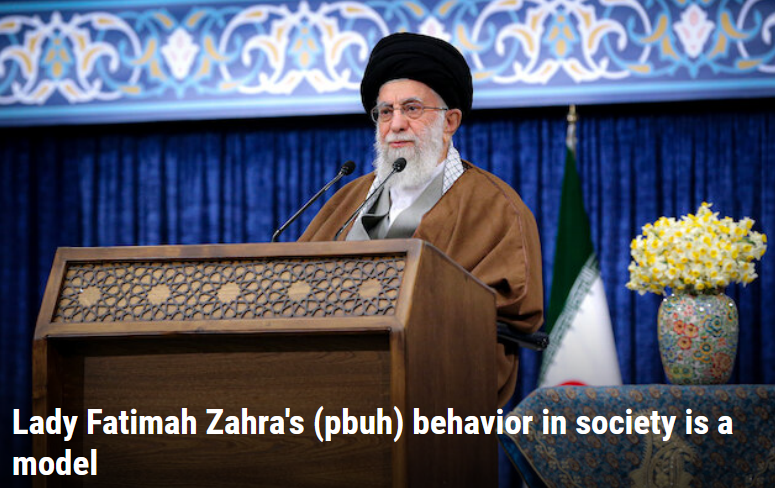
Lady Fatimah Zahra's (pbuh) behavior in society is a model
Well, the things that are well-known about this honorable
personage in the field of cultural affairs includes the issue of hijab, the
issue of standing up to falsehood in order to prove the truth, and supporting
the issue of Wilaya. These are things that can be seen and which were repeated
too. Another part of Lady Fatimah’s (pbuh) teachings was the issue of helping
others. I would like to say a few words about this social solidarity today and
about helping others. When her son asked, “Mother, why did you only pray for
others?” her answer was, “First the neighbor, then ourselves.” This is a lesson.
It reminds us of our social responsibility. Another example is that of helping
the poor, orphans, and captives as referred to in Surah Insan. The Almighty God
refers to this event as something magnificent, and 17 or 18 verses are dedicated
to it. This shows the significance of this event. “They give food, for the love
of Him, to the needy, the orphan and the prisoner, [saying,] ‘We feed you only
for the sake of Allah’” (Quran 76:8-9). It is a symbolic event. Yes, these
honorable individuals and all the members of their family endured hunger. They
helped the orphan, the poor, and the captive. This actually happened, but it is
also symbolic. Lady Fatimah (pbuh) could have asked them to go to the Mosque
instead. There was an Islamic government after all. However, the government’s
duty does not remove society’s duty. People in a society are required to truly
help one another. Various types of assistance should be offered in society,
including financial assistance, help in thinking, protecting the honor of
others, etc. This is a lesson from Lady Fatimah Zahra's teachings and her
understanding.”
Ayatollah Khamenei
Feb. 15, 2020
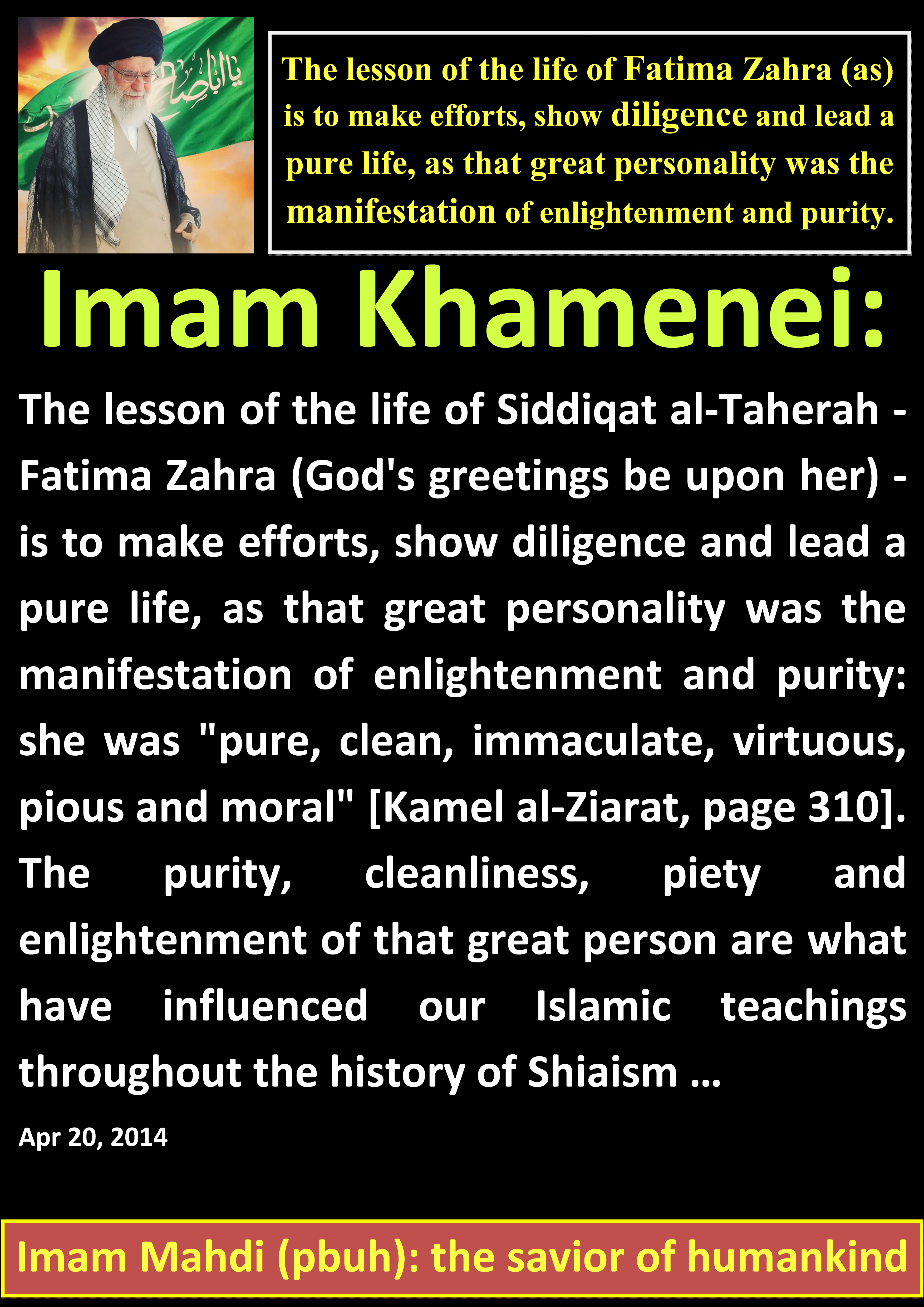
Imam Khamenei:
The lesson of the life of Siddiqat al-Taherah - Fatima Zahra (God's greetings be
upon her) - is to make efforts, show diligence and lead a pure life, as that
great personality was the manifestation of enlightenment and purity: she was
"pure, clean, immaculate, virtuous, pious and moral" [Kamel al-Ziarat, page
310]. The purity, cleanliness, piety and enlightenment of that great person are
what have influenced our Islamic teachings throughout the history of Shiaism …
Apr 20, 2014
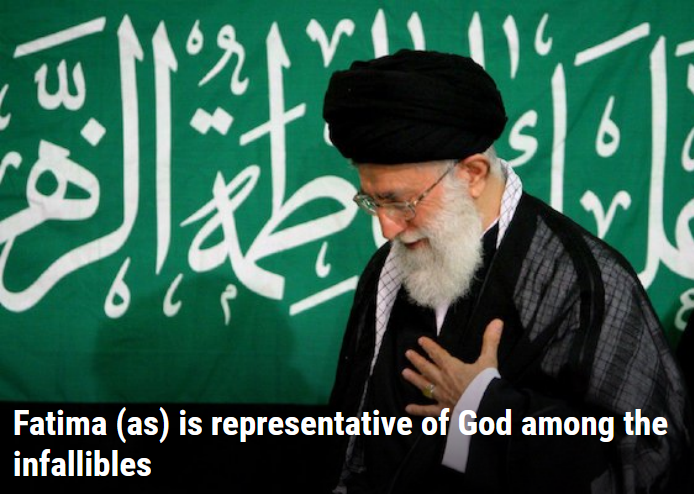
Fatima (as) is representative of God among the infallibles
Imam Khamenei:
This is based on a hadith which has been narrated by these Imams (a.s.). Fatima
Zahra (s.a.) is the representative of other divine representatives. She is the
Imam of Imams (a.s.).
In the Holy Quran, Allah the Exalted has mentioned how much women should be
respected. To Allah the Exalted, women are like men. There is no difference
between men and women in terms of spiritual and divine position. This path has
been created for human beings, not only for men or for women. Allah the Exalted
has created a woman like Fatima Zahra (s.a.) about whom Imam Askari (a.s.) or
Imam Hadi (a.s.) say, "We are the representatives of Allah among the people and
Fatima is representative of Allah among us." [Atayeb al-Bayan, volume 13, page
236]. This is based on a hadith which has been narrated by these Imams (a.s.).
Fatima Zahra (s.a.) is the representative of other divine representatives. She
is the Imam of Imams (a.s.).
Is there a greater personality? She was infallible. And such a person was a
woman. Great women such as Mary, Sara, Asiya and many other great women are the
outstanding personalities of the world. In the path of perfection and
transcendence, it is human beings which move forward. There is no difference
between men and women in terms of social rights. There is no difference between
men and women in terms of individual rights. Of course, in specific cases, women
have been given certain privileges and in a number of other cases, men have been
given certain privileges. This is based on the nature of men and women. This is
Islam. It has the most reasonable, the most dignified and the most practical
laws that one can ever imagine regarding the issue of gender. We should follow
this path. One of the major ways to do this is to raise a family, safeguard the
family environment and preserve love in the family. And this is the
responsibility of the lady of the house. May 1, 2013
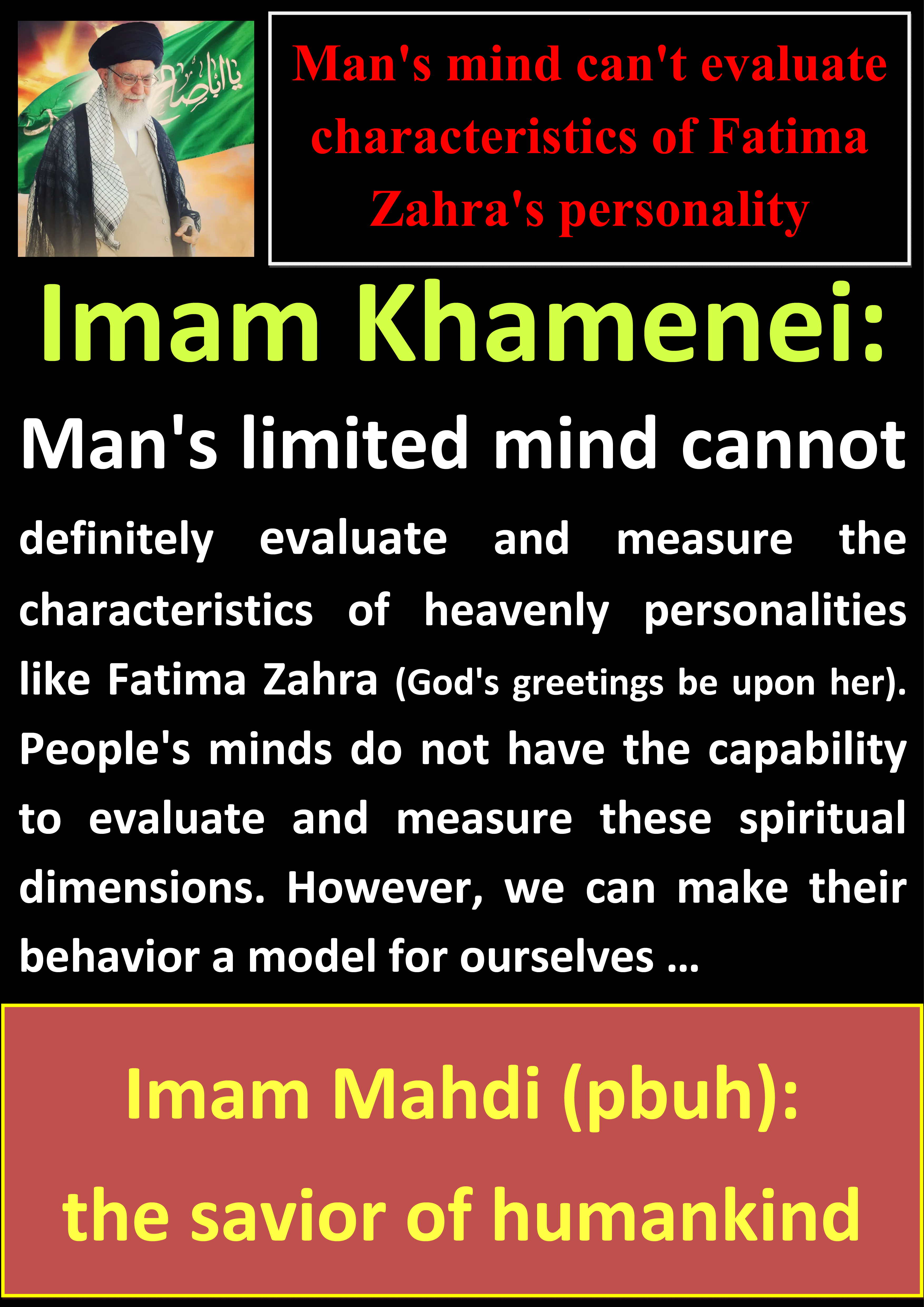
Imam Khamenei:
Man's limited mind cannot definitely evaluate and measure the characteristics of
heavenly personalities like Fatima Zahra (God's greetings be upon her). People's
minds do not have the capability to evaluate and measure these spiritual
dimensions. However, we can make their behavior a model for ourselves
We should make efforts. The lesson of the life of Siddiqat al-Taherah - Fatima
Zahra (God's greetings be upon her) - is to make efforts, show diligence and
lead a pure life, as that great personality was the manifestation of
enlightenment and purity: she was "pure, clean, immaculate, virtuous, pious and
moral" [Kamel al-Ziarat, page 310]. The purity, cleanliness, piety and
enlightenment of that great person are what have influenced our Islamic
teachings throughout the history of Shiaism.
Man's limited mind cannot definitely evaluate and measure the characteristics of
heavenly personalities like Fatima Zahra (God's greetings be upon her). People's
minds do not have the capability to evaluate and measure these spiritual
dimensions. However, we can make their behavior a model for ourselves. This was
also pointed out in the poems that the friends in this meeting recited.
The spiritual positions of these personalities are one thing and the patterns of
behavior which are in front of our eyes are quite another. This does not mean
that we can emulate these personalities by displaying a second version of their
patterns of behavior. This is not what it means. However, we can follow them at
least.
The Commander of the Faithful (a.s.) said, "I know that to adopt such a hard way
of life is beyond you, but at least try to be pious. Help me and be my companion
in virtue, diligence and simple living" [Nahjul Balaghah, Letter 45]. After he
describes his lifestyle - although he had a lofty position and had access to
many resources, he lived a life of piety and abstinence - he says, "You cannot
behave like me, but you can help me". With what? We can help him with piety,
avoidance of sins, effort and diligence. These are our responsibilities.
They have illustrated the goals for us, both individual and personal goals, and
social, political and general goals. In personal goals, our lofty ideal is
reaching the peak of human dignity. Everyone has been promised that they can
take this lofty and limitless flight. You youth are more capable than us. These
are the personal goals.
And our great social goals are creating a pure Islamic life and Islamic society,
one that allows individuals to move towards this goal. Such a society is
well-developed, free, independent, highly moral, united, unanimous, pious and
religious. These are the goals of Islamic society. The main social and political
goal of Islam is creating a world which is an introduction to the afterlife and
which helps individuals to achieve paradise easily. They have illustrated these
goals for us.
What is the way to achieve these goals? How can we reach these goals? As Imam
Ali (a.s.) said, we should help him to reach this goal - this is the Commander
of the Faithful's (a.s.) command. This goal is what the Commander of the
Faithful (a.s.) did in his entire life and during his efforts and jihad, which
is creating such a world for all the people throughout history. How can we help
him? We can help him with virtue, diligence and effort. Laziness is forbidden.
Idleness is forbidden. Feeling tired is forbidden. Becoming desperate is
forbidden. When this great movement is launched, you have gladdened the blessed
heart of Fatima Zahra (God's greetings be upon her) and the Commander of the
Faithful (a.s.) because they made all these efforts in order to reach this goal.
Apr 20, 2014
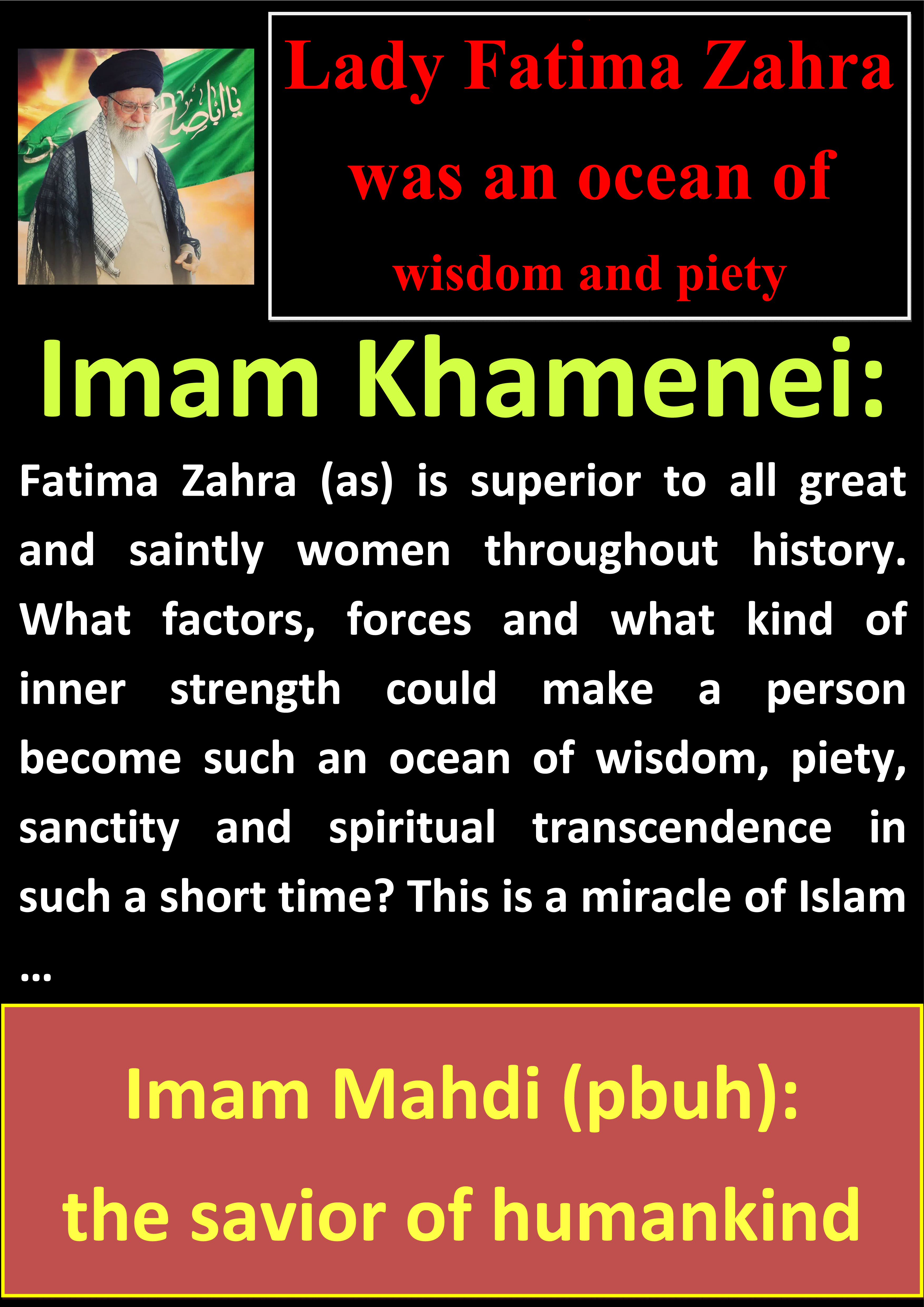
Imam Khamenei:
Fatima Zahra (as) is superior to all great and saintly women
throughout history. What factors, forces and what kind of inner strength could
make a person become such an ocean of wisdom, piety, sanctity and spiritual
transcendence in such a short time? This is a miracle of Islam.
The love of Fatima Zahra (s.a.), also known as Siddiqat al-Kubra, is a great
blessing for us
In her short life, Fatima Zahra (s.a.) achieved the position of the mistress of
all women. In other words, she is superior to all great and saintly women
throughout history. What factors, forces and what kind of inner strength could
make a person become such an ocean of wisdom, piety, sanctity and spiritual
transcendence in such a short time? This is a miracle of Islam.
Another point is the blessed descendants of this great person. The association
of Sura al-Kauther with Fatima Zahra (s.a.) - even if such an association had
not existed in our hadith collections - is an accurate association. There are so
many blessings that have been bestowed on the Holy Prophet's (s.w.a.) household
and on each and every one of the Imams (a.s.). The world is full of enjoyable
individual, social, worldly and otherworldly melodies which came out of the pure
throats of the Imams (a.s.). Hussein ibn Ali (a.s.), Zeinab al-Kubra (s.a.),
Imam Hassan al-Mojtaba (a.s.), Imam Sadiq (a.s.), Imam Sajjad (a.s.) and each
and every one of the Imams (a.s.) would produce these melodies. See what a great
excitement exists in the world of spirituality and in the path of guidance
because of the words of these great personalities and their lessons and
teachings. They are the children of Fatima Zahra (s.a.).
We should sincerely thank God. A number of the poems, which were recited by the
friends, contained this point. The love of Fatima Zahra (s.a.), also known as
Siddiqat al-Kubra, is a great blessing for us. Thank God we became familiar with
her. Thank God we relied on her kindness and thank God we appreciated her value.
Thank God we relied on her, asked her to help us gain an understanding of things
and expressed our love for her. These are great blessings. We should preserve
these blessings.
Leader's Speech to Panegyrists on Fatima Zahra's (s.a.) Birthday; July 5, 2007.
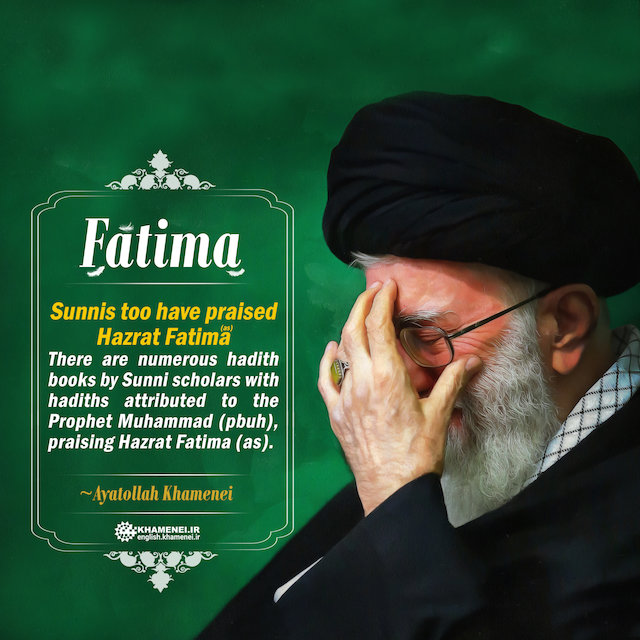
Imam Khamenei:
If you investigate the books written by Sunni scholars on
Hazrat Fatima (as), you will see numerous hadiths attributed to the Prophet
Muhammad (pbuh), praising Hazrat Fatima (as); or describing the behavior of the
Prophet (pbuh) towards her highness (as). Many of these hadiths were narrated by
those who were close to the Prophet (pbuh), like his wives.
About Hazrat Fatima (as), whenever we speak of her, words cannot describe her;
indeed, we do not know how to express that and what to think [in regard to
Fatima (as)].
The scope of this angelic woman's behavioral dimensions, this unique soul, this
quintessence of Prophethood and Wilaya is so vast and extensive that it is
beyond our understanding: this astonishes us completely.
As you know, living in the same era is a factor that prevents accurate
acknowledgement of great personalities. Shining stars among human societies,
while living, went mostly unrecognized by others who lived during their time,
except for a few of the prominent persons among prophets and pious
individuals--only known to a small number of the people.
However, Hazrat Fatima (as) was such a well-known personality
that, at her time, not only her father, husband, children (pbut) and her special
followers were aware of her high position, but even those who didn’t have a
close relationship with her admired her.
If you investigate the books written by Sunni scholars on Hazrat Fatima (as),
you will see numerous hadiths attributed to the Prophet Muhammad (pbuh),
praising Hazrat Fatima (as); or describing the behavior of the Prophet (pbuh)
towards her highness (as). Many of these hadiths were narrated by those who were
close to the Prophet (pbuh), like his wives.
For instance, there is a famous hadith from Aisha which reads: “I didn’t see a
person more similar to the Prophet (pbuh) than Fatima (as) who looked like him
in appearance, face, brightness, behavior and manners. When Fatima (as) came to
see the Prophet (pbuh), he got to his feet and advanced toward her
enthusiastically.”
The Arabic expression used in this hadith implies this meaning: "When Hazrat
Fatima (as) entered the room, the Prophet did not only stand up [as a sign of
respect], he stood and walked towards her." In some hadiths from the same
narrator [Aisha] we read: “He kissed Hazrat Fatima (as), took her hand, and
invited her to sit in his place.” This reveals the high status of Hazrat Fatima
(as).
What more can be said about this lady? What can be said about this magnificent
person?
November 24, 1994
Statements in a meeting with a group of panegyrists
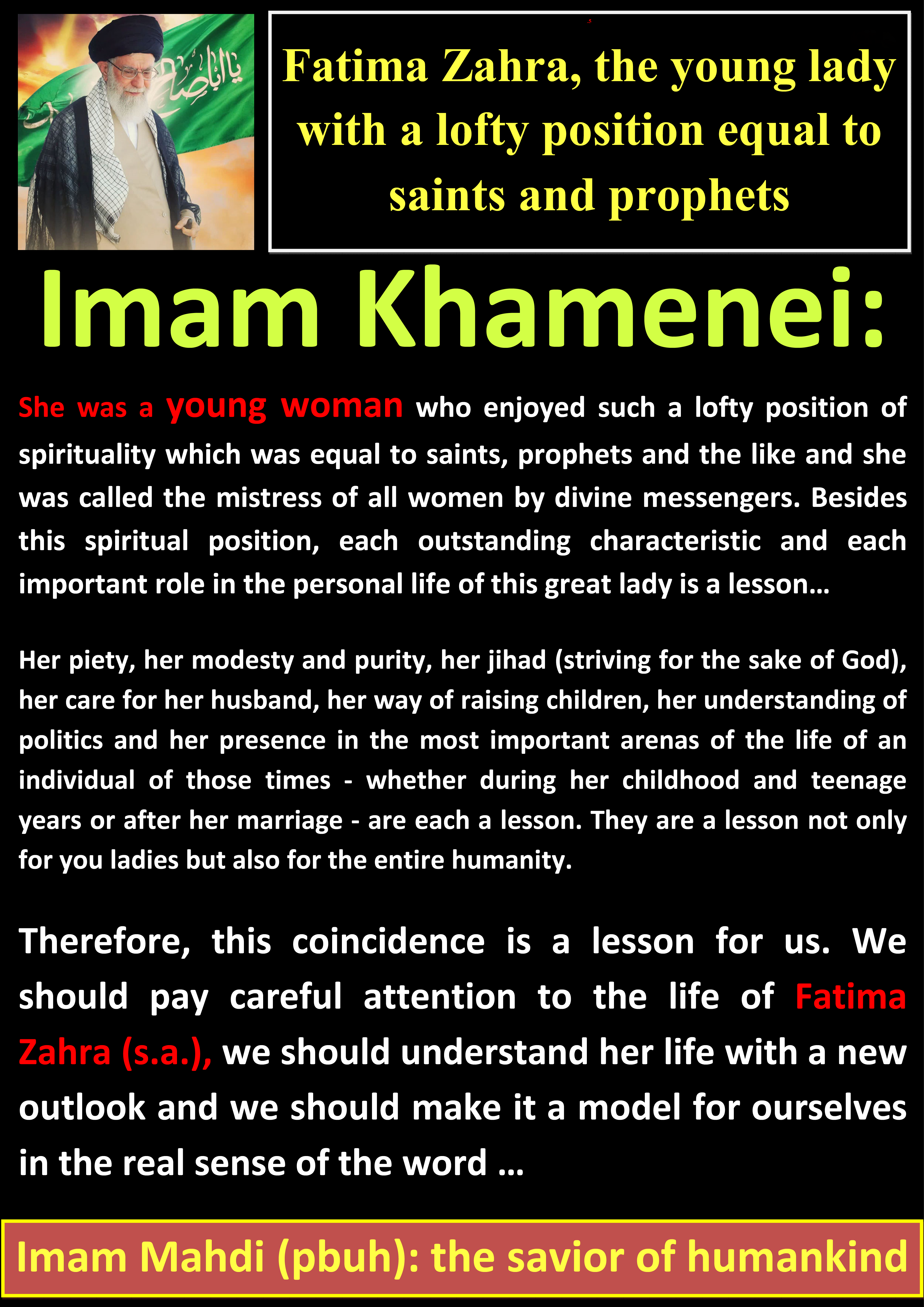
Imam Khamenei:
She was a young woman who enjoyed such a lofty position of
spirituality which was equal to saints, prophets and the like and she was called
the mistress of all women by divine messengers. Besides this spiritual position,
each outstanding characteristic and each important role in the personal life of
this great lady is a lesson.
The spiritual positions of Fatima Zahra (God's greetings be upon her) are among
the best spiritual positions which belong only to a few individuals. She was
infallible. Infallibility is particular to a few individuals who are chosen by
God and that great Hazrat - Fatima Zahra (God's greetings be upon her) - is one
of these few individuals. We should consider the fact that that Muslim woman and
that mujahide in the way of God lived only to the age of 20. Of course,
different narrations say that her age was from 18 to 25 years at the time of her
martyrdom.
She was a young woman who enjoyed such a lofty position of spirituality which
was equal to saints, prophets and the like and she was called the mistress of
all women by divine messengers. Besides this spiritual position, each
outstanding characteristic and each important role in the personal life of this
great lady is a lesson.
Her piety, her modesty and purity, her jihad (striving for the sake of God), her
care for her husband, her way of raising children, her understanding of politics
and her presence in the most important arenas of the life of an individual of
those times - whether during her childhood and teenage years or after her
marriage - are each a lesson. They are a lesson not only for you ladies but also
for the entire humanity.
Therefore, this coincidence is a lesson for us. We should pay careful attention
to the life of Fatima Zahra (s.a.), we should understand her life with a new
outlook and we should make it a model for ourselves in the real sense of the
word.
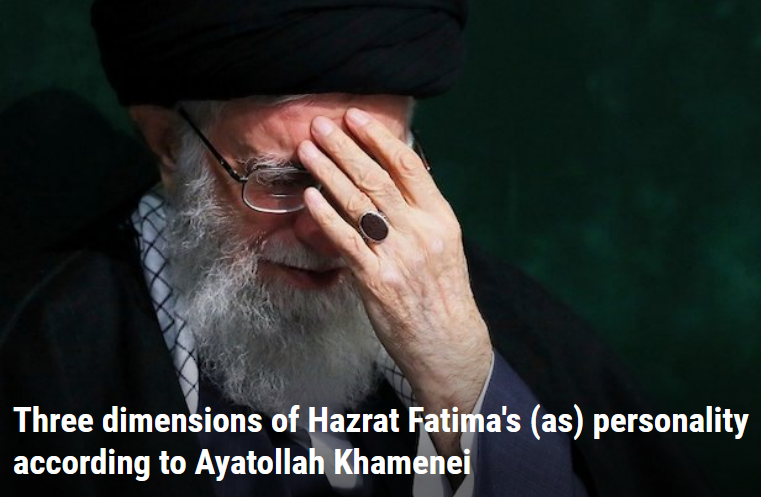
Three dimensions of Hazrat Fatima's (as) personality according to Ayatollah Khamenei
Presently, these days belong to the most superior woman who
walked on the earth, the greatest lady throughout history: Lady Fatima (as). She
was an exemplary woman, who, although lived a short life and departed earth as a
young lady, is a role model for all zealous, devout Muslim men and women, and
even non-Muslim people who are familiar with her prestigious position.
We should follow Fatima's lead. During the life of Fatima (as), there is one
point that we should consider. Here, we will not question the degree of her
spiritual position and knowledge; we are not even capable of comprehending the
spiritual greatness of Fatima (as). In fact, at the top of human spirituality
and perfection, only God knows and understands the high level of such
individuals--and others at their level. Thus, Fatima (as) is only known to her
husband, her great father Mohammad (pbuh), and her pure children. The people of
her time, of other times, and we in this era are not able to recognize the
brilliance and splendour of her spirituality. The bright light of spirituality
is not detectable by everybody’s eyes; our short-sighted and weak eyes are
unable to see the luminosity of humanity in these great personalities.
Therefore, we do not discuss the definition of Fatima’s (as) spirituality.
However, in her ordinary life, there is an important point: on the one hand, as
a Muslim woman, she perfectly performs her duties at home and behaves nicely
towards her husband and children; on the other hand, as a zealous, tireless
person she acts for her causes. In political events, shortly after the death of
her father Prophet Muhammad (PBUH), she went to the mosque, gave a speech,
expressed her position and defended her cause. Hence, she represented a
marvellous, fighting personality that is tireless, enduring, and tolerant.
The third aspect of her life reveals her as a devotee of Allah, who performs
prayers in the dark of nights, uprises for Allah, and is humble before Allah;
and, in the worshipping chamber, this young lady worships and speaks to God like
the old pious people. Combining these three dimensions is the luminous point in
the life of Fatima (as). She did not separate the three dimensions.
Some people think that those who worship God are only concerned with prayers and
worship, and cannot be involved in politics. Or, some people think that
those--women and men--who are active in politics and the arena of jihad on the
path of Allah, if a woman, she cannot perform her duties at home as a mother and
a wife; and as a man, he cannot be a good businessman, husband or father.
They think these qualities are contradictory. Whereas, in the view of Islam,
these aspects not only reveal that there are no contradictions, but they are
also helpful towards achieving the perfect human personality.
Ayatollah Khamenei, December 13, 1989
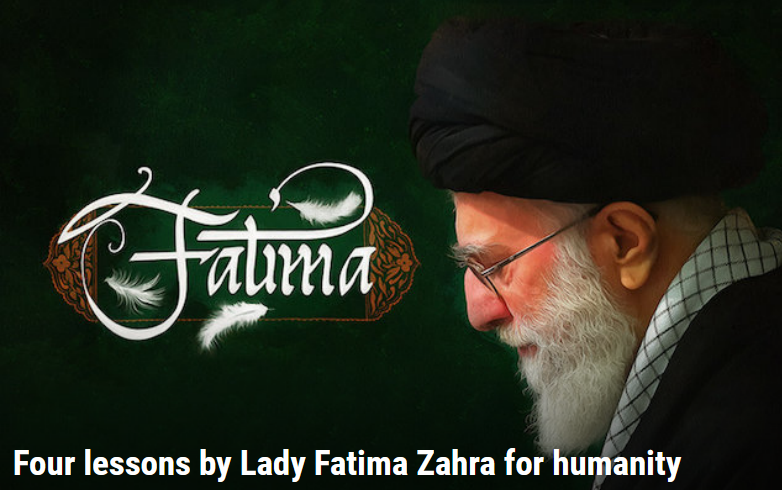
Four lessons by Lady Fatima Zahra for humanity
Imam Khamenei:
We should make greater efforts [towards emulating Fatima Zahra
(pbuh)]. Lessons to be learned from the life of Siddiqat al-Taherah, Fatima
Zahra (pbuh), involve making great efforts, showing diligence, and leading a
pure life;--just as that great personality, the manifestation of enlightenment
and purity, led her life: she was "pure, immaculate, virtuous, and pious,"
[Kamel al-Ziarat, page 310]. Traits of purity, piety and enlightenment of such
an exceptional person are what have influenced our Islamic teachings throughout
the history of Shi’a Islam.
Apr 20, 2014
That is to say, in her short life, Fatima Zahra (pbuh)
achieved the position as the primary woman of all females. In other words, she
is superior to all great and saintly women throughout history. What factors,
forces, and what kind of inner strength could lead one person to become such an
ocean of wisdom, piety, sanctity and spiritual transcendence in such a short
time? This is a miracle of Islam.
Another pivotal matter is in regards to the blessed descendants of this great
person [Lady Fatima Zahra (pbuh)]. The association of Sura al-Kauther with
Fatima Zahra (pbuh)--even if such an association had not existed in our
collection of hadith--is an accurate association. There are so many blessings
that have been bestowed upon the Holy Prophet's (pbuh) household and on each and
every one of the Imams (pbuh). The world is full of enjoyable individual,
social, worldly and otherworldly melodies, which rose from the pure lungs of the
Imams (pbuh). Hussain ibn Ali (pbuh), Zeinab al-Kubra (pbuh), Imam Hassan
al-Mojtaba (pbuh), Imam Sadiq (pbuh), Imam Sajjad (pbuh), each and every one of
the Imams (pbuh) would produce these melodies. See what great excitement exists
in the world of spirituality and on the path of guidance because of the words of
these great personalities and their lessons and teachings. They are the children
of Fatima Zahra (pbuh).
Jul 5, 2007
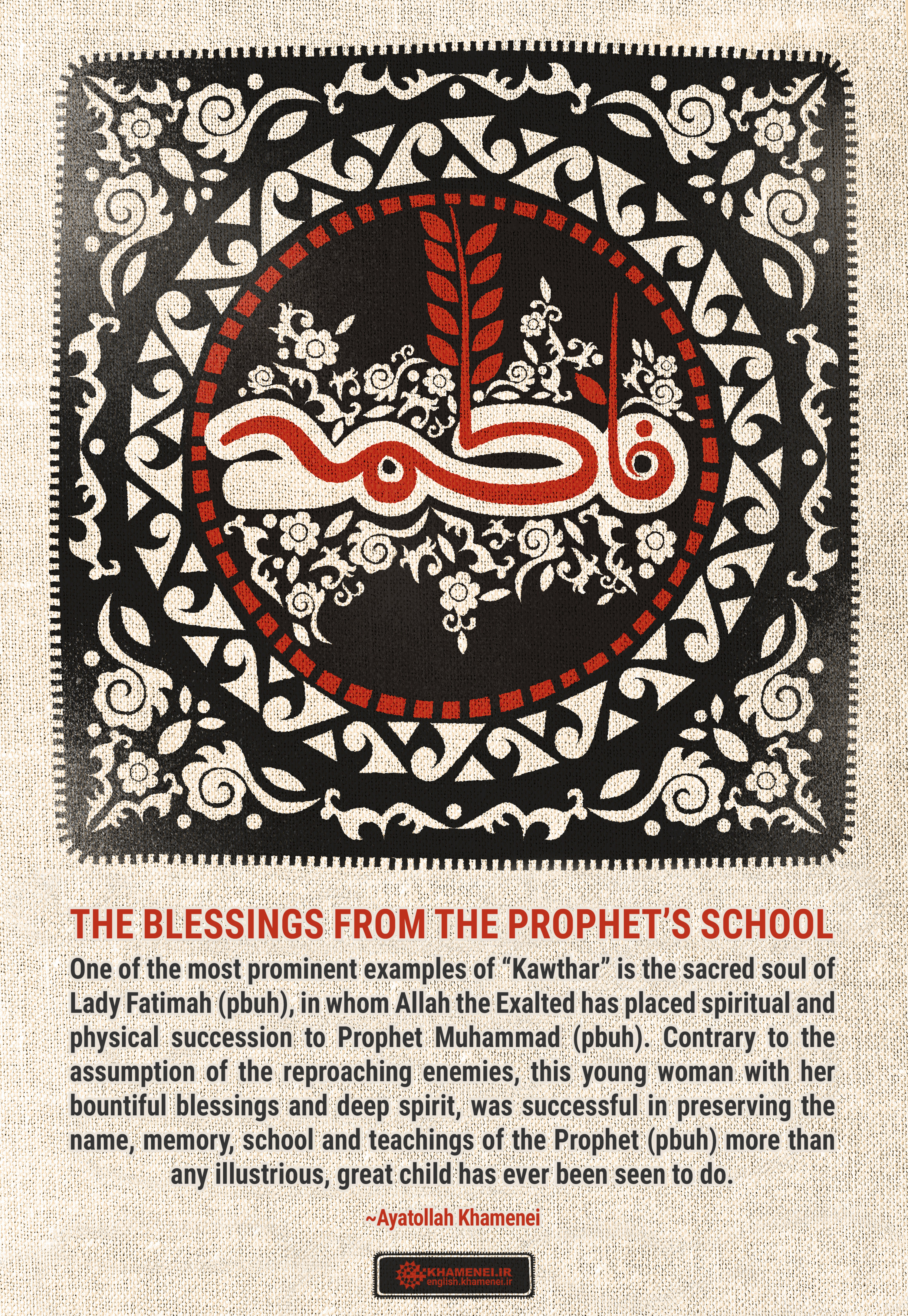
One of the most prominent examples of “Kawthar” is the sacred
soul of Lady Fatimah (pbuh), in whom Allah the Exalted has placed spiritual and
physical succession to Prophet Muhammad (pbuh). Contrary to the assumption of
the reproaching enemies, this young woman with her bountiful blessings and deep
spirit, was successful in preserving the name, memory, school and teachings of
the Prophet (pbuh) more than any illustrious, great child has ever been seen to
do.
Imam Khamenei, October 1, 1999

Sources:
Please click on the links below or any of the images above to view the
full text of Imam Khamenei's statements and access more...
https://english.khamenei.ir/news/9425/Lady-Fatimah-Zahra-s-pbuh-behavior-in-society-is-a-model
https://english.khamenei.ir/news/4626/Lady-Fatima-Zahra-was-the-manifestation-of-enlightenment-and
https://english.khamenei.ir/news/4629/Fatima-as-is-representative-of-God-among-the-infallibles
https://english.khamenei.ir/news/5485/Three-dimensions-of-Hazrat-Fatima-s-as-personality-according
https://english.khamenei.ir/news/5439/Four-lessons-by-Lady-Fatima-Zahra-for-humanity
https://english.khamenei.ir/news/7333/The-blessings-from-the-Prophet-s-school
Links:
https://english.khamenei.ir/Opinions/Imam_mahdi
Imam Hussain’s Revolution for Humanity
https://english.khamenei.ir/Opinions/AshuraUprising
Who is Imam Hussain? Why did he launch an uprising?
Note: All content is free to use
A nation founded on reason, faith, and patience does not fear the storm of propaganda ...
In the Name of Allah, the Merciful, the Most Merciful
Sura 21: AL-ANBIYA (THE PROPHETS) - Juz' 17 - Translation Qarib
**************
Note: All content is free to use

Serenity at the Summit of Power; Religious Rationality Amid the Media Storm
In an era where politics, religion, and media are intertwined, the presence of a
wise, courageous religious leader of a nation can itself be a powerful political
message one that acts more .deeply than a thousand words, without noise
The recent meeting of the wise Leader of the Islamic Revolution with scientific
elites and religious thinkers recalled the ancient bond between "the knowledge
of jurisprudence and prudent politics" a connection rooted in the thoughts of
scholars like Allameh Na'ini (may he rest in peace), which today has become a
tangible manifestation of religious and democratic governance .in the structure
of the Islamic Republic.
In this meeting, it was once again emphasized that religious rationality neither
tends toward passivity nor emotionalism. A system built upon faith and knowledge
advances its path with .stability, serenity, and wisdom even when the global
atmosphere is filled with psychological warfare and media destabilization.
Against the wave of distorted imagery and anxiety-inducing propaganda, the
continued programs, meetings, and direct dialogues of the wise and beloved
Leader of the Islamic Revolution :adored by monotheists worldwide are signs of
inner vitality and national self-confidence. Such a presence, free from slogans,
reveals a truth.
True power lies in serenity, and strength stems from rationality and faith not
from shouting and spectacle.
In this perspective, the memory of Allameh Na'ini revives a thought that sees
justice, legality, and public oversight as pillars of divine governance. He was,
in his time, a theorist of the link. between freedom and faith and today, the
continuation of that thought is reflected in the behavior and macro-management
of the country.
Iran's message to the world today is the same one that shines through the
silence and dignity of its leadership.
A nation founded on reason, faith, and patience does not fear the storm of
propaganda.
Serenity is the language of power. O Allah, protect and grant victory to our
Leader. The humble, S.M.R
ترجمه:

Resources:
To view the full text of Imam Khamenei's statements and access more information
Links:
https://english.khamenei.ir/Opinions/Imam_mahdi
Imam Hussain’s Revolution for Humanity
https://english.khamenei.ir/Opinions/AshuraUprising
Who is Imam Hussain? Why did he launch an uprising?
Note: All content is free to use
Everyone has acknowledged Imam al-Askari's (as) virtues, even his enemies ...
In the Name of Allah, the Merciful, the Most Merciful
Sura 21: AL-ANBIYA (THE PROPHETS) - Juz' 17 - Translation Qarib
**************
Note: All content is free to use

Imam Hassan Askari (pbuh) considered his followers to be his close family
Imam Khamenei:
Imam Hassan Askari (pbuh) considers his followers to be his close family, and
says, “There is a close family relationship between you and us.” This means that
we are like close family members; like father and child, like brothers. A
believer is the brother of another believer. That is, the relationship between
two believers is that of brotherhood, as in having the same parents, not even
like half-brothers. What is meant by a believer? The person who follows the way
of Imam Hassan Askari (pbuh). This is the strong organizational relationship
between the Imam (pbuh) and his followers...
Ayatollah Khamenei, 1972

Imam Hassan al-Askari (pbuh) is a role model for all believers, especially the youth
Imam Khamenei:
When this great man was martyred, he was only 28 years old. In the glorious
history of Shia Islam, there is no shortage of such people. With all those
virtues and spiritual characteristics, the father of our dear Imam of the Age
was only 28 years old when he was poisoned by his enemies. He is a role model:
the youth feel that they have a perfect role model in front of their eyes. Imam
Muhammad al-Jawad (a.s.) was martyred when he was 25 and Imam Hassan al-Askari
(a.s.) was martyred when he was 28 years old.
We are not the only ones who believe in their virtues and greatness, rather
their virtues have been acknowledged even by their enemies and those did not
believe in their imamate… Ayatollah Khamenei, February 29, 2012

Imam Khamenei:
Imam Hassan Askari's (pbuh) greatness attested to by both friends & enemies
Everyone including his supporters, his opponents, those who did not believe in
him, and everyone else acknowledged his knowledge, his piety, his infallibility,
his courage against his enemies, and his patience and steadfastness in the face
of hardships. When this great man was martyred, he was only 28 years old.
Ayatollah Khamenei Feb. 29, 2012

The Shias system spread extensively during the time of Imam Hassan Al-Askari
Imam Khamenei:
At the time of Imam Redha, Imam Jawad, Imam Hadi and Imam Hassan al-Askari
(pbut), the Shia communications were more extensive than any other time. At no
other time were Shia relations and the spread of Shiite system across the World
of Islam as extensive as during the time of these three Imams. The presence of
lawyers, representatives (nawwabs) and all that is narrated about Imam Hadi and
Imam Hassan al-Askari—for instance someone brought money to the Imam and the
Imam designated what the money would be spent on—are indicative of the same
fact. That is to say, despite being under custody, at the times of these two
noble Imams in Samarra as well as Imam Jawad and Imam Redha (though
differently), communications with the people expanded. These communications and
relations were also present before Imam Ridha, however, Imam Ridha’s moving to
Khorasan was very influential on the matter...
August 09, 2005

Different routs, same goal
Imam Khamenei:
Imam Sadeq, Imam Hadi and Imam Hassan al-Askari (pbut) fought and sacrificed
their lives for the resistance. This path leads to a clear goal. They migh have
taken different routes on this path, but they all lead to the same destination…
September 21, 2001

Everyone has acknowledged Imam al-Askari's (as) virtues, even his enemies
Imam Khamenei:
These days belong to Imam Hassan al-Askari (a.s.), who can be the role model for
all believers, especially for young people. Everybody including his supporters,
Shia Muslims, his opponents, those who do not believe in him and everybody else
has acknowledged his virtues, his knowledge, his piety, his purity, his
infallibility, his courage against his enemies, and his patience and
steadfastness in the face of hardships.
When this great man was martyred, he was only 28 years old. In the glorious
history of Shia Islam, there is no shortage of such people. With all those
virtues and spiritual characteristics, the father of our dear Imam of the Age
was only 28 years old when he was poisoned by his enemies. He is a role model:
the youth feel that they have a perfect role model in front of their eyes. Imam
Muhammad al-Jawad (a.s.) was martyred when he was 25 and Imam Hassan al-Askari
(a.s.) was martyred when he was 28 years old.
We are not the only ones who believe in their virtues and greatness, rather
their virtues have been acknowledged even by their enemies and those did not
believe in their imamate…
Leader’s Speech to Families of Martyrs and War Veterans; February 29, 2012.
Resources:
To view the full text of Imam Khamenei's statements and access more information
https://english.khamenei.ir/news/7146/Imam-Hassan-Askari-pbuh-considered-his-followers-to-be-his
https://english.khamenei.ir/news/6179/Imam-Hassan-al-Askari-pbuh-is-a-role-model-for-all-believers
https://english.khamenei.ir/news/4528/Shi-a-communications-were-most-extensive-at-the-time-of-Imam
Links:
https://english.khamenei.ir/Opinions/Imam_mahdi
Imam Hussain’s Revolution for Humanity
https://english.khamenei.ir/Opinions/AshuraUprising
Who is Imam Hussain? Why did he launch an uprising?
Note: All content is free to use