السلام علیک یا فاطمة الزهراء (س)
الّلهُمَّ صَلِّ عَلی مُحَمَّد وَآلِ مُحَمَّد وَعَجِّل فَرَجَهُمالسلام علیک یا فاطمة الزهراء (س)
الّلهُمَّ صَلِّ عَلی مُحَمَّد وَآلِ مُحَمَّد وَعَجِّل فَرَجَهُم
The reason the Karbala martyrs are so great ...
In the Name of Allah, the Merciful, the Most Merciful
Sura 21: AL-ANBIYA (THE PROPHETS) - Juz' 17 - Translation Qarib
**************
Note: All content is free to use
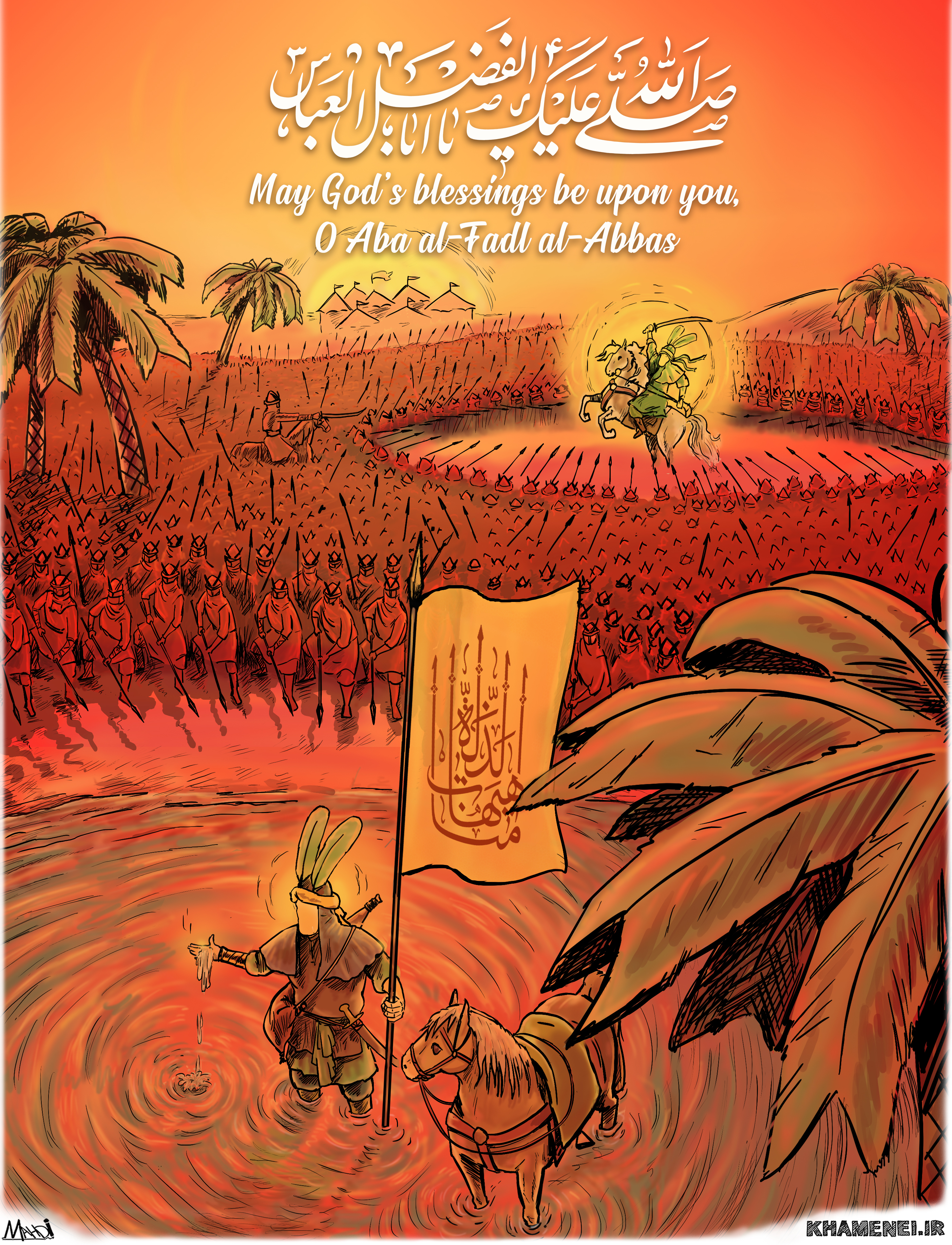
Why are Hazrat Abbas's (pbuh) sacrifices so valuable?
Imam Khamenei:
Abbas Ibn Ali's value resides in his jihad, self-sacrifice,
devotion and knowledge of Imam of his time. His significance is his patience and
endurance, his refusal to drink water while dehydrated; standing over the river
without any religious or customary prohibitions for ingesting water. The value
of those martyred at Karbala resides in the reality that they safeguarded a just
cause, in the most difficult conditions anyone could imagine.
Some people are ready to fight in a great, lost war and perhaps perish in the
heat of the battle, which is indeed a highly ranked position. Yet, not everyone
is ready for such a sacrifice, since martyrs and those who fight on the path of
God are numerable. Praise Be to God, during our war, we had outstanding martyrs.
However, becoming martyred on that battlefield was very different from being
martyred on the battlefield of Karbala, especially with a feeling of loneliness,
pressure, thirst and threats or harassment that plagued one's family.
One may often say, “I am ready to die on this battlefield, but it’s not possible
because my child will go hungry or lacks medicine”, it becomes a justification.
Sometimes, individuals care more about their families than they care about
themselves. They care about their infant more than self. Imagine men going to
the battlefield with an infant, wife, mother or the entire family; while all of
them are exposed to this danger one must prevent the weakness of his resolve.
The significance of Abbas Ibn Ali, Habib Ibn Mazahir and John Bin Huwai resides
in this persona, not in their height or muscular built. There are many people in
this world who are equal of height and many people of muscular stature, but this
is not a spiritual significance.
Imam Khamenei, [July 27, 2005]
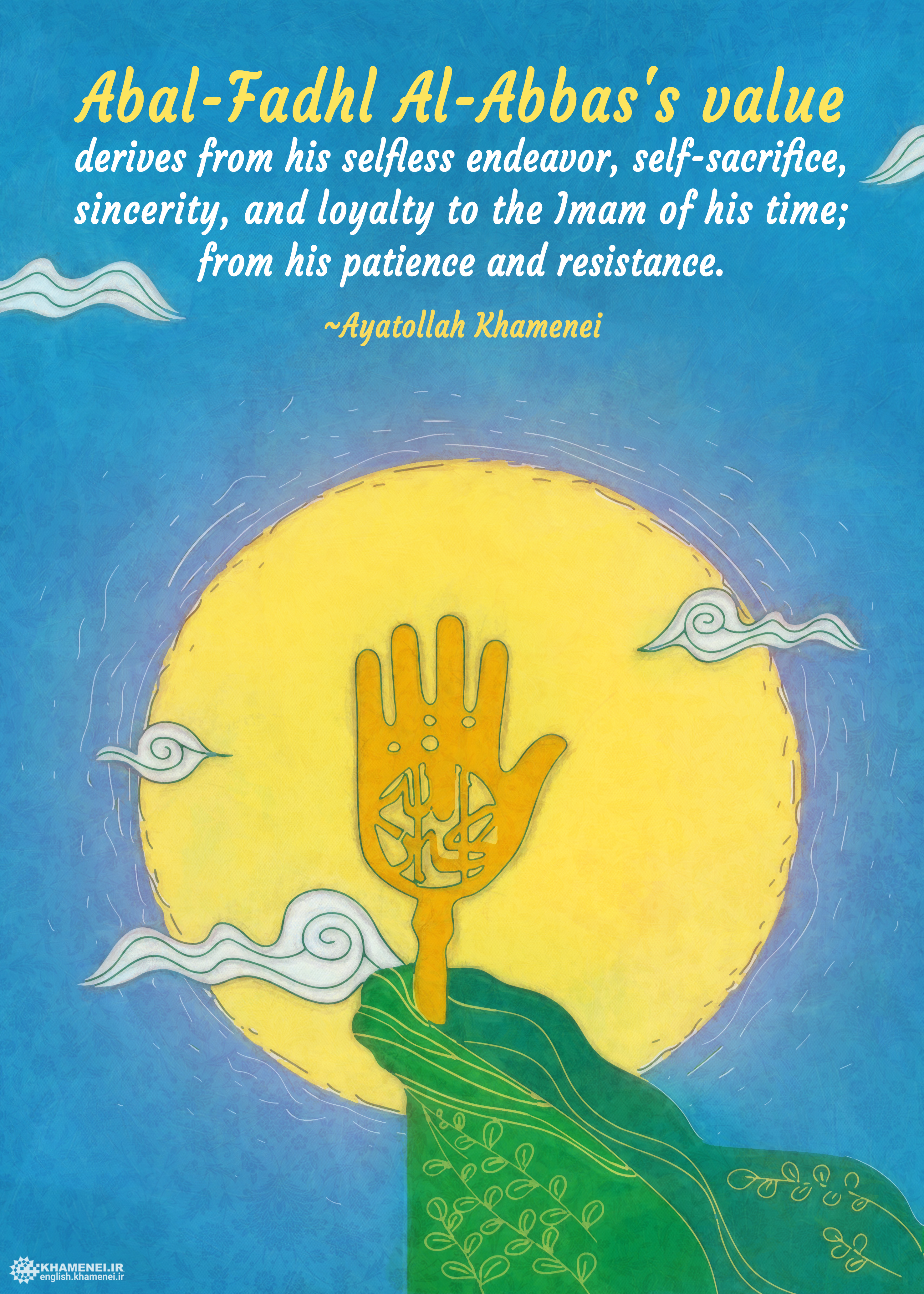
Why can Abbas (a.s.) make the world passionate about him?
Imam Khamenei:
Abal-Fadhl Al-Abbas's value derives from his selfless endeavor, self-sacrifice,
sincerity, and loyalty to the Imam of his time; his nobility originates from his
patience and resistance; it arises from his refraining to drink water while he
was thirsty and standing by the river [in respect and sympathy for his
companions who were thirsty].
Shi’a traditions are at the pinnacle of excellence. Our Shi’ite principals
persuaded a Western philosopher, who grew up familiar with Western concepts of
philosophy, like Henry Corbyn, to sit attentively in front of Allameh Tabatabai.
He felt humbled before this wisdom and thereafter became a Shi’a disciple who
promotes Shi’a principlas in Europe. Shi’a traditions can be taught at all
echelon, ranging from an average intellect to the highest rank of philosophers.
Abbas Ibn Ali's value resides in his jihad, self-sacrifice, devotion and
knowledge of Imam in his time. His significance is his patience and endurance,
his refusal to drink water while dehydrated; standing over the river without any
religious or customary prohibitions for ingesting water. The value of those
martyred at Karbala resides in the reality that they safeguarded a just cause,
in the most difficult conditions anyone could imagine.
Some people are ready to fight in a great, lost war and perhaps perish in the
heat of the battle, which is indeed a highly ranked position. Yet, not everyone
is ready for such a sacrifice, since martyrs and those who fight on the path of
God are numerable. Praise Be to God, during our war, we had outstanding martyrs.
However, becoming martyred on that battlefield was very different from being
martyred on the battlefield of Karbala, especially with a feeling of loneliness,
pressure, thirst and threats or harassment that plagued one's family.
One may often say, “I am ready to die in this battlefield, but it’s not possible
because my child will go hungry or lacks medicine”, it becomes a justification.
Sometimes, individuals care more about their families than they care about
themselves. They care about their infant more than self. Imagine men going to
the battlefield with an infant, wife, mother or the entire family; while all of
them are exposed to this danger one must prevent the weakness of his resolve.
The significance of Abbas Ibn Ali, Habib Ibn Mazahir and John Bin Huwai resides
in this persona, not in their height or muscular built. There are many people in
this world who are equal of height and many people of muscular stature, but this
is not a spiritual significance.
~Ayatollah Khamenei, July 27, 2005
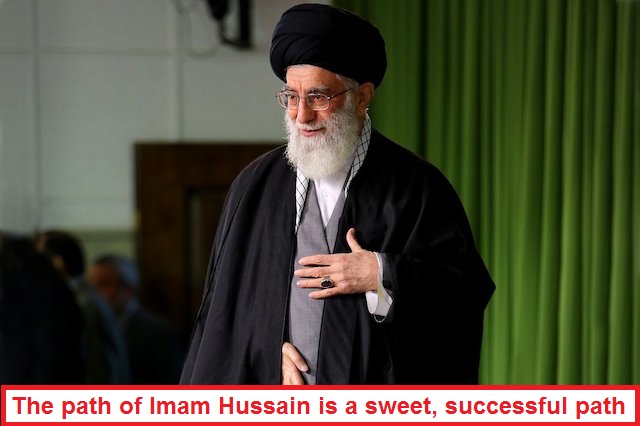
The path of Imam Hussain is a sweet, successful path
Imam Khamenei:
The 40 day period from Ashura to Arbaeen is one of the most important periods in the history of Islam. The day of Ashura is the peak of importance, and these 40 days between Ashura and Arbaeen are similar to the day of Ashura. If the day of Ashura is the peak of endeavor accompanied by sacrifice – the sacrifice of one’s life, loved ones, children and companions - then these 40 days are the peak of endeavor accompanied by clarification, disclosure and explanation. If it had not been for those 40 days and if it had not been for the great movement of Zainab al-Kubra (peace be upon her), Hazrat Umm al-Kulthum and Hazrat Sajjad (peace be upon him), perhaps the phrase “to liberate your servants from ignorance and from being left to wander in the dark” would not have been realized. It was this great movement and the extraordinary patience of the Holy Prophet’s Household led by Zainab al-Kubra (peace be upon her) and Imam Sajjad (peace be upon him) that were able to make the event of Karbala immortal. Their clarification was complementary to that sacrifice in the true sense of the word ...
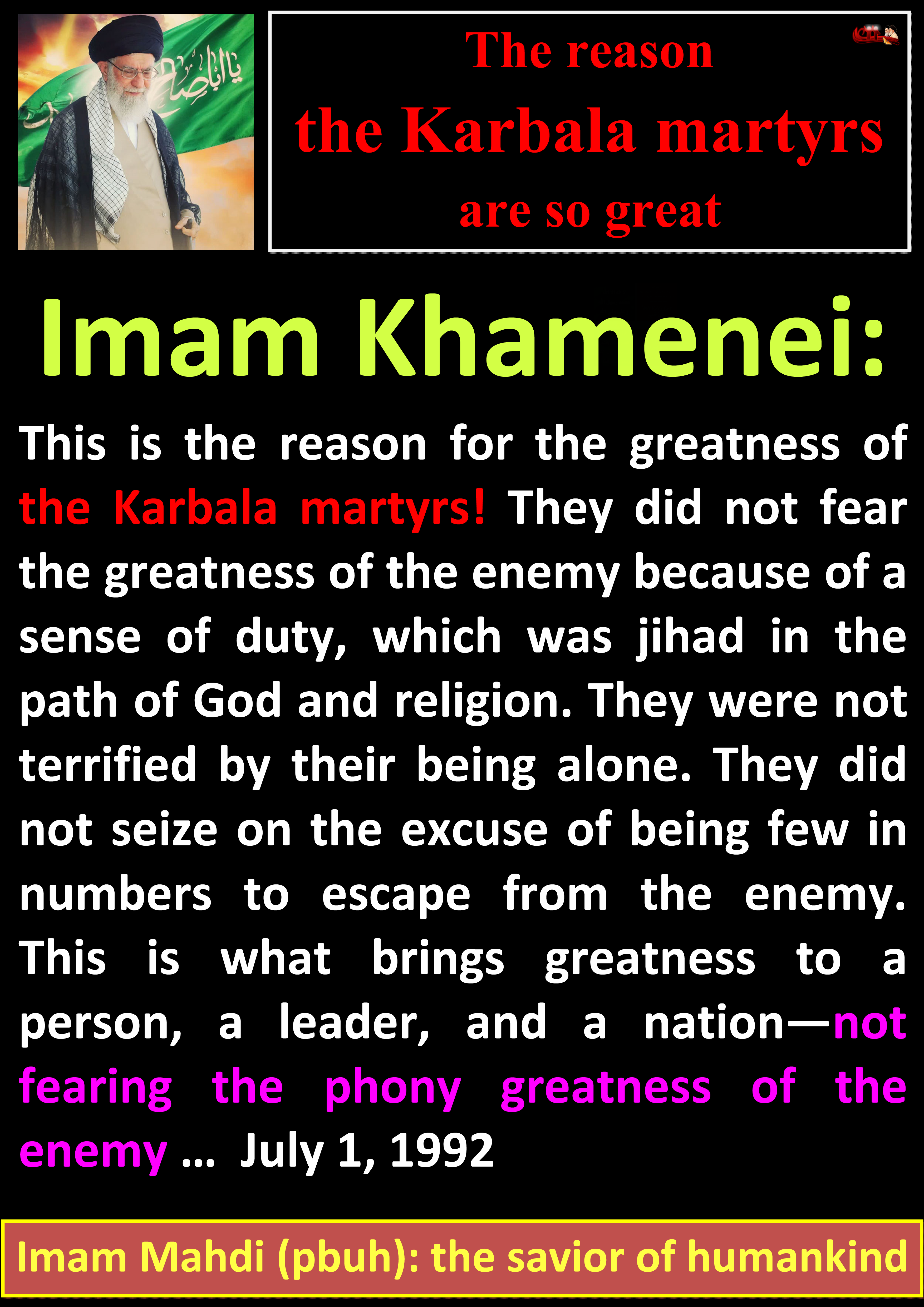
The reason the Karbala martyrs are so great
Imam Khamenei:
This is the reason for the greatness of the Karbala martyrs! They did not fear
the greatness of the enemy because of a sense of duty, which was jihad in the
path of God and religion. They were not terrified by their being alone. They did
not seize on the excuse of being few in numbers to escape from the enemy. This
is what brings greatness to a person, a leader, and a nation—not fearing the
phony greatness of the enemy.
Ayatollah Khamenei
July 1, 1992
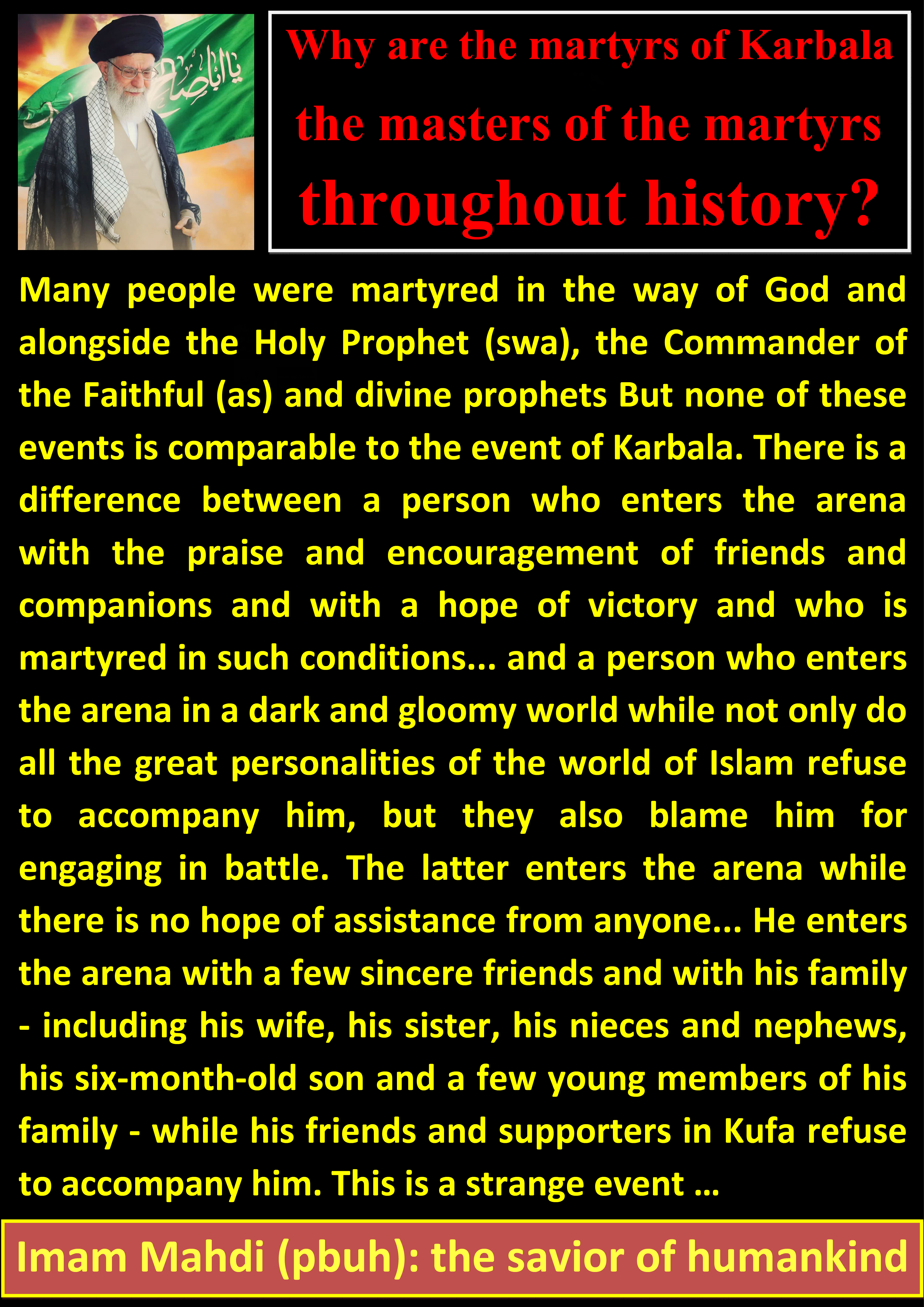
Why are the martyrs of Karbala the masters of the martyrs throughout history?
Many people were martyred in the way of God and alongside the Holy Prophet (swa), the Commander of the Faithful (as) and divine prophets But none of these events is comparable to the event of Karbala. There is a difference between a person who enters the arena with the praise and encouragement of friends and companions and with a hope of victory and who is martyred in such conditions... and a person who enters the arena in a dark and gloomy world while not only do all the great personalities of the world of Islam refuse to accompany him, but they also blame him for engaging in battle. The latter enters the arena while there is no hope of assistance from anyone... He enters the arena with a few sincere friends and with his family - including his wife, his sister, his nieces and nephews, his six-month-old son and a few young members of his family - while his friends and supporters in Kufa refuse to accompany him. This is a strange event.
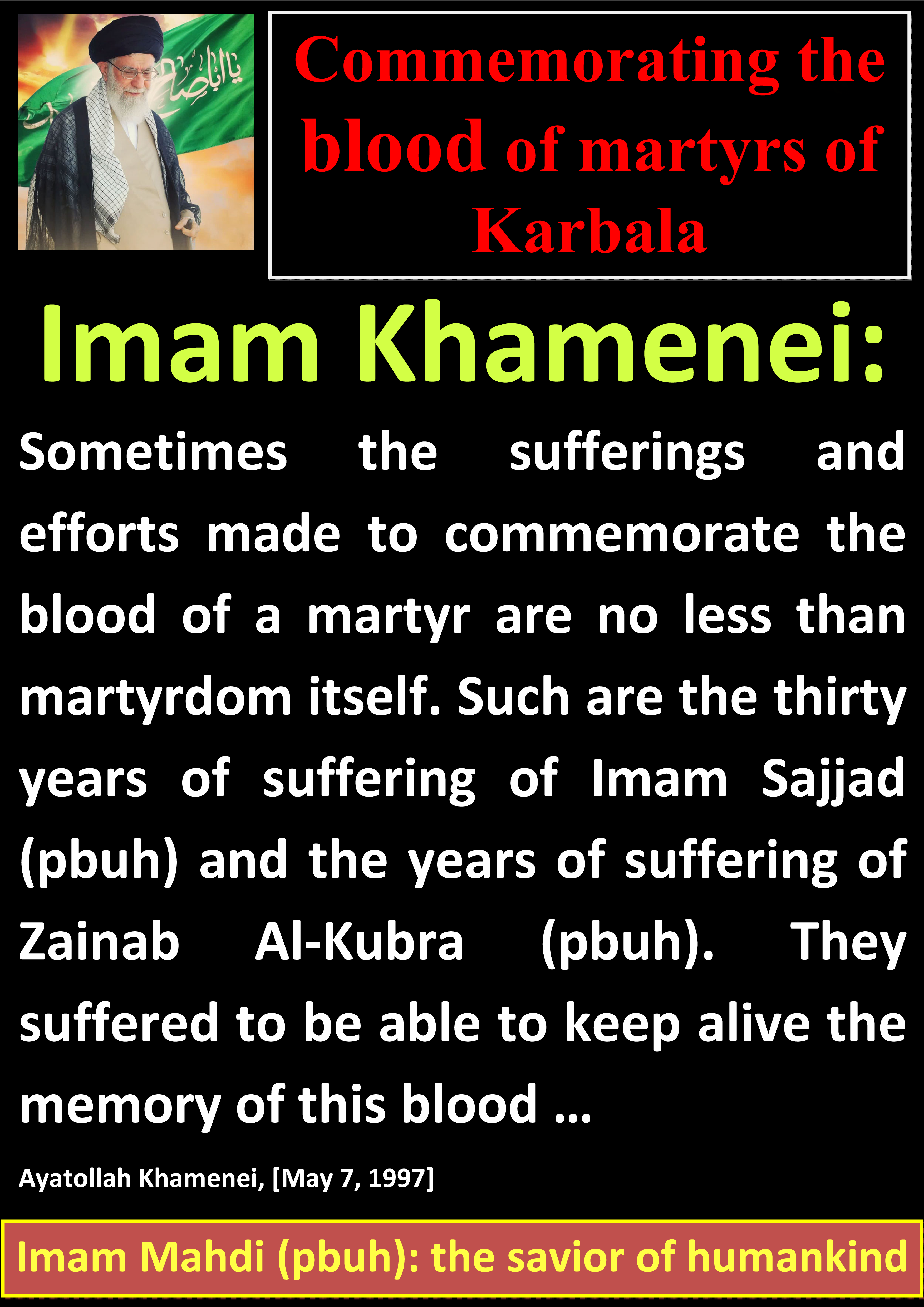
Commemorating the blood of martyrs of Karbala
Imam Khamenei:
Sometimes the sufferings and efforts made to commemorate the blood of a martyr
are no less than martyrdom itself. Such are the thirty years of suffering of
Imam Sajjad (pbuh) and the years of suffering of Zainab Al-Kubra (pbuh). They
suffered to be able to keep alive the memory of this blood …
Ayatollah Khamenei, [May 7, 1997]
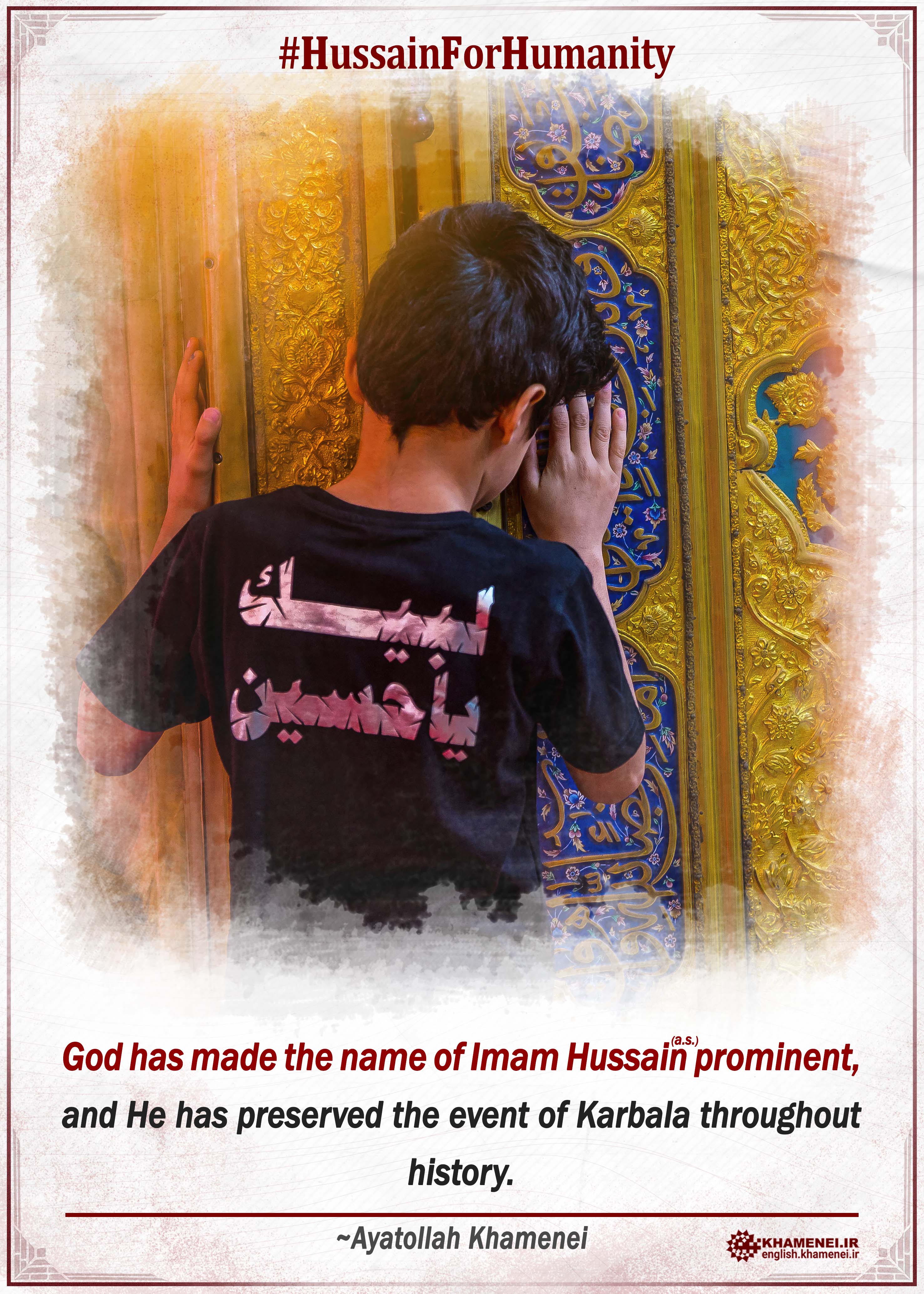
God has preserved the event of Karbala throughout history
Imam Khamenei:
We need to read between the lines, and carefully ponder over the life story of Hussain ibn-Ali (a.s.). Many have risen up in the world; they have had a leader, and they were also killed. Among them, numerous were children of the prophets and Imams (a.s.). However, Imam Hussain (a.s.) was unique. The event of Karbala was extraordinary. The martyrs of Karbala have a special position. Why? The answer is to be searched in the nature of the event, which gives a lesson to us all, including and maybe, in particular, to you, dear [disabled] war veterans.
One characteristic of the event is that Imam Hussain's movement was solely and truly for the sake of God, the religion and rectifying the society of Muslims. This first feature is very important. Imam Hussain (a.s.) stated: "I did not rise up [leaving my homeland] out of self-interest, for the sake of seeking pleasure, corruption or oppression;” —that is, it was not for swaggering, selling himself, desiring something for himself, or a pretentious spectacle. There was not even a bit of oppression or corruption in this movement. “I rise up only for the sake of rectification of the nation of my grandfather, the Messenger of Allah."-This is an extremely important point. The Arabic word used which means 'only' indicates that there is no other intention that can contaminate the pure intention and the sun-like mind of Imam Hussain (a.s.). When addressing the first Muslims of the early years of Islam, the Holy Quran states: "Do not be like those who marched out boastfully to show off their strength to people and hinder people from the way of God {Quran; 8:47}.” Here, Imam Hussain (a.s.) says: “I did not rise up out of self-interest or for the sake of seeking pleasure.”
These are two different manners, two different behaviors. The Quran reads: "Do not be like those who marched out boastfully”, arrogantly, and selfishly. It means that this kind of behavior lacks the purity of intentions. That is, in the movement of the corrupt approach, it is only self-centeredness that matters. “To show off”: This kind of a person adorns himself, rides an expensive horse, wears pieces of jewellery, recites arrogant chants, and comes out. Toward where? Toward the battlefield. The battlefield is where this person and many like him will die. Such a person rises up in this manner. There is nothing but arrogance in him.
This is one way [of coming out]. On the other side, the best example is Hussain Ibn Ali (AS) who is pure from any form of selfishness and is not after self-interest or personal, familial, or communitarian gains. This is the first characteristic of the movement of Hussain Ibn Ali (AS). The more selfless one is, the more value does he gain in what he does. The more one moves away from the peak of selflessness, the closer they get to the peak of selfishness, egotism, self-interest, personal and seeking familial gain and such which is a whole other spectrum. Between that pure selflessness and pure selfishness, there is a vast field. Going from one side of it to the other decreases the value of our work. It becomes less fruitful, and also less durable. This is an outcome of the matter. The more defective the product, the sooner it decays. If it is pure, it will never go bad. Giving you a physical example, a piece of 100% pure gold never decays. Nor does it rust. But the more copper, iron, and other cheaper elements are added to the alloy, the more it becomes prone to decay and destruction. This is a general rule.
This applies to what is tangible. But when it comes to spirituality, these equations are far more discerning. We do not understand it because of our materialistic and ordinary vision. Nonetheless, men of vision and understanding perceive. The Critic in this matter, the Goldsmith and the Jeweler, is God the Almighty. And for sure, the Critic sees well. If there is an ounce of impurity in our work, its value would diminish accordingly, and God would reduce its lasting effect.
God, the Exalted, is an insightful critic. The work of Imam Hussain (a.s.) is a work in which there is not even a slight hint of impurity. Hence, you see this quality achievement has lasted to this day and will last forever. Who could believe that after these people were killed in that desert far from their homes, while their bodies were buried there; with so much propaganda spread against them; all killed in such a heartless manner; their hometown of Medina put on fire even after their martyrdom (the story of Harra, which happened the next year); -- this rose garden was devastated, and the petals of roses were all thrusted, yet, later anyone would feel the aroma of the rosewater from this garden? According to which rule of nature, a petal of that rose garden can last so long in the nature? However, you view, the more time passes by, the more the aroma of that rose garden spreads. There are some people who do not believe that Prophet Muhammad (PBUH) is the grandfather of Imam Hussain (a.s.) and that he follows in his path; yet, they believe in Imam Hussain (a.s.)! Some do not believe in his father, Ali (a.s.), yet, they believe in Imam Hussain (a.s.)! They do not believe in God—the God Imam Hussain worshipped, yet, before Imam Hussain (a.s.), they are humble and respectful! This is the outgrowth of Imam Hussain’s purity.
January 16, 1994
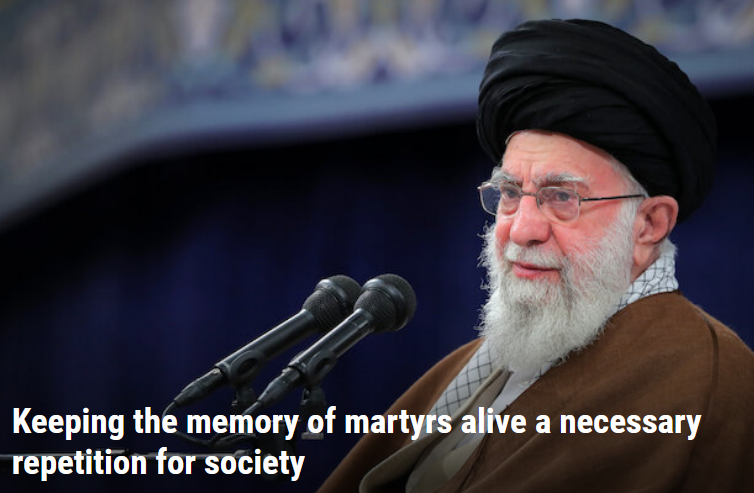
Keeping the memory of martyrs alive a necessary repetition for society
The following is the full text of the speech delivered by Imam Khamenei, the Leader of the Islamic Revolution, in a meeting with the organizers of the Congress for the Commemoration of the 10,000 Martyrs from the East Azerbaijan Province. This meeting took place in the Imam Khomeini Hussainiyah on December 6, 2023. The statements of Imam Khamenei were later published on December 14, 2023 at the place of this congress.
In the Name of God, the Compassionate, the Merciful
All praise is due to God, Lord of the Worlds, and peace and greetings be upon
our Master, Muhammad, and his pure Progeny, particularly the Remnant of God on
earth.
I would like to thank all the dear brothers and sisters here for this useful,
necessary action to keep the memory and names of the outstanding martyrs of
Azerbaijan and Tabriz alive. They are, of course, unforgettable. Once again you
have spoken about them in a better, higher, clearer fashion. What you did is
very good and very appropriate. Of course, there was a bit of a time gap between
the first commemoration ceremony, which was held several years ago, and this
commemoration ceremony. It is appropriate for these kinds of measures,
commemorations, tributes, and remembrances to be repeated more frequently, in
the same way that we honor the memory of the martyrs of Karbala every year
during the month of Muharram. That has been repeated over 1,300 years, and it is
not a mundane repetition. It is one of the necessary, useful repetitions for
today’s society and for the society of the future.
Well, there are plenty of admirable things to say about Tabriz and Azerbaijan,
and I have spoken about this many times during our annual meetings. Regarding
the martyrs, the statements of the respected Friday prayer leader and the
honorable commander of the IRGC today in this meeting were very good and
complete. Praise God, these gentlemen have paid attention to all of the
recommendations that I wanted to give and the ones I usually mention, and you
have taken action on many of them. Let me just say that one of our duties is to
be aware of ourselves, the identity of ourselves. The Iranian nation should not
forget its identity. If it forgets its identity, it will be harmed, it will be
slapped in the face, and fall behind.
Regarding those who have forgotten Almighty God, He says, “Do not be like those
who forget Allah, so He makes them forget their own souls” (Quran 59:19). They
forgot God, [so] God made them forget themselves. This shows that paying
attention to oneself, one's identity, and one's own characteristics is necessary
for every person, nation, and group. Azerbaijan must pay full attention to the
identity that has caused it to stand out. The place we call Azerbaijan truly has
an outstanding identity among the people of the Iranian nation.
Azerbaijan is the birthplace of martyrs and people who have sacrificed their
lives, and this is not just limited to the Sacred Defense. It was the same
before that, and it remains the same after that. With regard to matters related
to the event of the Islamic Revolution, if we are to look at it, the martyrs of
Azerbaijan started from before the Revolution. That is, from the beginning of
Imam Khomeini and the Iranian nation’s movement, the behavior leading to
martyrdom and the movement toward martyrdom in Azerbaijan began and has
continued up until today.
In the case of the Defenders of the Shrines, there are martyrs from Azerbaijan.
Of course, the peak of these sacrifices, the peak of showing the high value and
character of Azerbaijan, was seen during the Sacred Defense in the figures that
were mentioned, such as Martyr Mehdi Bakeri, Martyr Hamid Bakeri, Martyr
Tajallai, and Martyr Yaghchian. These were our great, distinguished brothers who
went to meet God. Praise God, there are other dear, prominent figures like them
as well today.
So, this characteristic of seeking martyrdom and the outstanding behavior that
was observed in their sacrifices is not limited to the Imposed War. This wasn’t
just during the Sacred Defense. This began before the Revolution and has
continued up until today. This city [Tabriz] has two martyred Friday prayer
leaders. In other words, out of the five Friday prayer leaders who were martyred
and who were among the best of our clerics in the country, two of them came from
the city of Tabriz. These things are very important.
What I am saying as a recommendation is that, first of all, do not let the
effervesce of the martyrs’ blood abate. Commemorating the martyrs should not be
limited to just reminiscing about them. The piety, the sacrifices, the bravery,
the shining gem within people like Martyr Bakeri, which drew them to the middle
of the field, for example, should be reflected and conveyed to the younger
generation to serve as role models for them.
Our youth crave role models. The best role models are these. Some nations, which
completely lack this or lack it to a great extent, create and make up their own
role models without them even existing. We have these role models before us.
Martyr Bakeri should not just be looked at on the battlefield. We should also
see what he was like behind the scenes of the battlefield. We should see what he
was like when he went to Tabriz University. We should see what activities he
took part in during the pre-revolutionary period. That spirit should be seen.
I met Martyr Mehdi Bakeri in Mashhad before the Revolution. He was a
high-spirited, enthusiastic, intelligent person who was well able to analyze
different events. That is what made him shine like that and draw people’s hearts
toward him during the Sacred Defense. This kind of spirit needs to be reflected.
If we make films, if we write books, and if we compile and publish books of
recollections about him, we must be careful to reflect his spirit in them. This
spirit is a constructive spirit. This is the first issue. Do not let the
effervesce of the martyrs’ blood abate.
As I mentioned at the beginning of my speech, make these like the mourning
ceremonies for Imam Hussain (pbuh). Every year during Muharram, when it’s
Ashura, it’s as though you are seeing Ashura before your eyes, the Ashura that
took place in the year 61 AH. The events are reflected, and the characters come
alive before the eyes of the audience. This must also take place with regard to
the martyrs of the Sacred Defense and the 10,000 martyrs you spoke about. This
is one point.
The second matter is that you should not forget the families of the martyrs.
Unfortunately, many of their parents have passed away. They have joined their
martyrs. Make use of the memories and accounts related by those who are
available, whether they are the wives of the martyrs, their parents, their
colleagues, or their friends.
For example, Martyr Bakeri had a large number of coworkers during the war.
Praise God, some of them are still alive, healthy, and prepared to talk about
the details of his life that they saw. Courage does not exist only in fighting
battles. Courage is needed in self-control, in speaking, in not speaking, in
forbearance, and in taking action. All of these things are very important. There
are some who had seen and known these martyrs personally. Make use of these
people. Interview them. Talk to them. The characteristics of the martyrs should
be recorded and recognized in the form of real documentation. This is another
matter.
Another issue is that when we are studying the martyrs, the foundation that
brought about their ascension should also be identified, that is, the people or
those who ignited the first sparks, such as Martyr Qazi Tabatabai. He ignited
the first spark and the first movement during the Revolution, for example, on
February 18, 1978. He was the one who took the first step, invited people to his
area and his mosque, and so on. So the foundation for these things must be
identified.
Why is it that after the events that took place in Qom, the next movement took
place in Tabriz and not in this city or that city? What feature do these people
have that allowed them to produce and raise these kinds of young people and to
bring forth these kinds of martyrs? These are very important matters. We are
talking about an ethnic identity, a national identity, a religious identity [,
etc.]
I once mentioned in a similar gathering of brothers and sisters from Azerbaijan
that the late Sattar Khan had a note in his pocket from the scholars of Najaf
during the Constitutional Revolution, the events that it involved, and the
actions he was taking at that time. He had consulted the scholars of Najaf and
asked them a question, and they had written their responses. So, he took action
based on this intention. This is very important. What is the foundation for a
move? This needs to be clear. This shows us that. If these things are done, then
the movement will continue.
I would like to refer to the second tactical airbase (Tabriz Air Base). Well,
the 31st Ashura Division clearly included individuals who truly shined. That
great movement of the planes, our fighters had carried out that great task in
the very first days of the war. Of course, they had taken off from the first
base and other bases, including the third and fourth bases. They did this during
the first week of the war, and I went to the Majlis [Iranian parliament] and
presented a report of this endeavor to the representatives in the Majlis.
These are noteworthy matters. They are extremely important, and God willing,
they should be preserved in people’s minds and recorded in the Iranian nation’s
historical memory. The most important thing that needs to be done is to record
these significant events, these influential, unique phenomena — events that are
unparalleled at times — in the Iranian nation’s historical memory.
Our youth and our teenagers should know these things. Of course, we have not
worked as hard as we should have, and many of our youth do not know about our
prominent figures. They are also unaware of many events. We need to share these
things, whether it is by way of official broadcasting outlets such as the IRIB,
etc., or by way of the devices and means that are available to people today.
I hope the Almighty God will grant all of you success so that you will be able
to complete this great task. God willing, in the future, the time gap between
these commemoration ceremonies and remembrances will be less than the time gap
that existed between today’s session and the previous commemoration ceremony.
May God’s greetings, mercy, and blessings be upon you.
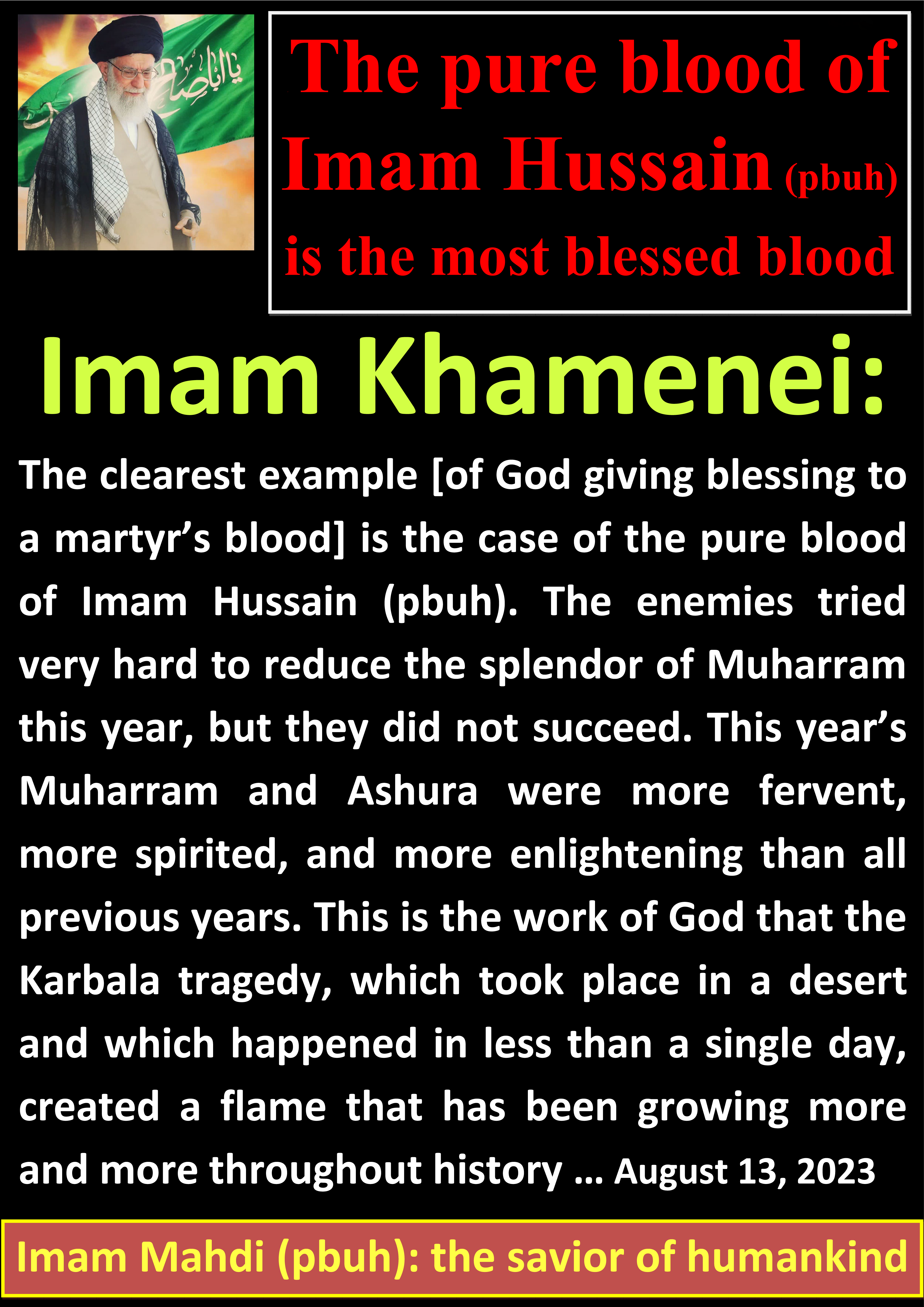
Imam Khamenei:
The clearest example [of God giving blessing to a martyr’s blood] is the case of
the pure blood of Imam Hussain (pbuh). The enemies tried very hard to reduce the
splendor of Muharram this year, but they did not succeed. This year’s Muharram
and Ashura were more fervent, more spirited, and more enlightening than all
previous years. This is the work of God that the Karbala tragedy, which took
place in a desert and which happened in less than a single day, created a flame
that has been growing more and more throughout history … August 13, 2023
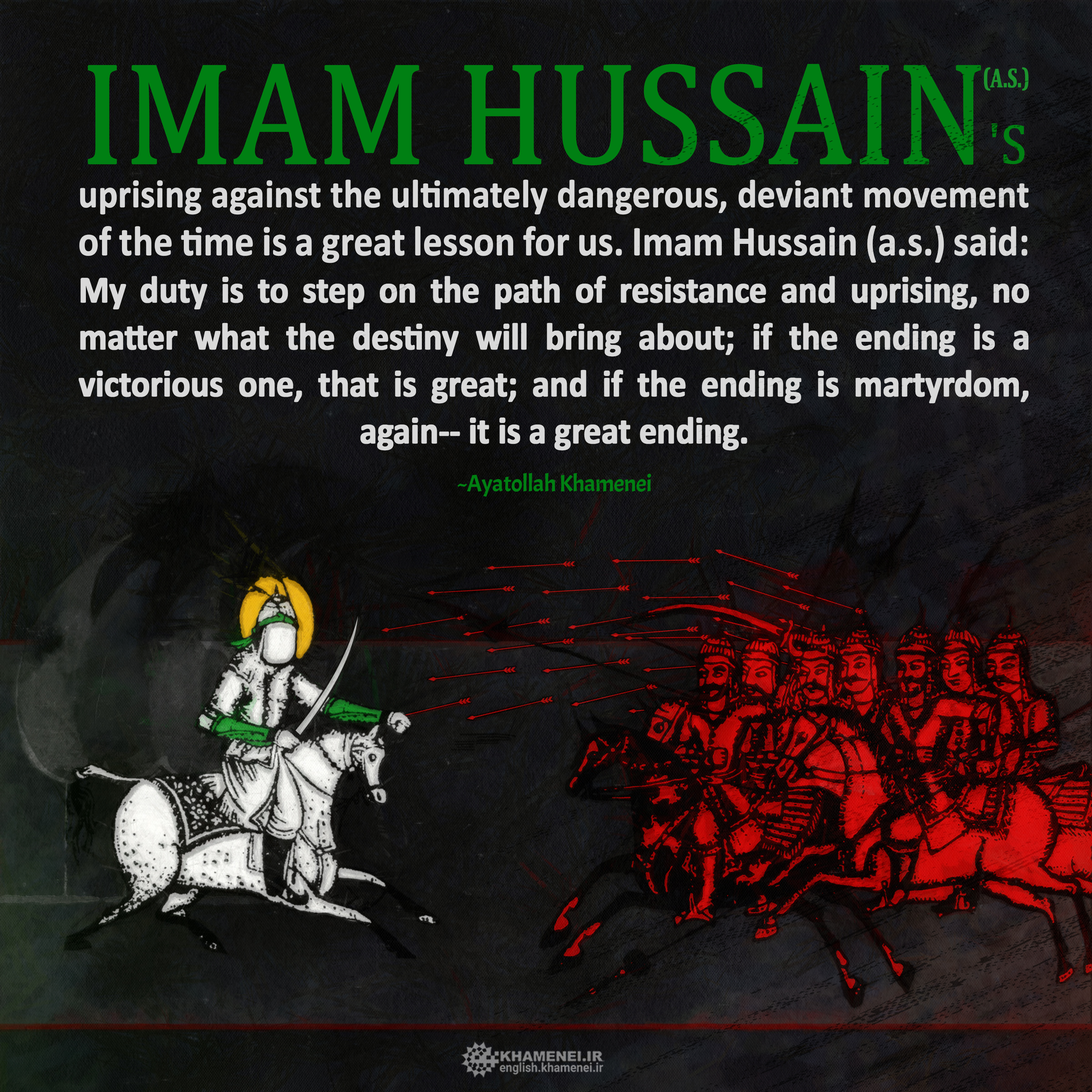
Imam Hussain’s movement, an instructive movement, a role model for nations ...
Imam Khamenei:
The concept of guardianship was embodied by Imam Hussain (a.s.) with all its
dimensions and with all the necessary and possible means. This is not to say
that others did not do such a thing or did not want to do such a thing, rather
it means that this movement was fully realized in the behavior of the Lord of
the Martyrs (a.s.) during his ten-year imamate. One can clearly notice in his
lifestyle all the methods that could have been used by a descendant of the Holy
Prophet (s.w.a.) to preserve the great legacy of Islam which has been passed
down by the Holy Prophet (s.w.a.) and his father as well as their genuine
followers. We can clearly see everything in the lifestyle of the Lord of the
Martyrs (a.s.) - everything ranging from clarification, to forewarning, to
promotion of Islam, to provoke the conscience of prominent figures of his time
during a sermon in Mina. All these things are tangible in the lifestyle of the
Lord of the Martyrs (a.s.). Later on, he stood up against a great deviation and
laid down his life. Imam Hussain (a.s.) was aware of the consequences of his
movement. He was an infallible Imam. Infallible Imams' extensive knowledge and
insight are beyond our heads. Imam Hussain (a.s.) revolted to set a role model
and he refused to surrender. He asked people to help him and when a group of
people from Kufa expressed their willingness to accompany him on this path, Imam
Hussain (a.s.) accepted their offer and moved towards Kufa and he did not give
up in the middle of the way. Imam Hussain (a.s.) stood up against the deviated
current of his time, which was extremely dangerous. And this became a lesson and
Imam Hussain (a.s.) himself makes the same point. That is to say, he backed up
his action with the order of Islam. He said that his duty was what he was doing.
He said that he had to express his opposition, no matter what the consequences
were. He said, "It is good if my destiny is a victory and if my destiny is
martyrdom, so much the better." This was how Imam Hussain (a.s.) acted.
This was a perfect instance of self-sacrifice and it safeguarded Islam. This
move preserved Islam. This move institutionalized values in society. If Imam
Hussain (a.s.) had not accepted this danger, if he had not made a move, if he
had not taken action, if his blood had not been shed, if those great tragedies
had not happened to the shrine of the Holy Prophet (s.w.a.), to Imam Ali's
(a.s.) daughter and to the Holy Prophet's (s.w.a.) descendants, this event would
not have gone down in history. The event that could have prevented that great
deviation had to shock people and history as much as the deviation did. This
shows Imam Hussain's (a.s.) self-sacrifice.
Of course, this is easier said than done. What Imam Hussain (a.s.) did was an
extraordinary feat. That is to say, the dimensions of his action are far more
than what we estimate. We usually ignore aspects and details. Once I spoke about
Imam Hussain's (a.s.) patience. His patience was not limited to enduring thirst
or seeing his companions being killed. These things are relatively easy to
tolerate. The kind of patience that is difficult to practice is to listen to
influential, aware and respectable people who keep creating doubts and telling
you that what you are doing is dangerous and wrong. Who did those things? People
like Abdullah Ja'far, Abdullah Zubair and Abdullah Abbas. These prominent
figures of that time were constantly telling Imam Hussain (a.s.) not to do what
he was doing. If it were somebody else, somebody who did not have that
determination and stable character, he would have thought, "Well, I did my duty.
These people are talking like this and the world is acting like that, so I
should just say what I am supposed to say and do nothing else." A person who
decides to stand up against such statements, such temptations, such doubts and
such efforts to bend sharia and is not dissuaded from continuing his path - such
a person is the one who can give rise to such a great transformation. In this
regard our magnanimous Imam (r.a.) was similar to the Lord of the Martyrs. I
explained this in another meeting and I do not want to go into the details now.
This was how Imam Hussain (a.s.) acted as a guardian.
Jul 4, 2011
_y734.png)
Imam Khamenei:
As long as the light of Hazrat Khadijah al-Kubra (s.a.) and Hazrat Fatima Zahra (s.a.) continues to shine, the old and new anti-woman plots will not reach any results …
Muslim Iranian women have opened a new chapter in history for women throughout the world and they proved that it is possible to be a woman, to be modest, to wear hijab, to be noble and at the same time to play a pivotal role and make great achievements ...
thousands of Iranian women with Karbala-like spirit stand up against the
apparent cruelties against women but they also revealed the true nature of
modern cruelties to women. They showed that women's divine right to dignity is
the most important right of women, a right that has never been recognized in the
so-called modern world and it is time for this right to be recognized …
Sources:
Please click on the links below or any of the images above to view the
full text of Imam Khamenei's statements and access more...
https://english.khamenei.ir/news/8011/Why-are-Hazrat-Abbas-s-pbuh-sacrifices-so-valuable
https://english.khamenei.ir/news/8707/The-path-of-Imam-Hussain-is-a-sweet-successful-path
https://english.khamenei.ir/news/9112/The-reason-the-Karbala-martyrs-are-so-great
https://english.khamenei.ir/news/7900/Commemorating-the-blood-of-martyrs-of-Karbala
https://english.khamenei.ir/news/7032/God-has-preserved-the-event-of-Karbala-throughout-history
https://english.khamenei.ir/news/10032/The-pure-blood-of-Imam-Hussain-pbuh-is-the-most-blessed-blood
https://english.khamenei.ir/news/5944/Imam-Hussain-s-movement-an-instructive-movement-a-role-model
https://english.khamenei.ir/news/1753/Leader-Issues-Message-to-Congress-7-000-Martyred-Iranian-Women
Links:
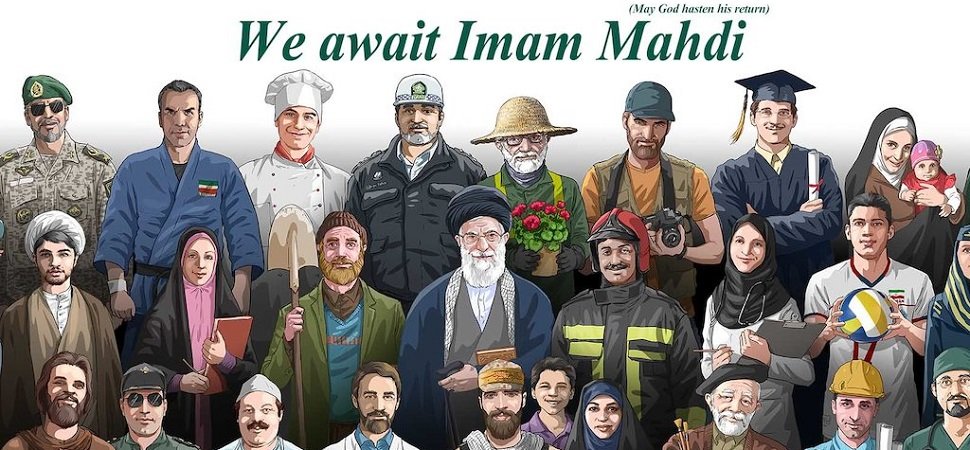


https://english.khamenei.ir/Opinions/Imam_mahdi
Imam Hussain’s Revolution for Humanity
https://english.khamenei.ir/Opinions/AshuraUprising
Who is Imam Hussain? Why did he launch an uprising?

Note: All content is free to use
The exceptional role of Hazrat Masumah (pbuh) ...
In the Name of Allah, the Merciful, the Most Merciful
Sura 21: AL-ANBIYA (THE PROPHETS) - Juz' 17 - Translation Qarib
**************
Note: All content is free to use
Imam Khamenei:
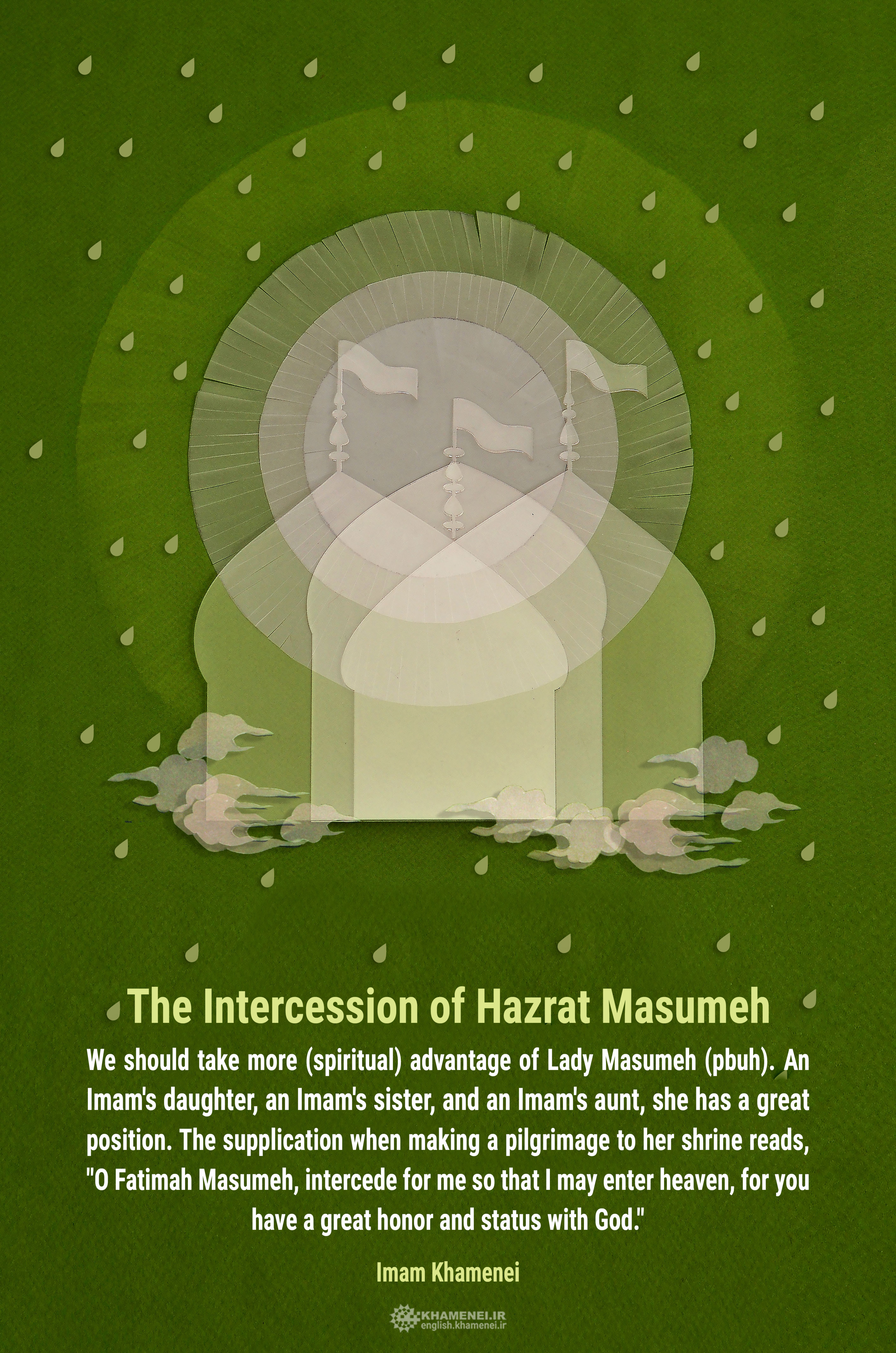
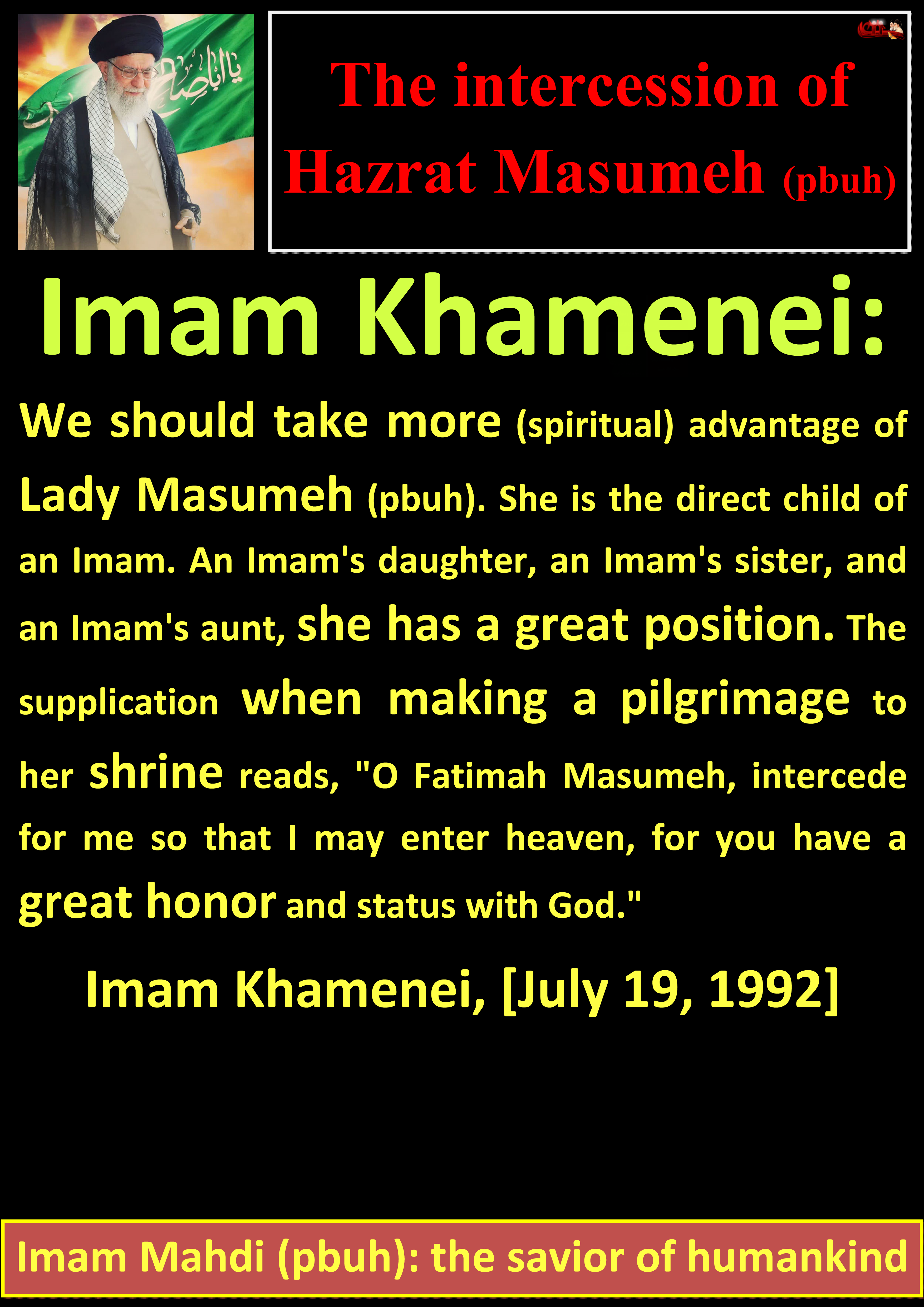
We should take more (spiritual) advantage of Lady Masumeh (pbuh). She is the
direct child of an Imam. An Imam's daughter, an Imam's sister, and an Imam's
aunt, she has a great position. The supplication when making a pilgrimage to her
shrine reads, "O Fatimah Masumeh, intercede for me so that I may enter heaven,
for you have a great honor and status with God."
Imam Khamenei, [July 19, 1992]
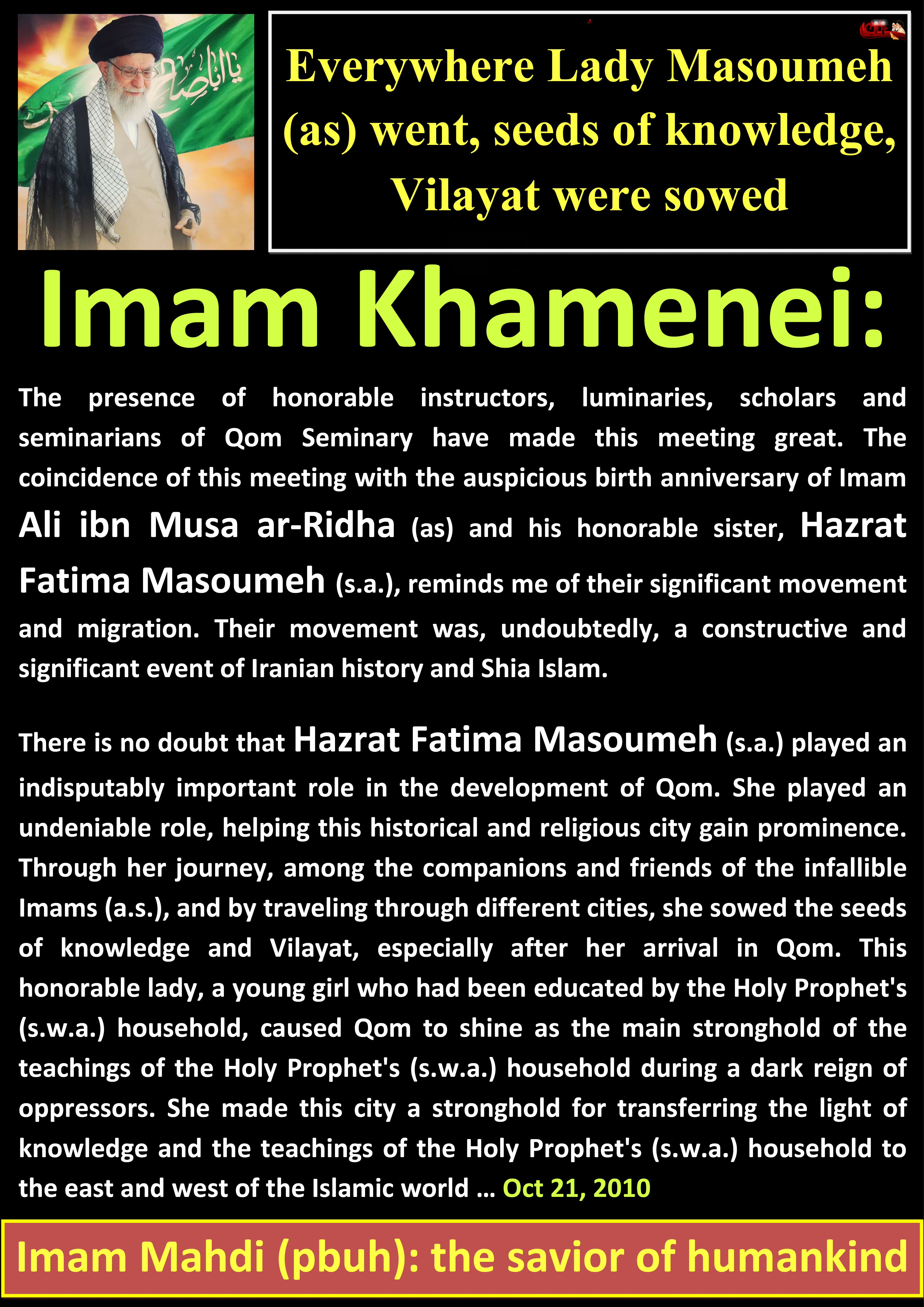
Imam Khamenei:
The presence of honorable instructors, luminaries, scholars and seminarians of
Qom Seminary have made this meeting great. The coincidence of this meeting with
the auspicious birth anniversary of Imam Ali ibn Musa ar-Ridha (as) and his
honorable sister, Hazrat Fatima Masoumeh (s.a.), reminds me of their significant
movement and migration. Their movement was, undoubtedly, a constructive and
significant event of Iranian history and Shia Islam.
There is no doubt that Hazrat Fatima Masoumeh (s.a.) played an indisputably
important role in the development of Qom. She played an undeniable role, helping
this historical and religious city gain prominence. Through her journey, among
the companions and friends of the infallible Imams (a.s.), and by traveling
through different cities, she sowed the seeds of knowledge and Vilayat,
especially after her arrival in Qom. This honorable lady, a young girl who had
been educated by the Holy Prophet's (s.w.a.) household, caused Qom to shine as
the main stronghold of the teachings of the Holy Prophet's (s.w.a.) household
during a dark reign of oppressors. She made this city a stronghold for
transferring the light of knowledge and the teachings of the Holy Prophet's
(s.w.a.) household to the east and west of the Islamic world … Oct 21, 2010
_8ahg.png)
Imam Khamenei:
There exist three glittering, outstanding points among all the bright spots of
Qom: First, the holy shrine of Hazrat Fatimeh Masoumeh (ra); an exceptional
woman, from near her holy grave arose, for the first time, this bounteous,
exuberant spring [city of Qom], bringing blessings to the entire world,
especially to the Muslim world.
Secondly, Qom has forever been the birthplace of innovation in science,
jurisprudence, and hadith: the reputed seminary has been present in the holy
city. Beginning 1200 years ago, great scholars, jurists, precious philosophers,
sovereign hadith writers and eminent authors rose from this city, or they took
refuge in Qom, settling underneath the illuminated rays of Hazrat Masoumeh
(ra)... October 05, 2000
_awdm.png)
Imam Khamenei:
Qom is the city of knowledge. It is the city of jihad, the city of insight. The
insight of the people of Qom is a crucial factor which has revealed itself
during past 32 years. It is interesting that the establishment of the city of
Qom resulted from a jihad-like movement accompanied by insight. That is to say,
when the Ash'aris settled in this region, they turned it into a center for
propagating the teachings of the Holy Prophet's household (a.s.). They started a
cultural jihad in this region. Before they came to Qom, the Ash'aris had already
engaged in armed jihad. The leader of the Ash'aris had fought alongside Zayd ibn
Ali (a.s.). This was why al-Hajjaj ibn Yusuf became furious with them, and they
were forced to leave for this region and make it the center of knowledge relying
on their efforts, insight and knowledge. This caused Hazrat Masoumeh (s.a.) to
express her tendency to stay in Qom when she was passing by. It was all because
of the Ash'ari luminaries who were living in this region.The Ash'aris welcomed
Hazrat Masoumeh (s.a.) and invited her to their city. After her demise, they
built a shrine for her in this city. As the ones who started this great cultural
movement, the people of Qom established a center for promoting the teachings of
the Holy Prophet's household (a.s.) at that time. They trained hundreds of
religious scholars, hadith experts and exegetes of Islamic and Quranic teachings
and send them to different parts of the world of Islam. Knowledge spread from
Qom to Khorasan, Iraq and Sham. This shows the insight that the early residents
of Qom enjoyed. Qom was established on the basis of insight and jihad. Oct 19,
2010
_3hqd.png)
Imam Khamenei:
There is no doubt that Hazrat Fatima Masoumeh (s.a.) played an indisputably
important role in helping Qom become Qom. She played an undeniable role in
helping this historical and religious city gain prominence. Through her journey
among the companions and friends of the infallible Imams (a.s.) and by traveling
through different cities and sowing the seeds of knowledge and Vilayat during
her journey, especially after arriving in Qom, this honorable lady, this young
girl who had been educated by the Holy Prophet's (s.w.a.) household, caused Qom
to shine as the main stronghold of the teachings of the Holy Prophet's (s.w.a.)
household during that dark reign of oppressors. She made this city a stronghold
for transferring the light of knowledge and the teachings of the Holy Prophet's
(s.w.a.) household to the east and west of the world of Islam. Oct 21, 2010
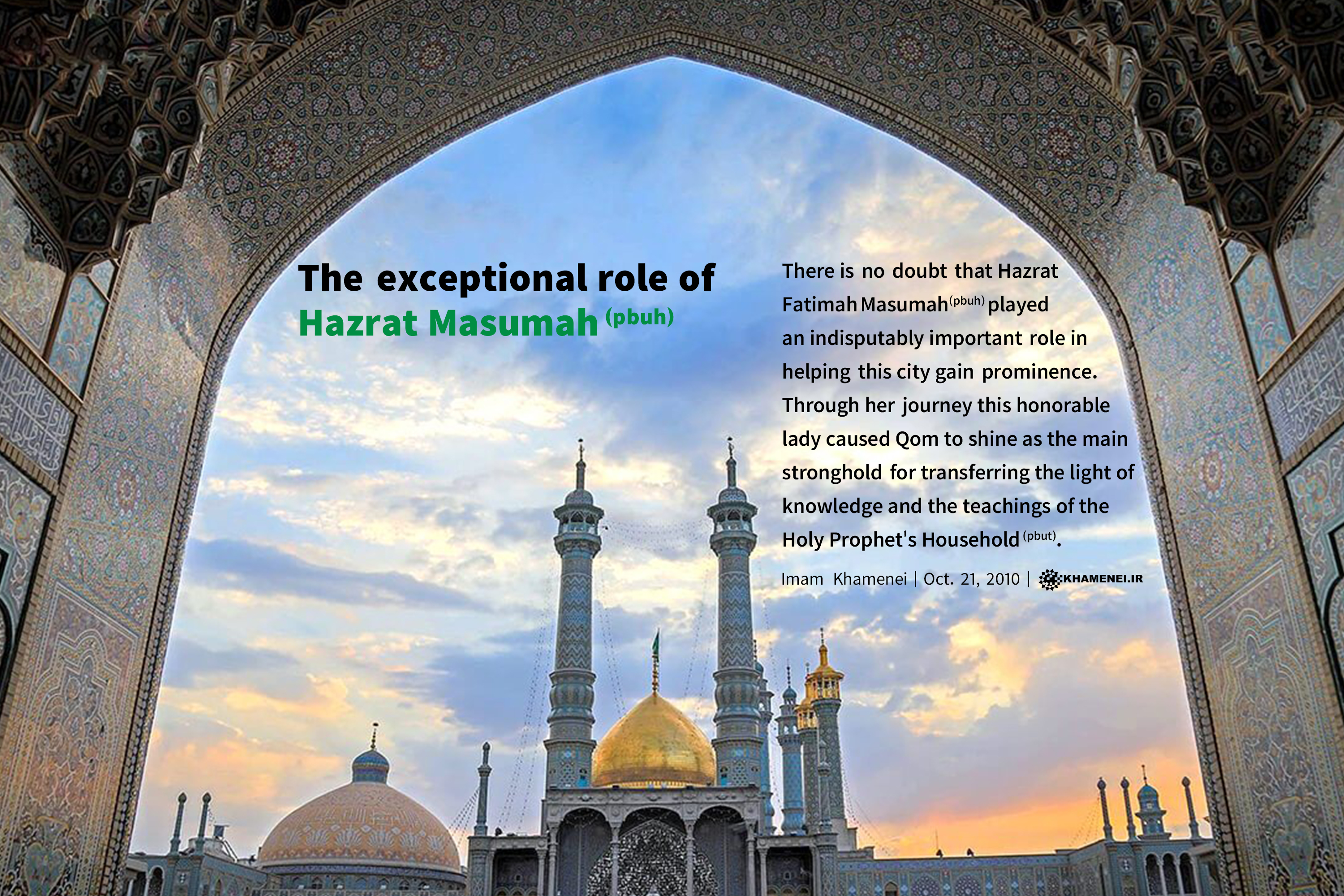
Imam Khamenei:
There is no doubt that Hazrat Fatimah Masumah (pbuh) played an indisputably
important role in helping this city gain prominence. Through her journey this
honorable lady caused Qom to shine as the main stronghold for transferring the
light of knowledge and the teachings of the Holy Prophet's Household (pbut).
Imam Khamenei
Oct. 21, 2010
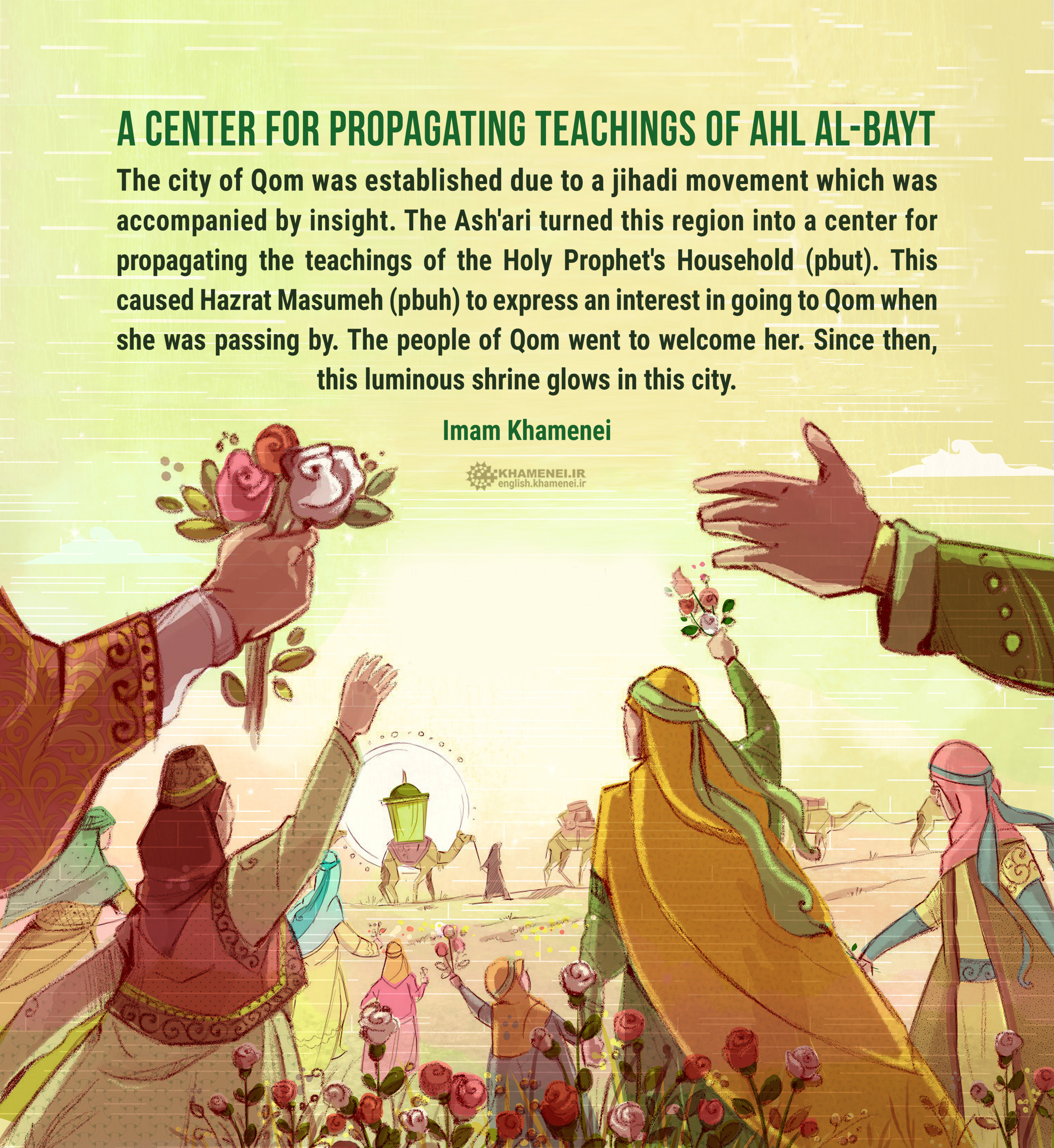
Imam Khamenei:
The city of Qom was established due to a Jihad-like movement, which was
accompanied by insight. The Ash'ari turned this region into a center for
propagating the teachings of the Holy Prophet's Household (pbut). This caused
Hazrat Masumeh (pbuh) to express an interest in going to Qom when she was
passing by. They (the people of Qom) went to welcome Hazrat Masumeh. Since that
time, this luminous shrine glows in this city.
Imam Khamenei, [Oct 19, 2010]
Resources:
To view the full text of Imam Khamenei's statements and access more information
https://english.khamenei.ir/news/7652/The-intercession-of-Hazrat-Masumeh-pbuh
https://english.khamenei.ir/news/5033/Everywhere-Lady-Masoumeh-as-went-seeds-of-knowledge-Vilayat
https://english.khamenei.ir/news/4048/Lady-Masoumeh-s-a-sowed-the-seeds-of-knowledge-everywhere
https://english.khamenei.ir/news/9789/The-exceptional-role-of-Hazrat-Masumah-pbuh
https://english.khamenei.ir/news/1369/Leader-s-Speech-on-His-Arrival-in-Qom
Links:
https://english.khamenei.ir/Opinions/Imam_mahdi
Imam Hussain’s Revolution for Humanity
https://english.khamenei.ir/Opinions/AshuraUprising
Who is Imam Hussain? Why did he launch an uprising?
Note: All content is free to use